

Prior Tiburon CEO Summits (2008-2009)
Tiburon has held 47 prior CEO Summits, with the first Tiburon CEO Summit taking place in 2001. Details of Tiburon CEO Summits XIV-XVII are included below; for details of other Tiburon CEO Summits, please click here: Most Recent, 2024-2025, 2022-2023, 2020-2021, 2018-2019, 2016-2017, 2014-2015, 2012-2013, 2010-2011, (2008-2009), 2006-2007, 2004-2005, 2001-2003.
Tiburon CEO Summit XVII: October 7- 8, 2009
Tiburon CEO Summit XVII was held October 7-8, 2009 at the Ritz Carlton Hotel in San Francisco, CA. The Summit started at 7:45am on Wednesday, October 7, included a networking dinner that evening at Servino's Restaurant, & concluded at 2:30pm on Thursday, October 8. Almost 125 senior industry executives took two days out of their busy schedules to participate. Chip Roame (Managing Partner, Tiburon Strategic Advisors), Jon Baum (CEO, The Dreyfus Corporation), John Calamos (CEO, Calamos Asset Management), Deena Katz (Chairman, Evensky & Katz and Associate Professor, Texas Tech University), Pete Kight (Vice Chairman, Fiserv), Steve Lockshin (CEO, Convergent Wealth Advisors), Andrew Rudd (CEO, Advisor Software & Former CEO, Barra), Steve Wallman (CEO, Foliofn), & Jim Weddle (Managing Partner, Edward Jones & Company) made general session presentations. Tiburon CEO Summit XVII also saw the successful inauguration of the Tiburon CEO Summit Awards presentations, with an award going to Charles Schwab (Chairman, The Charles Schwab Corporation) and Ken Fisher (CEO, Fisher Investments). In addition to the nine great speakers and two fantastic award recipients, Tiburon CEO Summit XVII also included a special general session discussion panel called Meet the Plaintiffs' Attorneys, which yielded some very relevant information for CEO Summit attendees.

Tiburon's CEO Summit XVII was held October 7-8, 2009 in San Francisco, CA
Tiburon CEO Summit XVII Attendee Statistics, Meet thy Neighbor, & Brief Introductions
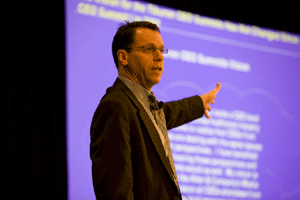 Mr. Roame outlined Tiburon CEO Summits' past & current attendee statistics, encouraged the audience to meet one another, & proceeded with brief introductions for the remainder of CEO Summit XVII.
- The Tiburon CEO Summits vision has not changed since CEO Summit I in 2001
- Tiburon CEO Summit XVII had 112 confirmed attendees, all Tiburon clients, all c-level executives & executive vice presidents, which amounted to the firm's biggest ever West coast group & right in its target zone
- Tiburon CEO Summit meet thy neighbor tradition returned to CEO Summit XVII, allowing attendees the opportunity to meet & greet right out of the gate
- Tiburon CEO Summit XVII client attendees were less so first time attendees due to the return to the West coast but that slant was offset by Tiburon’s growing client base
- Tiburon CEO Summit XVII client attendees are increasingly from markets & distribution companies from CEO Summit XIII, with slight decreases continuing in both product & service companies and financial advisors
- Tiburon CEO Summit XVII client attendees were increasingly from large companies due to industry mergers and a tightening of the client definition
- Tiburon CEO Summit XVII tied its record for female attendance
- Tiburon CEO Summit XVII included nine guest speakers, including Jim Weddle (Managing Partner, Edward Jones & Company), Jon Baum (CEO, The Dreyfus Corporation), John Calamos (CEO, Calamos Asset Management), Pete Kight (Vice Chairman, Fiserv), Steve Wallman (CEO, Foliofn), Andrew Rudd (CEO, Advisor Software), Fred Jonske (CEO, M Financial Group), Steve Lockshin (CEO, Convergent Wealth Advisors), & Deena Katz (Chairman, Evensky & Katz and Associate Professor, Texas Tech University)
- Tiburon CEO Summit XVII included its inaugural CEO Summit award recipients, including Ken Fisher (CEO, Fisher Investments) and Charles Schwab (Chairman, The Charles Schwab Corporation)
Two Important Tiburon Side Notes ...
Tiburon Strategic Advisors
- Tiburon delivers research reports, market seminars, custom market research & strategy consulting projects, & advisory board roles
- Tiburon is seeking specific personnel to exploit its considerable industry content & client needs, including a chief consulting officer or entrepreneurial consulting team, associate principals, & mid-level employees
Tiburon CEO Summit XVIII
- Tiburon CEO Summit XVIII will take place on April 14-15, 2010 at the Ritz Carlton Battery Park Hotel in New York, NY with guest speakers to include Ed Bernard (T.Rowe Price), Abby Cohen (Goldman Sachs Group), Steve Forbes (Forbes Media), Jim McCool (The Charles Schwab Corporation), Eric Schwartz (Cambridge Investment Research), Jonathan Steinberg (Wisdom Tree), David Tittsworth (Investment Advisor Association), & Fred Tomczyk (TD Ameritrade)
Tiburon CEO Summit XVII Agenda Highlights & Guest Speaker Introductions
Tiburon CEO Summit XVII Award Recipients
- Ken Fisher (Challenging Conventional Wisdom)
- Proud junker (plus web-based advertising, infomercials, & radio)
- Specialization of labor
- Centralized service
- Charles Schwab (Maintaining a Focus on Consumer Needs)
- Products: discount brokerage, mutual fund supermarkets, money management, banking, custodial services, & customized technology
- Channels: telephone service centers, 300 branches, the web, & specialized service centers
Tiburon CEO Summit XVII Guest Speakers
- Jim Weddle (Edward Jones & Company)
- Opportunities & challenges for financial services firms
- Focusing on client service excellence
- Relying on long-term strategic planning
- Jon Baum (The Dreyfus Corporation)
- Crossroads of recovery
- Implications for asset management industry
- Distribution success drivers (maintaining client focus & providing needs-based offerings)
- John Calamos (Calamos Asset Management)
- Ongoing challenges of today's uncertain economy
- Increasing importance of risk management
- Firm transformation - from a convertible securities specialist to an institutional caliber global investment manager
- Pete Kight (Fiserv Corporation)
- Digital consumer, digital investor, digital business
- Focusing on client service excellence
- Relying on long-term strategic planning
- Digital consumer, digital investor, digital business
- Steve Wallman (Foliofn)
- Too big to fail?
- Regulation and contagion
- Innovation versus regulation
- Next generation regulatory structure
- Meaningful corporate governance
- Too big to fail?
- Andrew Rudd (Advisor Software & Barra)
- Goal-based investing
- Fred Jonske (M Financial Group)
- Impact of the financial crisis
- Serving ultra affluent clients’ financial needs
- Future of the ultra affluent market
- Carrier relationships
- Managing a member owned organization
- Impact of the financial crisis
- Steve Lockshin (Convergent Wealth Advisors)
- Implications of the market crash
- Future of independent financial advisors: small but growing
- Hedge funds: Dead, taking a breather, or ready to explode
- Strategic versus tactical asset allocation: introducing strategical
- Where will the money go…
- Implications of the market crash
- Deena Katz (Evensky & Katz and Texas Tech University)
- Lack of human capital in the financial industry
- Lack of educated consumers to participate in the industry
- Lack of human capital in the financial industry
Tiburon CEO Summit XVII - Meet the Plaintiffs' Attorneys Panel (Facilitated by Ken Fisher of Fisher Investments)
- Ryan Bakhtiari (Aidikoff, Uhl, & Bakhtiari)
- Partner
- Beverly Hills, CA
- Boyd Page (Page Perry)
- Senior Partner
- Atlanta, GA
- Scott Shewan (Born, Pape, & Shewan)
- Partner
- Clovis, CA
Tiburon CEO Summit XVII Break-Out Sessions
- Unified Managed Households (Facilitated by Mike Gianoni of Fiserv Corporation)
- Next step beyond models only programs and unifed managed accounts
- Technology implications
- Next step beyond models only programs and unifed managed accounts
- Financial Advisor Technology (Facilitated by Viggy Mokkarala of Envestnet)
- Opportunities presented by large firm transformations
- Technology as the great equalizer
- Opportunities presented by large firm transformations
- Retirement Income (Facilitated by Tif Joyce of Joyce Financial Management)
- Savings shortage & retirement income challenges of 76 million baby boomers
- Impact of lower account balances and lower home pricesngoing challenges of today's uncertain economyFirm transformation - from a convertible securities specialist to an institutional caliber global investment manager
- Savings shortage & retirement income challenges of 76 million baby boomers
- Public Relations (Facilitated by Jenn Connelly of JCPR)
- Digital consumer, digital investor, digital business
- Focusing on client service excellence
- Relying on long-term strategic planning
- Human Capital (Facilitated by Mitch Vigeveno of Turning Point)
- Attracting & retaining top talent
- Management talent needed to fully capture the pending economic recovery
- Attracting & retaining top talent
Tiburon CEO Summit Awards Presentations
Tiburon Managing Partner Chip Roame sat down with the winners of the two inaugural Tiburon CEO Summit Awards, which were awarded for the twin characteristic themes of the Tiburon CEO Summits. Specifically, details include:
- Maintaining a Focus on Consumer Needs: Charles Schwab (Chairman, The Charles Schwab Corporation)
- Challenging Conventional Wisdom: Ken Fisher (CEO, Fisher Investments)
Aside from Tiburon Managing Partner Chip Roame's opening keynote presentation, nine guest presentations anchored the CEO Summit XVII agenda. Specifically, details include:
- Jim Weddle (Managing Partner, Edward Jones & Company)
- Jon Baum (CEO, The Dreyfus Corporation)
- John Calamos (CEO, Calamos Asset Management)
- Pete Kight (Vice Chairman, Fiserv Corporation)
- Steve Wallman (CEO, Foliofn)
- Andrew Rudd (CEO, Advisor Software & Former CEO, Barra)
- Fred Jonske (CEO, M Financial Group)
- Steve Lockshin (CEO, Convergent Wealth Advisors)
- Deena Katz (Chairman, Evensky & Katz and Associate Professor, Texas Tech University)
General Session Panel Discussion
One of the key themes of every Tiburon CEO Summit is the need to more closely listen to clients by way of presenting information in an open manner through a carefully moderated guest panel. Tiburon CEO Summit XVII included a special panel that might help Tiburon clients address certain legal needs in the coming months & years. In response to the assertions made by one CEO Summit XVI attendee that the financial services industry is vulnerable to litigation as a result of the crises of the last 18 months, a special Meet the Plaintiffs' Attorneys panel was assembled. The questions that were posed were fairly broad in nature, but the answers that were provided in response were quite specific. In true Tiburon CEO Summit spirit, this allowed Tiburon CEO-level clients to hear directly from their potential assailants in an unvarnished way. This is in sharp contrast to most CEOs' daily activities, where they are forced to rely on interpreting marketing data or listening to anecdotal stories from their sales forces. Addressing these opposing figures head-on through questions & answers may help Tiburon clients fully consider the legal ramifications of the crisis of 2008 and perhaps respond with some measure of confidence moving forward.
Attendees
Tiburon CEO Summit XVII had 110 Tiburon client attendees, including:
- Chip Roame (Managing Partner, Tiburon Strategic Advisors)
- Rick Adler (CEO, Convergent Capital Management, City National Corporation)
- Gurinder Ahluwalia (CEO, Genworth Financial Wealth Management, Genworth Financial)
- John Alshefski (Head, Business Development, Investment Manager Services, SEI Investments)
- Ryan Bakhtiari (Partner, Aidikoff, Uhl, & Bakhtiari)
- Chuck Baldiswieler (Group Managing Director, TCW Advisor Group, Private Client Services, & Retirement Services Group, TCW Group, Trust Company of the West, (TCW), Societe Generale Asset Management, Societe Generale)
- Tony Batman (CEO, 1st Global Capital Corporation)
- Jon Baum (CEO, The Dreyfus Corporation, The Bank of New York Mellon Corporation)
- Bob Behan (President, Global Distribution, Calamos Investments)
- Michael Bell (CEO, Curian Capital, Jackson National Life Insurance Company, The Prudential)
- Walt Bettinger (CEO, The Charles Schwab Corporation)
- Chris Blunt (Executive Vice President, Retirement Income Security, New York Life Insurance Company)
- James Boyne (Chief Operating Officer, Distribuiton, Calamos Asset Management)
- Derek Bruton (CEO, LPL Affiliated Broker/Dealers, Independent Advisor Services, LPL Financial, LPL Investment Holdings)
- Steve Burnett (President, Hanson McClain)
- John Calamos (CEO, Calamos Asset Management)
- John Cammack (Chairman, Mutual Fund Education Alliance)
- Amit Choudhury (Managing Partner, Pinnacle Partners Systems)
- John Clendening (Executive Vice President, Shared Strategic Services, The Charles Schwab Corporation)
- Frank Coates (CEO, Coates Analytics, PNC Global Investment Servicing, PNC Financial Services Group)
- Jenn Connelly (CEO, JCPR)
- Bill Crager (President, Envestnet Asset Management)
- Peter Crenier (Head, Business Development, Investment Services, Fiserv)
- Jay Cromarty (CEO, Investment Management & Wealth Advisory Groups, Boston Private Wealth Management Group, Boston Private Financial Holdings)
- Ben Cukier (Partner, FTV Capital)
- Jeff Cusack (President, Forward Management, Sutton Place Associates)
- Cliff D’Amato (CEO, Matrix Financial Solutions)
- Jim Dario (Head, Business Development & Relationship Management, Pershing Advisor Solutions, Pershing, The Bank of New York Mellon Corporation)
- Scott Dell’Orfano (Executive Vice President, Fidelity Institutional Wealth Services, Fidelity Investments)
- Jeffrey Dunham (CEO, Dunham & Associates Investment Counsel)
- Steve Dunlap (Chief Operating Officer, Pershing Managed Account Solutions, Pershing, The Bank of New York Mellon Corporation)
- Cynthia Egan (President, Retirement Plan Services, T. Rowe Price Group)
- Ken Ehinger (CEO, M Holdings Securities, M Financial Group)
- Harold Evensky (President, Evensky & Katz, Fiduciary Network)
- Pat Farrell (CEO, Investacorp, Ladenburg Thalmann Financial Services)
- Ken Fisher (CEO, Fisher Investments)
- Robin Foote (Managing Director, Novantas)
- Rob Foregger (Chief Strategy Officer, My Vest Corporation & Personal Capital Corporation)
- George Gatch (CEO, JP Morgan Funds Management, JP Morgan Asset Management, JP Morgan Chase)
- Mike Gianoni (President, Fiserv Investment Services, Fiserv)
- Dave Goerz (Chief Investment Officer, High Mark Capital Management, Union Bank of California, Mitsubishi UFJ Financial Group)
- Charles Goldman (President, Fidelity Institutional Platforms, Institutional Products Group, Fidelity Investments)
- Rich Goldman (CEO, Security Global Investors, Rydex/SGI)
- Craig Gordon (President, RBC Correspondent Services, Royal Bank of Canada)
- Scott Grinis (Chief Technology Officer, Envestnet Asset Management)
- John Grogan (CEO, Northwestern Mutual Wealth Management Company, Northwestern Mutual)
- Bill Hackett (CEO, Matthews International Capital Management, City National Corporation)
- Marco Hanig (President, AQR Funds, AQR Capital Management)
- Scott Hanson (Co-CEO, Hanson McClain)
- AJ Harper (President, PNC Managed Investments, PNC Global Investment Servicing, PNC Financial Services Group)
- Fred Harring (General Counsel, Fisher Investments)
- Bill Harris (Chairman, My Vest Corporation & Personal Capital Corporation)
- Mark Headley (Chairman, Matthews International Capital Management, City National Corporation)
- Gary Holland (Publisher, Barron’s, Dow Jones & Company, News Corporation)
- Bob Huret (Founding Partner, FTV Capital)
- Bob Hussey (Executive Vice President, Wealth Solutions & Institutional Services, Natixis Global Associates, Natixis Global Asset Management, Natixis, BPCE)
- Bryce James (CEO, Smart Portfolios)
- Steve Janachowski (CEO, Brouwer & Janachowski, Fiduciary Network)
- Fred Jonske (CEO, M Financial Group)
- Judy Joyce (Executive Vice President, Joyce Financial Management)
- Tif Joyce (President, Joyce Financial Management)
- Deena Katz (Chairman, Evensky & Katz, Fiduciary Network)
- Pete Kight (Vice Chairman, Fiserv)
- Pete Kris (Partner, Brazos Capital Management, AIG Investments, American International Group, (AIG))
- Richard Lampen (CEO, Ladenburg Thalmann Financial Services)
- Chuck Lewis (CEO, My Vest Corporation & Personal Capital Corporation)
- Jim Livingston (CEO, National Planning Holdings, The Prudential)
- Steve Lockshin (CEO, Convergent Wealth Advisors, Convergent Capital Management, City National Corporation)
- Tom Lydon (President, Global Trends Investments)
- Matt Lynch (CEO, Capital Analysts, Western & Southern Financial Group)
- Adam Malamed (Chief Operating Officer, Ladenburg Thalmann & Company, Ladenburg Thalmann Financial Services)
- Liz Manibay (Executive Vice President, JCPR)
- Jim McCool (Executive Vice President, Schwab Institutional Services, The Charles Schwab Corporation)
- Nick Mencher (Head, Consulting Firm Relations, Asset Management Business Development, TIAA-CREF Asset Management, TIAA-CREF)
- Mark Mettelman (CEO, Triad Advisors, Ladenburg Thalmann Financial Services)
- Viggy Mokkarala (Executive Vice President, Envestnet Asset Management)
- Cheryl Nash (Global Head, Product Strategy & Business Development, Investment Services, Fiserv)
- Karen Novak (Chief Operating Officer, Pershing Advisor Solutions, Pershing, The Bank of New York Mellon Corporation)
- Bob Oros (Executive Vice President, Custom Clearing Services, LPL Financial, LPL Investment Holdings)
- Terry Otton (CEO, RS Investments, Guardian Life Insurance Company of America)
- Ken Ouimet (CEO, My World Investing)
- Tim Ouimet (Founder, My World Investing)
- Michael Pagano (Executive Vice President, Private Client Services, City National Corporation)
- Boyd Page (Senior Partner, Page Perry)
- John Phillips (Executive Vice President, Sales, National Financial Services, Fidelity Investments)
- Alex Potts (CEO, Loring Ward Group)
- Alan Reid (CEO, Forward Management, Sutton Place Associates)
- George Riedel (Head, Sales & Client Services, Third-Party Distribution, T. Rowe Price Group)
- Neal Ringquist (President, Advisor Software)
- Andrew Rudd (CEO, Advisor Software)
- Bill Salus (Chief Business Development Officer, PNC Global Investment Servicing, PNC Financial Services Group)
- Matt Schiffman (Head, Retail - America, Legg Mason)
- Chuck Schwab (Chairman, The Charles Schwab Corporation)
- Sandeep Sharma (Executive Vice President, Product Strategy, My World Investing)
- Sterling Shea (Head, Winner’s Circle Advisor Rankings & Conference Program, Barron’s, Dow Jones & Company, News Corporation)
- Scott Shewan (Partner, Born, Pape, & Shewan)
- Tom Sholes (Executive Vice President, Strategic Planning & Global Product Management, PNC Global Investment Servicing, PNC Financial Services Group)
- Babu Sivadasan (Executive Vice President, Engineering, Envestnet Asset Management)
- David Smith (Group Publisher, Financial Advisor & Private Wealth Magazines, Charter Financial Publishing Network)
- Esther Stearns (President, LPL Financial, LPL Investment Holdings)
- Marie Swift (CEO, Impact Communications)
- Camille Taglia (Executive Vice President, Research, Barron’s, Dow Jones & Company, News Corporation)
- Frank Trotter (President, Ever Bank Direct, Ever Bank Financial)
- Mitch Vigeveno (CEO, Turning Point)
- Greg Vigrass (President, Folio Institutional, Foliofn)
- Craig Walling (CEO, Private Banking, Wealth Management US, UBS)
- Steve Wallman (CEO, Foliofn)
- Gib Watson (CEO, Prima Capital Management, Prima Capital Holding, Matrix Financial Solutions)
- Jim Weddle (Managing Partner, Edward Jones & Company)
- Carol Yochem (Executive Vice President, Wealth Management, First Citizens Bank, First Citizens Banc Shares)
Also in attendance for Tiburon CEO Summit XVII was Tiburon employee Tudor Jones (Business & Marketing Associate).
Tiburon CEO Summit XVI: April 15-16, 2009
Tiburon CEO Summit XVI was held April 15-16, 2009 at the Ritz Carlton Hotel in New York, NY. Tiburon CEO Summit XVI started at 7:45am on Tuesday, April 15, included a networking dinner that evening at Delmonico's Restaurant, & concluded at 5:30pm on Wednesday, April 16. Over 125 senior industry executives took two days out of their busy schedules to participate. Chip Roame (Managing Partner, Tiburon Strategic Advisors), Jud Bergman (CEO, Envestnet Asset Management), Jessica Bibliowicz (CEO, National Financial Partners), Mark Casady (CEO, LPL Financial), Kip Condron (CEO, Axa Financial), Jeffrey Dunham (CEO, Dunham & Associates Investment Counsel), Ken Fisher (CEO, Fisher Investments), Roger Ibbotson (Professor, Yale University; CEO, Zebra Capital Management; & Former CEO, Ibbotson Associates), Scott Powers (CEO, State Street Global Advisors), & Paul Stevens (CEO, Investment Company Institute) made general session presentations. Four general session panel discussions included a consumers panel, an advisors panel, a gatekeepers panel, & the now permanent special general session panel discussion addressing current events.
Chip Roame (Managing Partner, Tiburon Strategic Advisors)
Tiburon's CEO Summit XVI was held April 15-16, 2009 in New York, NY
Tiburon CEO Summit XVI Welcome & State of the Financial Services IndustryTiburon CEO Summits Vision, Tiburon Core Business Services, & A Brief Introduction
.gif) Mr. Roame summarized the Tiburon CEO Summits vision and outlined the firm's core business services, taking a few moments to thank the Tiburon CEO Summit XVI speakers & sponsors:
Mr. Roame summarized the Tiburon CEO Summits vision and outlined the firm's core business services, taking a few moments to thank the Tiburon CEO Summit XVI speakers & sponsors:
- Human Capital (Facilitated by Mitch Vigeveno of Turning Point)
- Tiburon's CEO Summits were created in 2001 after Mr. Roame noted the lack of CEO-level interaction across traditional industry lines and yet saw the consistency of issues being addressed by these same executives
- Tiburon's CEO Summits have evolved from a just a handful of industry colleagues meeting in Tiburon to 100+ CEO-level Tiburon clients attending two day conferences at the Ritz Carlton Hotel in San Francisco, CA & New York, NY
- Mr. Roame reiterated the two themes of all Tiburon CEO Summits - Challenging Conventional Wisdom & Maintaining a Consumer Orientation
- Tiburon's core businesses include Research Reports & Research Report Access Program, Market Seminars & Conference Speeches, Market Research & Strategy Consulting Projects, & Advisory Board Roles
- Mr. Roame introduced Tiburon CEO Summit XVI's nine terrific guest speakers, including Jud Bergman (CEO, Envestnet Asset Management), Jessica Bibliowicz (CEO, National Financial Partners), Mark Casady (CEO, LPL Financial Services), Kip Condron (CEO, Axa Financial), Jeffrey Dunham (CEO, Dunham & Associates Investment Counsel), Ken Fisher (CEO, Fisher Investments), Roger Ibbotson (Professor, Yale University; Chairman, Zebra Capital Management; & Former CEO, Ibbotson Associates), Scott Powers (CEO, State Street Global Advisors), & Paul Stevens (CEO, Investment Company Institute)
- Mr. Roame then thanked the Tiburon CEO Summit XVI sponsors, including Advisor Software, Envestnet Asset Management, Fiserv (Fiserv Investment Services), Foliofn (Foliofn Institutional), JCPR, LPL Financial, Mass Mutual Financial Group, Natixis (Natixis Global Associates), PNC Financial (PNC Global Investment Servicing), Rafferty Holdings (Direxion Funds), State Street Corporation (State Street Global Advisors), TD Ameritrade (TD Ameritrade Institutional), The Bank of New York Mellon Corporation (Pershing Advisor Solutions), & The Charles Schwab Corporation (Schwab Institutional) whose financial support allow the CEO Summits to be held at the Ritz Carlton Hotel and attendance to be open to 100+ CEOs
State of the Financial Services Industry
Year-End 2007 Recollection: Winning Products & Channels
Mr. Roame introduced his presentation with a brief overview of the recent past, discussing such factors as consumer wealth, the retirement issue, leading & growing products, the state of the channels, and a mention of the increasing role of global markets:
- The ratio of consumer household financial assets had been relatively stagnant since 2002, with investable assets accounting for two-thirds of all financial assets
- Baby boomers were still not saving the traditional way in 2007, maintaining negative saving rates from 2005 & 2006
- Life expectancy was becoming a problem, but consumers, and especially baby boomers, had lots of assets in retirement plans & houses that they could liquidate to retire
- Mutual funds were the dominant investment product and mutual fund net flows still led those of other investment products
- Target date mutual funds had become the industry darling and were gathering assets quickly
- Exchange traded funds had become the most significant product development since mutual funds in the 1940s
- Hedge funds had gathered over $2.0 trillion assets, more than SMAs & ETFs combined
- The wirehouses and retail banks controlled almost two-thirds of all consumer investable assets
- And for investment management firms, non-US mutual funds assets under management had surpassed those of US mutual funds
2008-2009 Credit Crisis: Consumer & Industry Impacts
With the table set, Mr. Roame then discussed the events of the last year, presenting some high-level Tiburon research findings:
- And then came the credit crisis, with lots of parties to share the blame, including consumers who took out loans they were unable to handle, commercial banks who created sub-prime & no-documentation processes, mortgage brokers who paid huge agent incentives to close any transaction, & investment banks who created & sponsored complex mortgage backed derivative products
- The stock markets all declined sharply in 2008, with the indices being down 31% to 41%
- And then came the government's help... All five of the larges US government bailouts have been of financial services companies, wiht four happening in 2008, including the Economic Stabilization Act, and the bailouts of Fannie Mae & Freddie Mac, AIG, and Bear Stearns
- The average American worker lost one-quarter of his or her 401k retirement plan savings in 2008
- Consumer households lost $2.0 trillion in real estate equity since 2006, down to $8.9 trillion, with home equity levels falling to 43%, which is the lowest number on record
- In aggregate, consumer household net worth fell $11.0 trillion in 2008 to $52.0 trillion
- And the number of consumer households with over $1.0 million net worth declined almost 30% in 2008 to 6.7 million
- There have been several dramatic financial service industry impacts as a result, including huge AUM drops, 325,000 jobs lost worldwide since 2007, $680 billion of losses & write-offs in US firms alone, and investment manganager margins dropping from 40% to 25%
- Actively managed equity mutual funds had net outflows of $238 billion in 2008 after years of positive net flows
- Hedge fund assets ended 2008 at $1.3 trillion having peaked at $1.8 trillion mid-year
- Financial institutions' capital raises have just offset their losses & write downs
- Retail banks have had the highest market capitalization loss by percentage in the financial services industry at negative-63%
- Bank of America & Merrill Lynch, Citigroup, AIG, Wells Fargo & Wachovia, and JP Morgan Chase, Washington Mutual, & The Bear Stearns Companies all lost over $100 billion of market capitalization since October 2008
- As a result of recent events, consumers are skeptical of the financial services industry, with three-quarters believing that Bernie Madoff type behavior is common
- Investors are increasingly going to court to seek resolution, filing 210 class action lawsuits alleging securities fraud, up almost 100% since 2006, half of such against financial institutions
2009 & Beyond: New Industry Trends & Directions
Clearly the industry stands at a crossroads, so Mr. Roame then addressed the future of products & services and the market & distribution channels that will deliver them:
- Investment products will likely move from complex, risky, & high fees to more simple, risk averse, & sustainable products. Fading products might include closed-end funds, mortgage related products, & securitized products. Those with unclear futures include credit funds, distressed debt funds, & real estate funds. Those products that look like they might emerge as winners include individual equities & bonds, CDs, 40 act structures, and ETFs & Active ETFs
- For example, while ETF assets declined from $608 billion to $578 billion in 2008, net flows into ETFs increased to $178 billion, up 20% since 2007
- And while 2008 investment returns depressed ten year hedge fund investment returns, those returns are still positive, unlike the long-only world
- The most highly ethical and value-added markets & distribution channels are likely to gather the greatest assets. Fading channels might include wirehouses, investment bankers, & investment consultants. Those with inclear futures might include define contribution plans, retail banks, & discount brokers. Those channels that look like they might emerge as winners include online financial services, independent reps, & fee-based financial advisors
- On one hand, the major investment banks have gone bankrupt, been acquired, or converted to banks
- Goldman Sachs Group's employees have seen their earnings plummet, with an average of $357,000 in 2008, down 50% since 2007
- Almost all wirehouse clients say that they intend to take money away from their brokers
- Meanwhile, fee-based financial advisors' big three custodians have brought in more new assets since the beginning of 2007 than the big four wirehouses, and The Charles Schwab Corporation's 5,500 fee-based financial advisors have brought in more assets than even Merrill Lynch's 16,690 brokers since the beginning of 2007
- Retail banks will be the most aggressive acquirers because they are the largest institutions and financial institutions buyouts are likely to grow significantly from just 13% of all buyouts
Tiburon CEO Summit XVI Kick-Off
Tiburon CEO Summit Guest Speakers Introduction & Agenda Highlights
- Tiburon's CEO Summits have evolved from a just a handful of industry colleagues meeting in Tiburon to 100+ CEO-level Tiburon clients attending two day conferences at the Ritz Carlton Hotel in San Francisco, CA & New York, NY
- Jud Bergman (Envestnet)
- Jessica Bibliowicz (National Financial Partners)
- Mark Casady (LPL Financial)
- Kip Condron (Axa Financial)
- Jeffrey Dunham (Dunham & Associates Investment Counsel)
- Ken Fisher (Fisher Investments)
- Roger Ibbotson (Yale, Zebra, & Ibbotson)
- Scott Powers (State Street Global Advisors)
- Paul Stevens (Investment Company Institute)
- Modern Portfolio Theory
- Break Away Brokers
- Financial Advisor Technology
- Retirement Income & the Impace of the Recent Credit Crisis
- Alternative Investments
- Distribution Insight that Works
- Lineup of luminaries that are now fallen is staggering
- Change of players has been remarkable
- Brands will need significant re-tooling
- Wirehouses were the Tiffany in 1999
- Too Big to Fail (stabilization of firms left standing)
- Integration to new fee-based business model
- Recovering credibility
- Re-allocation of capital on infrastructure
- New regulations
- Independent brand value not yet fully recognized on Main Street
- Securities America & Commonwealth have done very well in pointing to the brand of the independent advisor rather than the custodians
- E-Money & Assetmark have done good jobs on branding independent advisors
- Risk/Reward comfort level
- Time horizon for meeting goals & objectives
- Strategic asset allocation
- Emotional frontier & current frame of mind
- Objectivity
- Alignment
- Flexibility
- Platform providers will become increasingly important much in the same way as cable providers have, but branding will be more closely associated with the independent advisors themselves (cable channels) versus the platform provider (cable providers)
- As a product provider, trying to increase performance predictability is a key motivator
- Lower employment affects broker side the most
- Compensation is under scrutiny
- Medical cost inflation continues
- Rate increases are passed on to employees
- Tighter underwriting
- Employers unbundle and price-shop benefits
- Employer-based
- Plus coverage for 47 million uninsured
- People don't want to see volatility, just to see the wealth transfer
- Creative product innovation returning vibrancy to the insurance world and post-retirement investing community
- Will allow products to come to market more quickly, rather than having to be approved across the 50 state level
- Brokers are still moving within the wirehouses, but now clients are leaving
- There is an opportunity to improve all the wirehouses by working to improve client confidence
- Open architecture is here to stay
- Conserve cash by working on networking opportunities with friends in the investment management industry
- LPL research of today's consumers shows effects of the market decline:
- 25% trust their full-service brokers less
- 42% view full-service brokers more negatively
- 50% are contacted less than monthly or not at all by their full-service brokers
- 53% now using independent advisors are more satisfied
- 61% claim advisor relationship is more important than brand
- Scared & uncertain about the future
- Serious impact to long-term financial plans
- 42% concerned about job loss
- 31% decrease in average net-worth
- 38% will delay retirement
- Consolidation leading to greater resources will create more competitiveness, and this cycle will serve to allow certain firms to focus on scale
- Axa has been encouraging the implementation of a federal regulator for the insurance industry
- When TARP money became available to banks, which were regulated, insurance companies were without access to the funds unless they purchased a bank
- The regulation of the insurance industry is antiquated
- The Financial Services Roundtable, which Mr. Condron is currently chairing, is looking to make recommendations on the issue of savings incentives
- 77 million baby boomers lost 40% of their retirement assets over the last year
- Guarantees within the 401k plan
- Axa sees these as the wave of the future
- Started a business in late 2007 to create the model product for in-plan guarantees
- Market research shows that 50% of 401k beneficiaries would buy a guarantee, especially after the recent downturn
- In a $3 trillion business, that's $1.5 trillion, but capacity is limiting the growth of the business
- Acquisitions must currently be marked on the balance sheet, and no companies are currently prepared to mark their balance sheets
- Current market capitalization does not allow consolidation
- Mr. Condron sees forced marriages by regulators, modeled similarly to the PNC Financial & National City deal
- He is concerned by the risks he sees competitors taking due to the fact that they are now operating on borrowed funds
- Fair value for services received
- Adjustment of fees based on performance against the index
- Paid based on results is by nature a fiduciary responsibility
- Better aligns investors' objectives with industry compensation
- Other firms offering performance fees include Vanguard, Janus, Fidelity, Riversource, & USAA, but only Dunham offers 100% performance fees on its funds
- Measured on a relative basis on investment-to-investment professional relationship
- Consumers don't care about relative performance, they only care about dollars gained and/or lost
- If fund managers beat the index, the fees go up; if fund underperforms the market, the fees go to zero
- Maximum fees vary from 50 to 100 basis points, with measurement based on rolling 12-months
- Minimum fees vary from 0 to 25 basis points
- Can be paid on a fixed fee basis or can be paid on a performance fee basis
- Performance fees for financial advisors are based only on absolute return basis
- Fees based on a monthly accounting of portfolio balance, with the balance at the beginning of each month resetting the benchmark for absolute returns
- Qualified investors must be one of the following:
- Mr. Fisher discussed his series of consumer conferences, highlighting key metrics he uses in evaluating clients' needs; he also addressed ways that his firm builds trust by encouraging clients to speak to one another at these conferences
- Focus on the woman of the house, for she is likely to play a larger role in the family finance after this latest downturn
- Cut programs that cost money and focus on free or cheap programs that increase innovation
- Mr. Fisher spent considerable time addressing the coming wave of lawsuits that he believes will besiege the financial services industry
- Statute is five years
- Most aggressive prosecutors will build up their case files against biggest firms for massive class-action suits
- Now is the time to invite these prosecutors to upcoming CEO Summits to participate in panel discussions on the current landscape
- Stick to the core, cut costs, and boost budget
- Market share is the number one target for Fisher
- Increase service standards in formalized programs for existing and new clients
- 2008 was second-worst stock return year in United States history (1931)
- Hedge funds down 20%
- Real estate, private equity, & hedge funds all had high returns & growth in AUM
- Hedge funds lost about half as much as stock markets in 2008
- Beta impacted returns, but equity market neutral has low risk
- Ten year returns still positive, with 2008 (-18.4% & -6.2%) driving 1998-2007 at 9.9% & 6.3% down to 1999-2008 at 7.5% & 4.5% for weighted composite & equity market neutral returns, respectively
- Continual job losses
- A year of negative growth
- Volatility as high as the 1930s
- Market will bottom at first sign of improvement
- Large positive stock returns will occur before the recession ends
- Investors today are seeing absolute negative returns, and the questions are prevalent
- But nobody knows what to do next, what the alternatives are
- Clients will pay for the floor and give up some of the upside
- Much more of a sense of urgency in conversations surrounding this concept
- The risk of inflation must be considered
- Matching liabilities with overlay strategies with growth pockets that add value over time
- Becoming much more prevalent at the large planned sponsor level because unfunded liabilities become a balance sheet obligation
- Managed volatility and absolute return space has not been a shining light of returns recently
- How much is skill versus how much is beta that is leveraged?
- People are not giving up on hedge funds (uncorrolated sources of return)
- Focus is on predictability of return
- Handling multiple asset classes
- Handling multiple outcome oriented strategies
- Negotiated down to an attractive fee structure
- If they can deliver alpha, they will be paid hansomely
- The -40% rate of return in the last year has caused a serious problem
- The portfolios have been de-risked as liabilities have been off-loaded, so at this point, there is a requirement for either greater risk or the injection of new capital
- Washington will implement some kind of device to measure this; the Fed lost credibility as it fell asleep in dealing with the early stages of the subprime crisis
- Congress will most likely opt to assemble a coucil of regulators, perhaps led by the Secretary of the Treasury, with a statutory mandate and an independent staff of its own, working outside of the system, but addressing identified risks through operating regulating agencies
- Unregistered pools
- Hedge funds & private equity will have to live with new forms of regulation, with perhaps non-public visibility to the regulators, but there seems to be an appetite to go beyond that even
- OTC derivatives
- Credit default swaps will incur public action, by making the market more standardized through regular clearing mechanisms subject to oversight
- Broker/dealer & investment advisor regulations
- In Washington, issues with fiduciary responsibility are never resolved to a lesser extent
- Brokers want fee-based business model without having the fiduciary responsibility, but the ICI believes there should be increased harmony between fees & responsibility
- Suitability has been defined as not completely unsuitable, and that is likely to change
- A very substantial market that ought to have a better regulatory framework to improve disclosure, although this issue is highly political
- SEC must be re-invigorated, with a staff reorganization, relationships with industry revamped, and active management without a requirement for lawyers
- Continued congressional scrutiny
- Adequacy
- Disclosure
- Targe-date funds
- Retirement income
- Auto IRA
- ICI response
- Highlight success of 401k system & support ways to improve it
- Work with Congress and Department of Labor to implement better disclosure
- Fix social security
- Daily & weekly minimum (5% & 20%, respectively)
- Adopt a second WAM calculation
- Prohibit money market funds from investing in second-tier securities
- Understand client requirements
- Liquidity & redemption needs with respect to concentrated client base
- Recommend the SEC authorize fund boards to suspend redemptions under certain circumstances
- Chip Roame opened the discussion by introducing the two objectives of the panel: firstly, to identify the causes & culprits of the credit crisis and secondly, to address how the world will change moving forward (government regulations, products, channels, and mergers & acquisitions activity moving forward):
- Chuck Baldiswieler addressed on & off balance sheet leverage, derivatives, & lack of oversight as the main culprits driving the crisis, speaking of the 30 to 1 leverage common practices
- John Cammack addressed ample credit, unbridled securitization, lax regulations, disingenuous rating agencies, and misperception of magnitude & globalization of systematic risk. Mr. Cammack blamed the belief system, and said that the entire financial services industry is at fault for allowing the culture to exist
- Steve Deschenes pointed to the separation of loan underwriting from financial impact through securitization, speaking specifically to the lack of accountability that occurred with debt packaging
- John Murphy spoke of freely available credit, government encouragement of Freddie Mac & Fannie Mae, living large (excess ownership & excess speculation), easy securitizations with AAA ratings, & lack of full collateralization
- Steve Wallman addressed regulatory structures, compensation failures (rewarding returns, ignoring risk), regulatory implementation (when the hundred year flood happens everyone is wiped out), poor governmental responses to the initial housing, & then a broader credit crisis
- Chip Roame thanked the panelists for answering the first question, then moved on to addressing how the world will change moving forward given the new regulatory environment
- Chuck Baldiswieler talked about the mergers activity that he sees coming, which will involve more active management than blind investing. He addressed the potential for different types of investments that take advantage of the good assets that remain in the markets. He spoke of the equity promise having been broken, corporate pensions, public pensions, endowments & foundations dealing with liquidity issues, saying that RIAs and family offices will win, with long time horizons and self-regulation
- John Cammack spoke to increased regulation to control risk, consolidation & better synchronization of oversight, suitability versus fiduciary standard resolution, and higher industry operating costs a byproduct of these steps. He spoke of a large share of US wealth moves into post work mode, fee-based pricing & open architecture trends to continue, ETFs & indexing growing share, and hedge fund industry consolidation. He also spoke of active management broadening to include absolute returns & overlays, and outcome based products eclipsing the role of standalone funds. He talked of a handful of mega distributors dominating, saying that an X factor is more open-access to consumers and financial advisors via the web
- Steve Deschenes addressed increased regulation, higher taxes, and attempts to reduce the too big to fail issue. He mentioned that existing investment theory (modern portfolio theory) faces pressures with focus on absolute returns, diversification beyond equities, fixed income, & cash, guarantees being more valuable, and tax deferral being more valuable. He spoke of increased focus on transparency, lower fees, & independence. Finally, he mentioned that mergers & acquisitions activity will be based on new regulatory & financial rules
- John Murphy first encouraged all the attendees in the audience to go to Washington DC to prevent adverse legislation to the industry, saying that government officials really want help in understanding what to do. He spoke of a systemic risk regulator with potentially excess 401K regulation. He spoke of a clearinghouse for credit & derivative instruments (with capital requirements, transparency, & real time reporting), and the implementation of money market working group recommendations. He said that financial advisor focus should be on rebuilding confidence with clients with more financial advisors choosing the independent route to move away from the damaged brands. He said that boutiques will continue to emerge as people leave larger firms and private equity will become major players
- Steve Wallman talked about the unprecedented spending by government, saying that by saving the big brokerages and propping up the big banks, the government is ensuring that the behaviors that have dominated will likely continue. He talked of the tax burden and debt burden sure to hang over the country for years to come, and said that for all the spending that has occurred not much is actually happening (citing the AIG compensation blow-up that is now buried somewhere in the Senate)
- Chuck Baldiswieler talked about the mergers activity that he sees coming, which will involve more active management than blind investing. He addressed the potential for different types of investments that take advantage of the good assets that remain in the markets. He spoke of the equity promise having been broken, corporate pensions, public pensions, endowments & foundations dealing with liquidity issues, saying that RIAs and family offices will win, with long time horizons and self-regulation
- Josh works for Cisco Systems and has been investing with his wife for years. He started his first financial advisor relationship based on a personal relationship he had out of high school. He is an active investor who values trust in his advisor more than anything else. He speaks to communications following mistakes, and says he will always go back to the expectations that were laid down in the beginning. He stopped investing his new assets with his first advisor because the management fees were too high, but fees are not the determining factor in how he values the people who invest for him. Part of the reason Josh moved along was because he couldn't be sure that his advisors could do much better than he could. Josh had a very bad experience with a leading national advisory firm where he had asked for a transfer of funds that was not executed, followed by a dip in the market where he lost money. The firm held several different positions as he pursued resolution, and as the decision was levvied against him, he decided not to ever work with that firm again. Josh then talked about what his ultimate goals are, and said they have nothing to do with how well his advisor is doing compared to his advisor's advisor buddy. Josh then addressed a question out of the audience inquiring how he made decisions to move from advisor to advisor, saying that he typically followed advice of his wife, his brother-in-law, his friends
- Sonja started by saying that she emigrated from Sweden in 1973 with no financial experience at all. Her husband had five businesses that he ran in the United States, and as they traveled she began reading the New York Times financials section, becoming interested in stocks. After a sale of one of her family's companies, she researched the stocks she thought were worthwhile, and chose her investments in 1995. In 2001, her portfolio crashed with the stock market, and then her husband died in 2002. She had been responsible for many of the family's original trading practices, but as the complexity of her portfolio increased with trusts and new investment devices, Sonja decided it would be a good idea to seek professional help. She followed an advisor from Merrill Lynch to Morgan Stanley in 2007, and then, in 2008, when the markets collapsed, she stayed with him. She felt that her advisor was paralyzed as he continued to tell her not to sell, that she should buy Freddie Mac & Fannie Mae, and when she did that and her assets plummeted, she decided to move on. Sonja was asked by an audience member how she made her decision to switch advisors, and she too said that she listed to friends. Her decision was based on her desire to have a more diversified portfolio under the management of an advisor who had a broad view of investments
- Keith is a financial services industry reporter who has invested for many years, and has chosen to delegate investment responsibilities to advisors based on his desire to maintain a little distance between his own professional interests and his personal financial interests. Keith has invested with several different advisors over time, and began to invest in alternative investments, specifically funds-of-funds and structured notes. Keith is very familiar with financial products and began questioning the wisdom of his financial advisors, and shared his concerns about structured notes with his advisor, specifically about Lehmans structured notes. He continued to question his advisor as the markets worsened. Two weeks before the Lehman bankruptcy, Keith agressively pursued getting out of the structured products notes again. Two major factors were not disclosed to Keith by his advisor: first, he was not told that the structured notes were basically unsecured corporate bonds; second, his advisor never told him that incentives were being provided to sell these structured products. Keith didn't even find out this information from his advisor, but from a lawyer who contacted him looking to sue the large firms. Keith felt wronged by his advisor, but attributes the behavior on a larger scale to the industry on the whole. Keith's trust was broken, and now Keith is looking for a new advisor. He is looking for trust and is therefore seeking referrals from his trusted friends. One of these referrals took him to a new prospect, who in the initial meeting, when hearing about the incentivized structured products sales, asked him - Well, how else are we supposed to make money? Keith has to laugh...
- Maureen is a retiree with a 401k, with the kids gone & graduated from university. Suddenly, financial conditions changed for her husband's family, as her father- and mother-in-law both started to behave oddly with their investments. Both in their 90s, and living in an assisted living facility, the elderly couple became convinced that they had no more money left. As it turned out ... the elders were not correct about having no money, but their concern speaks to the future nightmare scenarios surrounding increasing healthcare costs that come with the onset of dementia that is becoming increasingly frequent as age expectancy rises
- Tom Lydon, of Global Trends, maintains 90 client relationships with high-net-worth individuals and maintains asset management responsibilities with tactical allocation via ETFs, all-the-while maintaining a blog called ETFTrends.Com that has begun to take up much of his time. His average clients size is $800,000. Tom spoke about the importance of client management and sang the praises of his blog, which he says makes his clients happy on a day-to-day basis. He told a story about asking his friend, a recent retiree, to perform a jovial & unstructured survey of his clients, which proved to him that he was in good shape. Tom's clients are almost all in equityETFtrends.com
- Mark Penske, of United Advisors, maintains 1,500 client relationships with mass affluent advisors who maintain $500,000 to $2 million in revenues. His firm offers back-office support & compliance to advisors in the asset management, financial planning, & individual insurance space. His average client size is $500,000. Mark, like Tom, also recognizes the importance of personal touch, and by showing facts to his clients about prior market downturns, Mark's firm is able to maintain trust with his clients. He is attempting to pick up wirehouse advisors, and in so doing is trying to focus on the first impression coming from a primary referral call. Mark's value proposition is on providing support & compliance. Mark spoke of the ever-evolving role of business development departments within financial advisory firms
- Adam Sheer, of The Roosevelt Investment Group, maintains 10,000 client relationships with high-net-worth individuals, corporations, endowments, foundations, & Taft Hartley plans, and maintains asset management responsibilities. His average client size is $500,000. Adam spoke about maintaining clean lines of communication with custodians, so that that line of communication can be relayed to the end consumers in a way that maintains confidence all the way up & down the supply chain. Responsiveness and flexibility were specifically identified as valuable qualities in custodians. Like Mark, Adam believes very strongly that there are huge numbers of opportunities for idea generation in business development
- Bill Walsh, of Hennion & Walsh, maintains 15,000 client relationships with mass affluent, unaware high-net-worth individuals, with responsibilities that include fixed income portfolios, asset management, & mutual funds. His average client size is $500,000. Bill's firm has always managed downside risk very well, with a great sales force and good relative performance, doubling assets over the last year from $1.5 billion to $3.0 billion, and is looking for a great liftout opportunity that include cultural & investment synergies$500,000has shared ownership of his own company since entering into the financial services industry as a former engineer. Since 2000, his business has changed its name seven times as a result of being bought and sold several times over. This has given Mr. Pollock a significant perspective on client retention and on building relationships that last. He manages individual customized portfolios including stocks, with a special attention paid to estate and tax planning. With a 98.5% client retention rate, Mr. Pollock also says that constant communication with the client is the only way to go, and that by using trustworthy products and services, clients are empowered to stay with him. Mr. Pollock also added that by always doing the right thing an advisor will always have good clients
- Bill Crager, of Envestnet Asset Management, runs a turnkey asset management platform supporting a financial advisor force of 14,000 advisors with $60.0 billion in assets under management. Product listing philosophy includes open architecture across a broad range of investment product categories. Needs from products companies include extension of service model for advisors. Bill elaborated by expanding on Jud Bergman's earlier general session presentation description of being analagous to a cable platform that allows many different cable channel to run into a houseExtension of service model for advisorsr
- Steve Dunlap, of Pershing Managed Account Solutions, runs an open-architecture platform & turnkey asset management provider supporting a financial advisor force of 100,000 advisors with $80.2 billion in assets under management. Product listing philosophy includes comprehensive suite of fee-based and advisory solutions, ranging from firm-directed to fully outsourced. Needs from products companies include transparency, competitive fees, value-added, and consultative sales support. Steve elaborated by indicating that Pershing, being such a ubiquitous firm with so many capabilities, seeks to be involved in gatekeeping across all aspects of the marketplace, specializing on every aspectConsultative sales supportp
- AJ Harper, of Advisor Port, runs a customizable or turnkey asset management platform and advisory services business, with a financial advisor force of 20,000 advisors with $81.0 billion in assets under management. Product listing philosophy includes designing and implementing custom, open-architecture managed account solutions including award-winning flexible UMA, SMAs, and Fund/ETF wraps. Needs from products companies include integrated service model for advisor development. AJ elaborated by speaking to opportunities that exist in asset re-allocation through advancing technologies, speaking to his firm's responsibility of getting such technologies to market
- Brian O'Toole, of Genworth Financial Wealth Management, runs a turnkey asset management platform and business consulting business supporting a financial advisor force of 6,500 advisors with $15.0 billion in assets under management. Product listing philosophy includes open architecture platforms including Best of Class Investment Managers as determined by Callan and Rocaton. Needs from products companies include accessibility, proven track record, and disciplined philosophy & processes. Brian elaborated by asking - Who is taking care of people like Joe Wurzelbacher? - as in, what is being done to take care of all those directed funds accounts for the non mass affluent & high-net-worth individual investor markets. Gatekeeping in a nimble way is the question
- Chip Roame (Managing Partner, Tiburon Strategic Advisors)
- Chris Alpaugh (Senior Managing Director, Global Business Development, Alliance Bernstein, Axa Group)
- John Alshefski (Head, Business Development, Investment Manager Services, SEI Investments)
- David Bailin (President, Alternative Investment Solutions, Global Wealth & Investment Management, Bank of America Corporation)
- Chuck Baldiswieler (Group Managing Director, TCW Advisor Group, Private Client Services, & Retirement Services Group, Trust Company of the West (TCW), Societe Generale, Asset Management, Societe Generale)
- Tony Batman (CEO, 1st Global Capital Corporation)
- Jon Baum (CEO, The Dreyfus Corporation, The Bank of New York Mellon Corporation)
- Michael Bell (CEO, Curian Capital, Jackson National Life Insurance Company, The Prudential)
- Jud Bergman (CEO, Envestnet Asset Management)
- Jessica Bibliowicz (CEO, National Financial Partners)
- Donna Blank (Chief Financial Officer, National Financial Partners)
- Stephanie Bogan (CEO, Quantuvis Consulting, Genworth Financial Wealth Management, Genworth Financial)
- John Cammack (Head, Third-Party Distribution, T. Rowe Price Group)
- Frank Campanale (CEO, Advanced Equities Wealth Management, Advanced Equities Financial Corporation)
- Rich Cancro (Managing Director, Product Development, Broker/Dealer & Investment Advisor Services, JP Morgan Chase)
- Sal Capizzi (Chief Sales & Marketing Officer, Dunham & Associates Investment Counsel)
- Mitch Caplan (Executive Advisor, Acquiline Capital Partners, Aquiline Holdings)
- Mark Casady (CEO, LPL Financial)
- Jerry Chafkin (President, Alpha Simplex Group, Natixis Global Asset Management Alternatives Group, Natixis Global Asset Management, Natixis)
- Amit Choudhury (Managing Partner, Pinnacle Partners)
- Randy Ciccati (President, ING Financial Solutions Group, ING Group)
- Dennis Clark (President, Bellatore Financial, Bellatore)
- Frank Coates (CEO, Coates Analytics, PNC Global Investment Servicing, PNC Financial)
- Steve Cohen (Chief Strategy Officer, Pro Funds Group)
- Kip Condron (CEO, Axa Financial, Axa Group)
- Jenn Connelly (CEO, JCPR)
- Chris Cordaro (CEO, Regent Atlantic Capital, Fiduciary Network)
- Ron Cordes (Co-Chairman, Genworth Financial Wealth Management, Genworth Financial)
- Bill Crager (President, Envestnet Asset Management)
- Ben Cukier (Partner, FTV Capital)
- Wayne Cutler (Managing Director, Brokerage, Novantas)
- Jim Dario (Chief Growth Officer, Pershing Advisor Solutions, Pershing, The Bank of New York Mellon Corporation)
- Pete D'Arrigo (Chief Financial Officer, Envestnet Asset Management)
- Dick Davies (Senior Managing Director, Defined Contribution, Alliance Bernstein Institutional Investments, Alliance Bernstein, Axa Group)
- Scott Davis (CEO, Essex National Securities, Addison Avenue Federal Credit Union)
- Joe Deitch (Chairman, Commonwealth Financial Network)
- Stuart DePina (CEO, Tamarac)
- Steve Deschenes (Chief Marketing Officer, Retirement Income Group, Mass Mutual Financial Group)
- Steve Dowden (CEO, CUNA Brokerage Services, CUNA Mutual Group)
- Jeffrey Dunham (CEO, Dunham & Associates Investment Counsel)
- Steve Dunlap (Chief Operating Officer, Pershing Managed Account Solutions, Pershing, The Bank of New York Mellon Corporation)
- Randy Epright (Chief Operating Officer, AIG Advisor Group, American International Group, (AIG))
- Wayne Ferbert (CEO, Tenbagger, TD Ameritrade, TD Bank Financial Group)
- Ken Fisher (CEO, Fisher Investments)
- Ron Fiske (Executive Vice President, Product Development & Management, Fidelity Institutional Wealth Services, Fidelity Investments)
- Bill Franca (Executive Vice President, Distribution, Direxion Funds, Rafferty Holdings)
- George Gatch (CEO, JP Morgan Funds Management, JP Morgan Asset Management, JP Morgan Chase)
- Mike Gianoni (President, Fiserv Investment Services, Fiserv)
- Al Girod (President, Convergent Wealth Advisors, Convergent Capital Management, City National Corporation)
- Bill Glavin (CEO, Oppenheimer Funds, Mass Mutual Financial Group)
- Rich Goldman (CEO, Security Global Investors, Security Benefit Group)
- Jeffrey Goldstein (Managing Director, Hellman & Friedman)
- Jennifer Grancio (Head, Distribution, iShares Americas, Intermediary Investor Business, Barclays Global Investors, Barclays)
- Larry Greenberg (CEO, Jefferson National Financial)
- Matt Grove (Executive Vice President, Business Development, Jefferson National Financial)
- Jim Hale (Founding Partner, FTV Capital)
- Scott Hanson (Co-CEO, Hanson McClain)
- AJ Harper (President, Advisor Port, PNC Global Investment Servicing, PNC Financial)
- Jim Hays (President, Private Client Group, Wachovia Securities, Wachovia Corporation, Wells Fargo Corporation)
- JoNell Hermanson (President, M Financial Wealth Management, M Financial Group)
- Tom Hexner (Executive Vice President, Bernstein Global Wealth Management, Axa Group)
- Rich Hughes (Group Co-President, Portfolio Management Consultants, Envestnet Asset Management)
- Robert Hussey (Executive Vice President, Wealth Solutions & Global Relationships, Natixis Global Associates, Natixis Global Asset Management, Natixis)
- Roger Ibbotson (Professor, Yale University; Chairman, Zebra Capital Management; & Former CEO, Ibbotson & Associates)
- Dwight Jacobsen (Executive Vice President, Intermediary Distribution, MSBC Securities Corporation, The Dreyfus Corporation, The Bank of New York Mellon Corporation)
- Alistair Jessiman (Managing Director, Wealth Management, Novantas)
- David Jobson (Executive Vice President, Product Development, US Retail, Allianz Global Investors, Allianz)
- Henry Johnson (Co-CEO, Fiduciary Trust Company International, Franklin Templeton Investments, Franklin Resources)
- Tom Johnson (Head, Strategic Institutional Business Development, Mass Mutual Financial Group)
- Tif Joyce (President, Joyce Financial Management)
- Geoff Kalish (Co-Founder, Aquiline Capital Partners, Aquiline Holdings)
- Atul Kamra (President, First Clearing Correspondent Services, Wachovia Securities, Wachovia Corporation, Wells Fargo Corporation)
- Dan Kreuter (CEO, DAK Associates)
- Peter Kris (Partner, Brazos Capital Management, American International Group, (AIG))
- Stephen Langlois (Executive Vice President, Strategic Development, LPL Financial)
- Charles Lowrey (CEO, Prudential Investment Management, Prudential Financial)
- Tom Lydon (President, Global Trends Investments)
- Doug Mangini (Chief Operating Officer, Retail & Intermediary Business, Morgan Stanley Investment Management,Morgan Stanley, Mitsubishi UFJ Financial Group)
- Pete Martin (President, Institutional Services, Natixis Global Asset Management, Natixis)
- Bill McDermott (Executive Vice President, Corporate Markets, Axa Equitable Life Insurance Company, Axa Group)
- Jim Minnick (President, Lovell Minnick Partners)
- Sanjiv Mirchandani (President, National Financial Services, Fidelity Investments)
- Ed Morrison (Chief Operating Officer, Albridge Solutions, PNC Global Investment Servicing, PNC Financial)
- Mike Mulcahy (President, Bridgeway Funds, Bridgeway Capital Management)
- Patrick Mulvey (Head, Global Sales & Marketing, Rogers Casey)
- John Murphy (Chairman, Oppenheimer Funds, Mass Mutual Financial Group)
- Nicole Newlin (Chief Operating Officer, Loring Ward Group)
- Karen Novak (Chief Operating Officer, Pershing Advisor Solutions, Pershing, The Bank of New York Mellon Corporation)
- Harry O'Mealia (CEO, Legg Mason Investment Counsel, Legg Mason)
- Andy O'Rourke (Head, Marketing, Direxion Funds, Rafferty Holdings)
- Brian O'Toole (CEO, Genworth Financial Management Wealth Management, Genworth Financial)
- Tim Ouimet (President, MyWorld Investing)
- Patrick Pagni (Executive Vice President, Trust Company of the West (TCW), Societe Generale Asset Management, Societe Generale)
- Mark Penske (CEO, United Advisors)
- James Poer (CEO, NFP Securities, National Financial Partners)
- Alex Potts (CEO, Loring Ward Group)
- Scott Powers (CEO, State Street Global Advisors, State Street Corporation)
- Andy Putterman (CEO, Fortigent, Lydian Trust Company)
- Matt Raynor (Executive Vice President, Sales, Natixis Global Associates, Natixis Global Asset Management, Natixis)
- Patrick Reinkemeyer (President, Morningstar Associates, Morningstar)
- Neal Ringquist (President, Advisor Software)
- Tony Rochte (Senior Managing Director, Intermediary Business Group, State Street Global Advisors, State Street Corporation)
- Jake Rohn (Executive Vice President, Corporate Development, Albridge Solutions, PNC Financial)
- Jim Ross (President, SSGA Funds Management, State Street Global Advisors, State Street Corporation)
- Bill Salus (Chief Business Development Officer, PNC Global Investment Servicing, PNC Financial)
- Michael Sapir (CEO, Pro Funds Group)
- Peter Schaffer (Chief Operating Officer, Zebra Capital Management)
- Ken Schapiro (President, Condor Capital Management, Nationwide Mutual Insurance Company)
- Bill Schreiner (Executive Vice President, Foliofn)
- Skip Schweiss (President, TD Ameritrade Trust Company, TD Ameritrade, TD Bank Financial Group)
- Sandeep Sharma (Executive Vice President, Product Strategy, MyWorld Investing)
- Adam Sheer (President, The Roosevelt Group)
- Jamie Shepherdson (Executive Vice President, Wholesale Distribution, Axa Equitable, Axa Group)
- Tom Sholes (Executive Vice President, Strategic Planning & Global Product Management, PNC Global Investment Servicing, PNC Financial)
- David Smith (Group Publisher, Financial Advisor & Private Wealth Magazines, Charter Financial Publishing Network)
- Anne Steer (Executive Vice President, Relationship Management, National Financial Services Corporation, Fidelity Investments)
- Paul Stevens (CEO, Investment Company Institute)
- Allen Thorpe (Managing Director, Hellman & Friedman)
- Frank Trotter (President, Ever Bank Direct, Ever Bank Financial)
- John Tyers (President, Broadcourt, Bank of America Merrill Lynch, Bank of America Corporation)
- Enrique Vasquez (CEO, Genworth Financial Investment Services, Genworth Financial)
- Greg Vigrass (President, Foliofn Institutional, Foliofn)
- Craig Walling (CEO, Private Banking, Wealth Management US, UBS)
- Steve Wallman (CEO, Foliofn)
- Bill Walsh (Chief Investment Strategist, Hennion & Walsh)
- Elliot Weissbluth (CEO, High Tower)
- Scott Welch (Senior Managing Director, Investment Research & Strategy, Fortigent, Lydian Trust Company)
- Janine Wertheim (President, Securities America Advisors, Securities America, Ameriprise Financial)
- Alistair Jessiman (Managing Director, Wealth Management, Novantas)
- Marion Asnes (Editor-in-Chief, Financial Planning Magazine, Source Media)
- Pam Black (Editor-in-Chief, Bank Investment Consultant, Source Media)
- Kristen French (Managing Editor, Registered Rep, Penton Business Media, Penton Media)
- David Geracioti (Editor-in-Chief, Registered Rep, Penton Business Media, Penton Media)
- Keith Girard (Reporter, The Improper)
- John Morgan (Senior Editor, Money Management Executive & Annuity Market News, Source Media)
- Tiburon's core businesses include Research Reports & Research Report Access Program, Market Seminars & Conference Speeches, Market Research & Strategy Consulting Projects, & Advisory Board Roles
- Tiburon manages its research in terms of Power Point pages created & added to it's expanding library of knowledge, including mutual funds distribution, separately managed account programs, alternative investments, wealth management services, insurance products, banking services, the fee-based financial advisor market, the CPA firm market, the family office market, & various international markets
- Mr. Roame suggested that Tiburon executes projects from a top down perspective, working closely with its clients' top executives
- While only serving financial services clients, Tiburon's clients also include technology companies that serve financial services companies, other consulting firms in need of financial services industry research, venture capital & private equity firms investing in financial services companies, & governments, trade groups, & conference companies. Mr. Roame presents at dozens of board meetings each year
- Tiburon's CEO Summits were created in 2001 after Mr. Roame noted the lack of CEO-level interaction across traditional industry lines and yet saw the consistency of issues being addressed by these same executives
- Tiburon's CEO Summits have evolved from a just a handful of industry colleagues meeting in Tiburon to 100+ CEO-level Tiburon clients attending two day conferences at the Ritz Carlton Hotel in San Francisco, CA & New York, NY
- Mr. Roame reiterated the two themes of all Tiburon CEO Summits - Challenging Conventional Wisdom & Maintaining a Consumer Orientation
- Tiburon's CEO Summits have evolved from a just a handful of industry colleagues meeting in Tiburon to 100+ CEO-level Tiburon clients attending two day conferences at the Ritz Carlton Hotel in San Francisco, CA & New York, NY
- Mr. Roame thanked the Tiburon CEO Summit XV sponsors, including Advanced Equities Financial Corporation, Advisor Software, Broadridge Financial Solutions, Dunham & Associates (Dunham Funds), Envestnet Asset Management, Fidelity Investments (National Financial Services Corporation), Fiserv (Check Free Investment Services), Foliofn (Foliofn Institutional), Genworth Financial (Genworth Financial Wealth Management), JC Public Relations, State Street Corporation (State Street Global Advisors), TD Ameritrade (TD Ameritrade Institutional), The Bank of New York Mellon Corporation (Pershing Advisor Solutions), & The Charles Schwab Corporation (Schwab Institutional) whose financial support allow the CEO Summits to be held at the Ritz Carlton Hotel and attendance to be open to 100+ CEOs
Tiburon CEO Summit XV Agenda
Mr. Roame thanked the five terrific guest speakers, giving brief insights into each general session presentation to come, highlighted the general session panel discussions, & introduced three new features, including an expanded break-out session schedule, a current events (credit crisis) panel, & a Tiburon question & answer session:
- Mr. Roame thanked the five terrific guest speakers, including Bruce Bond (CEO, Power Shares), Bill Hambrecht (CEO, WR Hambrecht + Company & Former CEO, Hambrecht & Quist), Norm Malo (CEO, National Financial Services Corporation), Joe Mansueto (CEO, Morningstar), & Andrew Rudd (CEO, Advisor Software; Chairman, Advisor Partners; & Former CEO, Barra) and offered insights into what each speaker would address, including the history & growth prospects of ETFs, an overview of the internal politics surrounding the Economic Stabilization Act, the changing landscape of distribution & clearing, including an overview of a new product, the interesting growth story of Morningstar, a company with broad exposure across the financial services industry, & interesting opportunities now presenting themselves in alternative investments, respectively
- Mr. Roame then highlighted the set of three general session panel discussions with the Ask the Consumers Panel (Moderated by Dennis Clark, Advisor Partners) asking what consumers want from their financial advisors & institutions, the Ask the Advisors Panel (Moderated by Skip Schweiss, TD Ameritrade) considering product and sales & marketing trends, the use of technology, & succession planning issues, & the Ask the Manufacturers Panel (Moderated by Tim Armour, Janus Capital Group) addressing product & channel flows and new products under development
- Mr. Roame took a moment here to thank the Tiburon CEO Planning Committee, including Tim Armour (Janus Capital Group), Dennis Clark (CEO, Advisor Partners), Tif Joyce (President, Joyce Financial Management), Tom Lydon (President, ETF Trends), Scott MacKillop (President, Frontier Asset Management), Kevin Malone (President, Greenrock Research), Skip Schweiss (President, TD Ameritrade Trust Company), & Gib Watson (CEO, Prima Capital Holdings)
- Mr. Roame then discussed three new features of Tiburon CEO Summit XV:
- Break-out sessions expanded from three to six sessions spread over two days
- Because of today's relatively unique situation, a special current events panel was put on the agenda to address the credit crisis
- A Tiburon question & answer session to discuss Tiburon research and/or moderate open discussion was added to open Day Two
- Break-out sessions expanded from three to six sessions spread over two days
The News: The Credit Crisis & the Upcoming Presidential Election
In a departure from past Tiburon CEO Summit Opening Keynote Presentations, Mr. Roame avoided a broad synopsis of the last six months of news to instead address the specific topic on everyone's mind: the news, including the credit crisis & the upcoming presidential election. Mr. Roame wasted no time in getting to the root causes & growing magnitude of the crisis, the effects on financial services industry giants, the response thus far, & a bigger picture perspective:
- The root causes of the credit crisis included artificially low interest rates & the rapid growth in subprime mortgages, with outstanding subprime loans more than doubling from $600 billion in 2006 to $1.3 trillion in 2007
- An amazing 41% of subprime mortgages were granted without full documentation, up from 22% in 1999, with Mr. Roame pointing out that these loan applications misstated income
- Subprime & other non-prime mortgages account for over 90% of all resetting mortgages in 2007 & 2008
- Hence, it is pretty easy to conclude that the intersection of adjustable rates & subprime mortgages was a disaster waiting to happen
- Over one-quarter of subprime adjustable rate mortgages are now 90 days or more past due, up from 5% to 10% in 2002 to 2006
- The GSEs became the big buyers of mortgages, purchasing almost two-thirds of mortgage originations, up from a low of 33% in 2006
- Meanwhile, the commercial & investment banks transformed themselves into packagers of products, with collateralized debt obligations issuances increasing rapidly to $310 billion, up 100% since 2005
- Hence, subprime write-offs have been staggering, led by those at UBS, Merrill Lynch, & Citigroup, with $37.1, $25.1, & $23.9 billion respectively
- Mr. Roame noted that various observers blame consumers (misstated income), commercial banks (knowingly made bad loans), investment banks (over-leveraged), & the US government (did nothing) for the credit crisis ...
- And said that the bailout strategy was established in March 2008 when Bear Stearns went under and Bernanke was quoted as saying the Federal Reserve action was "necessary to sustain the viability of the American financial system"
- Lehman Brothers lost 80% of its value, falling from $28 billion to just $6 billion and causing big hits for Alliance Bernstein ($476 million) & other large shareholders
- The failure of Washington Mutual was the largest bank collapse in United States history and Texas Pacific Group took a huge loss on its $2.0 billion investment made in April
- Wachovia Corporation's value has sunk to an amazing low, even less than the $25 billion it had paid for Golden West Financial
- The five largest US government bailouts have all been of financial services companies, including four this year
- Mr. Roame noted that there has been significant skepticism regarding giving more power to the government, with one past CEO Summit attendee saying "when you look at the quality of the people attracted to the Federal Reserve, I do not want them to have any more power"
- The stock market has declined sharply in 2008, with the indices being down 30% to 38% at one point
- While overall hedge funds have outperformed global markets in 2008, many large hedge funds have got clobbered
- Mr. Roame presented a slide including logos of financial services firms brought down this year that could have easily made up the leaders board recently
- There have been 760,000 jobs lost in 2008, the biggest loss since 2001
- Mr. Roame reminded attendees that the bigger picture public policy issue here is the threat to baby boomers' ability to retire as the losses in real estate equity will challenge the liquidation
- There were a few winners, including Bank of America Corporation, JP Morgan Chase, & Wells Fargo Corporation, as well as those consumers who use oil
- Mr. Roame said that Senator Obama will be elected President in November, due in large part to the current economy, briefly mentioning the so-called Bradley effect as a possible obstacle to this eventuality
- In keeping with the honest & balanced perspective adhered to at Tiburon CEO Summits, Mr. Roame reminded attendees that some had it even worse than any of us (Eliot Spitzer & OJ)
A Step Back: A Reminder About Fundamental Industry Trends
Mr. Roame then brought attention away from the immediate news noise and back to the long-term fundamental industry trends, presenting some high-level Tiburon research findings:
Fundamental Trends
- US households control almost three-quarters of all investable assets, two-thirds of that invested via financial advisors
- More than half of consumer households have less than $100,000 of investable assets, with 28% having less than $10,000
- Baby boomers are not saving the traditional way, with negative savings starting in 2005 and continuing in 2006 & 2007
- Only 2% of baby boomers will receive an inheritance of more than $100,000
- Even more critical is the fact that more than half of 65 year old males will reach age 85 and over one-third will reach 90
- Mr. Roame took a moment here to point out that the commonly held life expectancy of ~77 years is therefore meaningless, as it fails to take into account the fact that those who reach retirement age will out-live the projected retirement period and go broke
- Baby boomers' pending retirement will drive more assets into the investable assets market
Products & Services
- Mr. Roame mentioned the media noise surrounding the so-called next big thing, then pointed out that mutual funds are still the dominant investment product with $12 trillion AUM, giving an account of the daily telephone call he receives from reporters asking when ETFs will surpass mutual funds in AUM
- Mr. Roame paused here to point out that perspective must be maintained when everybody is focusing on percentages, saying that his clients are generally "seeking dollars, not percentage points"
- Mutual fund net flows still lead those of other investment products with $243 billion in 2007, more than hedge funds & ETFs with $195 billion & $151 billion, respectively
- Packaged fee-account assets have grown substanially over the past eight years to over $1.5 trillion
- The movement in the wirehouses is to unified managed accounts & broker wrap accounts
- More broadly, the investment process is being polarized with twin growth patterns in both market-linked products & alternative investments
- Exchange traded funds are the most significant product development since mutual funds in the 1940s, showing growth in excess of 30% year-to-year between 2002 & 2007, when assets reached $608 billion
- US hedge funds assets under management have also grown significantly to almost $2.0 trillion
- Mr. Roame said that if none of these invesments seems to work, one could start a winery like everyone else, showing that as of 2007, there are almost 6000 US wineries, almost three times as many as in 2000
- 14% or 40 million Americans lack health care insurance
- Annuities seem to be being misused, with 79% of annuities sales in 2006 really being existing policy transfers (1035 exchanges)
Markets & Distribution Channels
- On the channel side captive brokers & retail banks have historically dominated control of consumer investable assets
- But independent advisors collectively continue to outgrow the competition, growing at 18% annually between 1995 & 2007
- Mr. Roame mentioned the many "experts" predicting the mass flood to independence, but said it is not happening, showing that only 2% of financial advisors are actually breaking away and describing a carousel of brokers moving within the wirehouses & other captive channels
Strategic Conclusions
- Strategically, the independent broker/dealers have been in their second round of consolidation, with LPL, Advanced Equities, Ameriprise Financial & Securities America, & Ladenburg Thalmann having already made considerable acquisitions
- Mr. Roame pointed to retail banks showing that they constitute nearly two-thirds of the financial services sector's market capitalization and hence will be the most frequent buyers
- Although capital has gone scarce in private equity, financial services companies present a big opportunity and there may be many forced sellers
- Organically, the biggest growth is in the fee-based financial advisors, with Schwab Institutional heading towards $1.0 trillion in about three years
- Surprising to many, the discount brokers are also doing well, rapidly shifting to models of generating their revenues from advice
- For product companies, it is worth noting that non-US mutual funds assets under management have surpassed those of US mutual funds, crossing the 50% threshhold in 2006 and continuing to increase market share
Semi-Annual Tiburon Broad (& Sometimes Risky) Predictions
After concluding his opening remarks on the state of the industry, Mr. Roame spent a few moments addressing what the next six months might hold:
- Earnings season will be ugly; subprime write-offs will double in size
- Obama will win
- Stimulation plans will accelerate in early 2009 with the Democrats controlling all of Washington (and the media)
- ETFs will battle mutual funds for the lead in flows, leaving separately managed accounts behind
- More brokers will head for the exits (more lift-outs coming) but still look for no more than a 2% to 4% attrition rate
- LPL will acquire the AIG broker/dealers, creating the first 20,000 financial advisor force (and then will go public)
- Morgan Stanley will sell out to a bank and/or spin-off its reps
- UBS will spin-off its investment bank & refocus on its private banking franchiseUBS will spin-off its investment bank & refocus on its private banking franchise
Aside from Tiburon Managing Partner Chip Roame's opening keynote presentation, five guest presentations anchored the CEO Summit XV agenda:
Bruce Bond (CEO, Power Shares)
 Bruce Bond founded Power Shares Capital Management in 2003 to deliver investment performance through the benefit-rich ETF structure. Mr. Bond has received numerous awards for his pioneering achievements, including being named as the Greatest Contributor to the ETF Industry at the Global ETF Awards in 2005, 2006, & 2007. Mr. Bond was recently appointed as the inaugural chairman of the Board of Governors of the ICI ETF Industry Committee, the only executive level ETF industry group. Mr. Bond’s 2006 sale of Power Shares Capital Management to Invesco created a heightened understanding of the value of ETF companies around the globe, with resulting enthusiasm later referred to as the Bond Effect.
After an introduction by Tom Lydon (President, Global Trends Investments), Mr. Bond took center stage to address the history of Power Shares and the deal with Invesco, as well as some of the growth prospects of ETFs, including a specific focus on intelligent ETFs. Mr. Bond made the following points:
- Mr. Bond thanked Mr. Lydon, expressed his positive impression with his first visit to the Tiburon CEO Summits, & immediately began his presentation by talking about the fact that ETFs have fared remarkably well during the current crisis, pointing out that the market conditions will accelerate ETFs usage by financial advisors
- Mr. Bond presented a map of the world, introduced the cross-listing potential of ETFs, pointing out that global 24 hour trading is on the horizon, & inferred that the exchanges are aiming to change the way financial products are distributed, with the exchanges being used more & more to deliver products to the marketplace
- Mr. Bond mentioned that 34% of September's volume of trading on the US exchanges was in ETFs & said that the reason they are being used so much is because they mitigate volatility
- Mr. Bond presented a slide showing that the proliferation of ETFs now is nowhere near the proliferation of mutual funds during their growth period, pointing out that an average of 440 mutual funds per year were added to the market at the time; Mr. Bond said he did not believe that such proliferation would occur with ETFs, but that this is an interesting time to be watching as many new providers enter the marketplace
- Mr. Bond showed that ETFs flows outpaced mutual funds flows in the US; three of the top four leading investment companies, in terms of flows, are Vanguard, Barclays, & State Street Global Advisors, all with large ETFs divisions
- Mr. Bond presented a slide showing the results of a survey in which the mindset of the financial advisor is increasingly in favor of ETFs as the most important asset in a client's portfolio, growing from 11.5% to 15.7% from 2006 to 2007
- Mr. Bond said that ETFs growth will continue to accelerate for seven reasons, including low expenses, tax efficient framework (lacking capital gain distributions), intraday liquidity (provides flexibility in volatile markets), transparency, open-share structure, trading near or at NAV, & opportunity for diversification, and pointed out that Power Shares believes that four factors will contribute, including conversion rates among financial professionals, rapid growth of fee-based advisory platforms, increasingly sophisticated asset allocations, & breaking into retirement products markets
- Mr. Bond then introduced the Power Shares expertise in models including intelligent indexing & active ETF profiling, pointing out that since its initial product launch in May 2003, the firm has seen explosive asset growth as it has rapidly expanded its product line
- Mr. Bond mentioned that the Invesco takeover brought legitimacy to the brand and to the ETF model because Invesco understood that the business model really did deliver added value and was fully scalable
 Bill Hambrecht founded WR Hambrecht + Company in 1998, introducing OpenIPO® as a means to level the playing field for both investors and issuers. In 1968, Mr. Hambrecht co-founded Hambrecht & Quist, an investment banking firm specializing in emerging high-growth technology companies. Mr. Hambrecht has served as a director for numerous private and public companies. He currently serves on the Board of Trustees for The American University of Beirut and is on the Advisory Investment Committee to the Board of Regents of the University of California.
After an introduction by Chip Roame (Managing Partner, Tiburon Strategic Advisors), Mr. Hambrecht gave an overview of the internal politics surrounding the Economic Stabilization ACT, having just returned from Washington, DC where he had been meeting with speaker of the house Nancy Pelosi. Mr. Hambrecht made the following points:
- Mr. Hambrecht started by pointing out that Secretary of the Treasury Henry Paulsen had wanted carte blanche with the $700 billion that had been proposed, but that Ms. Pelosi wanted certain stipulations, including to only buy paper at market value, thereby maintaining capital in banks; for all parties, the speed of recovery was a main factor in the decisions that were made
- Mr. Hambrecht identified one idea that had arisen at the meeting that would address the housing crisis, thereby creating stability: if a homeowner who holds a $500,000 mortgage on a property currently valued at $400,000 is offered a new mortgage at a manageable payment plan (90% LTV or $360,000), the lender should receive equity in the property representing the percentage of debt forgiveness -- should the property appreciate, that equity would rise in value as well, and the lender would eventually be made whole - a debt for equity swap for mortgages; favoring this failed proposition, Mr. Hambrecht thought that the crisis mentality had been responsible for some poorly considered solutions that did gain traction
- Mr. Hambrecht said that the results of the crisis would include a regulatory climate (saying that nobody had suffered penalties in the self-regulatory era), increased transparency, & leverage limits
- Mr. Hambrecht then addressed some of the reasons for the crisis, including fundamental changes in the securities businesses & the rapid introduction of technologies, the combination of which drastically narrowed margins and created a perceived need to leverage more & more, which was in its own right a flawed concept
- Mr. Hambrecht said the winners coming out of the crisis will include the service & commercial banks with captive bases, low variable overhead, & old style business models
 Norm Malo is CEO of National Financial Services Corporation, a Fidelity Investments company. Fidelity Investments is the largest mutual fund company in the United States, a primary provider of workplace retirement savings plans, & a leading online brokerage firm.
After an introduction by Skip Schweiss (Chief Operating Officer, TD Ameritrade Trust Company), Mr. Malo addressed key changes to the landscape of distribution & clearing, including an overview of a new product. He made the following points:
- Mr. Malo said that now is a very dynamic time in the clearing business, with so many players in the clearing game changing ownership, three of the top four clearing businesses in play are now owned by banks, with National Financial Services Corporation being the only exception
- Mr. Malo went on to talk about how the new marketplace affects those with relationships to clearing businesses, saying: broker/dealers are concerned with re-defining value proposition in the market, regulations & efficiencies, & recruiting top talent; brokers & advisors are concerned with taking ownership of their clients; and investors are concerned with integrity & safety of investments
- Mr. Malo then talked specifically about the factors that have contributed to changes within Fidelity's clearing business, including price compression, technology complexity, & regulatory demands, all of which have caused the ongoing evolution of helping brokers & advisors
- More specifically, five years ago, broker/dealers said stay away from my brokers; now, broker/dealers say help me train my brokers
- Mr. Malo showed that fully-disclosed clearing providers have decreased from 150 in 1990 to 26 in 2008 and ventured to guess that they would decrease to 16 by 2010, saying that price compression has been driving the need to provide increasingly complex technology for added value
- Revenue streams have shifted from transaction tickets to other sources of fee-based services, all of which help broker/dealers & financial advisors provide added value to their clients
- Fidelity used to build everything themselves, but ten years ago they went in the direction of nurturing relationships with top providers of new technologies
- The question was raised as to how the new Hybrid One product came into being, to which Mr. Malo answered that the reality is that while RIAs were transacting outside of National Financial & National Financial clients were doing fee-based business outside of Institutional Wealth Services, Fidelity saw an opportunity to put a product out there that would help the advisor put their business where it is most valuable
 Joe Mansueto founded Morningstar in 1984. He served as CEO from the company’s inception to 1996 and from 2000 to present. In 2001, Mr. Mansueto was recognized by Smart Money magazine as one of 30 power brokers. He received the Distinguished Entrepreneurial Alumnus Award from the University of Chicago Graduate School of Business in 2000.
After an introduction by Tim Armour (Board Member, Janus Capital Group), Mr. Mansueto shared the interesting growth story of Morningstar, a company with a broad exposure across the financial services industry. He made the following points:
- Mr. Mansueto thanked his former colleague at Morningstar, Tim Armour, for the introduction. He then began his presentation by saying that Morningstar was founded with a mission of independence, proven by the fact that it is the only rating agency that performs its ratings before selling them
- Mr. Mansueto talked about building his business by applying the theory of stock analysis to mutual funds, believing that his audience would be investors, but soon realizing that financial advisors made up the majority of his clients
- After presenting the dramatic growth rates of Morningstar over the last 25 years, Mr. Mansueto addressed the future, by talking about five big trends shaping the financial services industry, including the rapid globalization of investment management, the demographic shifts driving the need for lifetime advice, the push for simple portfolio solutions for investors, the mutual fund alternatives outpacing the growth in old-line funds, & the shaken mindset of investors due to recent market turmoil, leading them to search for trusted partners
- Mr. Mansueto said that analysis of the rapid globalization of investment management leads to several key learnings about global markets, including acceptance that advisors dominate global fund sales (either independent advisors or captive advisors), investors seek simpler solutions than in the US, the world is moving to open architecture solutions, the self-directed individual investor is starting to emerge in some markets, and both US & local expertise are needed to succeed abroad
- Mr. Mansueto discussed the intersection of human capital & financial capital, saying that this analysis is of ultimate importance when thinking about the demographic shifts & lifetime advice, pointing out that different equity allocations are needed for different clients
- Regarding the simplification of portfolios, Mr. Mansueto discussed the growth of funds of funds, the rapid growth of target date & target risk funds, and the implications of these two factors to portfolio managers who manage across multiple asset classes while building diversified portfolios
- Mr. Mansueto discussed the growth of alternatives, including hedge funds & ETFs, showing data on flows & projected growth rates, echoing Mr. Roame's claim that it will be a long time before mutual funds do not dominate the market
- In addressing the current market conditions and the effects on investors, Mr. Mansueto talked about the value of businesses that focus on doing the right thing, and segued into the building of a business culture at Morningstar based on a casual atmosphere driven by sound ethics
 Andrew Rudd founded Advisor Software in 1995 to provide solutions which enable financial institutions & investment advisors to improve the quality & delivery of investment advice. Advisor Software’s most recent product, ASI Wealth Manager, is a goal-driven investment planning platform that couples institutional-caliber analytics & holistic management of the household balance sheet to deliver richer, more personalized advice than is currently available to a wide range of investors.
After an introduction by Chip Roame (Managing Partner, Tiburon Strategic Advisors), Mr. Rudd gave some insights into interesting opportunities now presenting themselves in alternative investments. He made the following points:
- Mr. Rudd's presentation, titled Authentic Collectibles, included a case study of a high-net-worth stamp collector from the financial services industry
- Mr. Rudd's subject, Bill Gross (Chief Investment Officer, Pimco) has the largest stamp collection in the world, with a 10% allocation, having spent from $50 to $100 million collecting, and saying that based on sales at auction, his profits are four times cost
- Mr. Rudd started by addressing what allocation to collectibles, if any, there should be in a high-net-worth portfolio, indicating that there is a difference between a 10% allocation for someone with $10 million and someone with $1 billion; Mr. Rudd said that the scale problem with investing in collectibles has to do with what happens when value is lost, asking what the implications of 10% portfolio loss might mean to someone who does not have $1 billion
- This served as an introduction into the question of why people might invest in collectibles, with Mr. Rudd talking about the distinction between primary (essential) and secondary (supplemental & aspirational) goals
- Mr. Rudd said that three factors contribute to the decision to invest in collectibles, including the love of collecting, the power & recognition that comes when a goal is achieved and a collection can be gifted to charity, & the associated wealth goal of return on investment
- Mr. Rudd also addressed the psychology of investing in collectibles, showing that one in three people collects something (toasters) and that this incidence rises with age, wealth, & time available; Mr. Rudd then moved into behavioral motivations, exploring recurrent themes such as addiction & compulsion, positive recognition, mutual identity within a group, & the concept that items benefit from contagion and promote a collector's self image & reinforce the significance of the collection
- After briefly addressing other authentic collectibles such as art, rare books, antiques/furniture, maps, & wine, Mr. Rudd pointed to the concept of a household balance sheet for financial advisors who must determine whether clients can afford & finance collecting
- In closing, Mr. Rudd indicated that for the sole rationale of financing future goals, collectibles might not be the answer, but that invariably, investors who do collect do so for many reasons, pointing to six conclusions from his study, including investing can be addictive, can also be fun (not to be confused with wealth creation), is a skill-based pursuit, can be profitable, requires advisors to step in & protect their clients, & that even high-net-worth investors can lose great deals of money
In closing, Mr. Rudd indicated that for the sole rationale of financing future goals, collectibles might not be the answer, but that invariably, investors who do collect do so for many reasons, pointing to six conclusions from his study, including investing can be addictive, can also be fun (not to be confused with wealth creation), is a skill-based pursuit, can be profitable, requires advisors to step in & protect their clients, & that even high-net-worth investors can lose great deals of moneyHe ended by saying that, “leadership is about caring for others around you and the real job of a leader is to always have their best interests at heart”
General Session Panel Discussions
One of the key themes of every Tiburon CEO Summit is the need to more closely listen to clients and peers. In open acknowledgment of the truly unique market conditions created by the 2008 credit crisis, Tiburon CEO Summit XV included a special general session current events panel in addition to its usual Tiburon CEO Summits' general session panel discussions (Ask the Consumers, Ask the Advisors, & Ask the Gatekeepers). All allowed Tiburon CEO-level clients to hear directly from their constituents in an unvarnished way. This is in sharp contrast to most CEOs' daily activities, where they are forced to rely on interpreting marketing data or listening to anecdotal stories from their sales forces. Addressing these constituents first-hand through questions & answers helps Tiburon clients further consider innovative ideas for serving these different client groups.
Credit Crisis
Tiburon CEO Summit XV included a special general session panel discussion on the credit crisis. The panel constitutents included John Cammack (Head, Third-Party Distribution, T. Rowe Price Group), Ron Cordes (Co-Chairman, Genworth Financial Wealth Management, Genworth Financial), Harold Evensky (CEO, Evensky & Katz, Fiduciary Network), Ken Fisher (CEO, Fisher Investments), Neil Hennessy (Chairman, Hennessy Advisors), & Paul Schaeffer (President, ReFlow, Sutton Investments), with Chip Roame leading a discussion that focused on four aspects of the credit crisis, including severity, culprits, winners & losers, and medium-term impacts. Because of the uniformly positive feedback from attendees (who appreciated the opportunity to listen to and participate in a lively debate among peers with varying opinions on a topic everyone was thinking about), future CEO Summits will implement a general session current events panel discussion loosely based on the solid foundation laid down at Tiburon CEO Summit XV.
- Chip Roame opened the discussion with a brief introduction of all the panelists, wasting no time addressing the first aspect of the debate, the perceived severity of the credit crisis. All of the panelists shared the view that the current market conditions are the worst they've seen in their respective lifetimes, but with varying views as to what this truly means
- John Cammack's serious tone underscored his concerns about the dangerous structural issues of having a bond market with no liquidity. He also talked about the violation of trust that has occurred across the board and the resulting lack of confidence in the system. Mr. Cammack also specifically referred to the "Magnificent Nine" banks that have emerged as players, who are effectively biding their time, and alluded to America's pastime by saying that we are "in the the third inning" of this potentially very severe crisis
- Ron Cordes said that on a scale of one-to-ten, with ten representing the Great Depression, the current crisis would fall somewhere between seven and eight. He also briefly mentioned that the 24-hour media coverage of the crisis serves to heighten the concern and lead people away from the core issues
- Harold Evensky cautioned that the fundamentals that have always governed the industry have disappeared or been completely ignored, saying that there is also a lack of accountability. He said there is no question that this situation is clearly bad
- Ken Fisher smiled wryly and said that the crisis is really bad if you got it wrong, that "nobody gives a rat's ass about bankers or investment bankers" and that this is just another big bear market
- Neil Hennessy said that this is clearly a severe situation, but that maintaining perspective by understanding the historical downturns such as the S&L crisis is important when it comes to taking any kind of action
- Paul Schaeffer defied the common catchphrase "credit crisis" by saying this is a solvency crisis, where the problem is structural rather than economic, and said that the real severity of the crisis will not be measurable until the commercial credit issues and implications of derivatives trading are fully realized
- John Cammack's serious tone underscored his concerns about the dangerous structural issues of having a bond market with no liquidity. He also talked about the violation of trust that has occurred across the board and the resulting lack of confidence in the system. Mr. Cammack also specifically referred to the "Magnificent Nine" banks that have emerged as players, who are effectively biding their time, and alluded to America's pastime by saying that we are "in the the third inning" of this potentially very severe crisis
- The next order of business was addressing the culprits behind the current market conditions, with the panelists from opposing sides of the political spectrum having markedly different perspectives
- John Cammack mentioned as culprits the home ownership mentality of the early 2000s, the influence of 9/11 and the response of Alan Greenspan, the new classes of investors to the marketplace, the introduction of the concept of self-regulation, and the surge of hedge-funds and other non-transparent investment vehicles
- Ron Cordes blamed the self-regulating nature of banks, the introduction of sub-prime mortgages to the marketplace, and the bad rolled up commercial paper
- Harold Evensky talked about the massive failure of the regulators and the fact that greed amongst those in power got out of control
- Ken Fisher argued that in his experience greed is good and that if you don't believe in greed you will go to hell, assailing capitalism as the high material spiritualism of our age. He then blamed the "two stooges, Ben Bernanke and Hank Paulson," for their non-feasance and malfeasance, respectively, in how they have bungled their handling of the crisis over the past 18 months
- Neil Hennessy went in a different direction, blaming the lax rating agencies and discussing the CMOs with more and more traunches, causing paper to lose value
- Paul Shaeffer said that the culpability for the current market conditions falls to the cultural lack of fiduciary responsibility that now pervades, blaming both political parties equally, and saying that a firm like LPL Financial Services that is prospering is doing so because of its focus on fiduciary
- John Cammack mentioned as culprits the home ownership mentality of the early 2000s, the influence of 9/11 and the response of Alan Greenspan, the new classes of investors to the marketplace, the introduction of the concept of self-regulation, and the surge of hedge-funds and other non-transparent investment vehicles
- Chip Roame next introduced the concept of winners and losers, those who might gain and suffer as a result of the credit crisis. The panelists shared similar views when it came to addressing this question
- John Cammack said that banks that are risk management oriented versus growth oriented will win big, whereas large investment banks with tarnished reputations will be the big losers as they will struggle to hold onto their employees as well as their clients
- Ron Cordes sees the big winners as the independent providers of advice. Like Mr. Cammack, Mr. Cordes expects the big losers to be the huge institutions with the brand names who have lost tremendous credibility amongst the skeptical public
- Harold Evensky said that the winners will be those companies that turn their focus back to fiduciary responsiblity, transparency, & process rather than product, and, in simple terms, that losers will be those that fail to do so
- Ken Fisher said the big winners would be the major banks as the public's focus returns from investment banking back to traditional banking (including lower risk), and that the big losers would be the wirehouses because dollars will be subjugated by the retail banks
- Neil Hennessy said the winners will be the independent financial advisor and the independent investor who realizes that we've been here before and that there are opportunities everywhere. He also said that Ken Lewis and Bank of America are in a position to win huge. Mr. Hennessy mentioned as losers those that fail to see the opportunity
- Paul Schaeffer thought that a company like LPL would come out a big winner because of its focus on fiduciary responsibility and that those that didn't already have such a culture or fail to quickly re-align will be the losers
- John Cammack said that banks that are risk management oriented versus growth oriented will win big, whereas large investment banks with tarnished reputations will be the big losers as they will struggle to hold onto their employees as well as their clients
- The final question that was posed to the panelists asked what kind of medium-term impacts could be expected as a result of the credit crisis
- John Cammack said that the inevitable increase in regulations will be constraining to wealth creation in the medium-term
- Ron Cordes said that the next administration, led by Barack Obama, will face very tough obstacles in getting out from under the current problems and setting new programs in motion
- Harold Evensky said that there will be a massive shift from product to process that will increase the focus on transparency
- Ken Fisher said that stocks are cheaper than ever compared to long-term interest rates and that there is a beautiful world ahead; after all, after every bear market there is a bull market
- Neil Hennessy said that the crisis will not last long and that the medium term impacts will include increased focus on transparency with massive opportunities for investors in the long-term
- Paul Schaeffer addressed the concept of adapting to the market conditions, which includes re-thinking business models with more attention paid to transparency and risk management. Mr. Schaeffer also talked about a shift in party politics that would create more focus on cooperation and pursuing alternative investments
- John Cammack said that the inevitable increase in regulations will be constraining to wealth creation in the medium-term
The panel was extremely frank and the net impression was that while there is a tremendous amount of uncertainty amongst the general public, the industry should not buckle to what might sometimes be seen as panic. This has happened before, will happen again, and no matter what anybody says, the future holds opportunity. More specifically, the future will impose regulations, firms must exhibit more transparency, and risk management will win out over leveraged growth opportunities.
Ask the Consumers
As has become the tradition at Tiburon CEO Summits, four real and unscripted consumers (Wyman, John, and Bruce) were interviewed by facilitator Dennis Clark (CEO, Advisor Partners) for the Ask the Consumers panel. The panel included four panelists in their 50s-60s. Wyman is a grandfather who enjoys watching his grandson play little league baseball. John is a former Schwab executive and industry insider. Bruce is a successful attorney with his own law-firm. All are high-net-worth individuals with similar considerations but slightly different investment strategies.While each provided a unique point of view, a number of common views were shared:
- Wyman had for years been with a local guy that he knew from the yacht club. When he became interested in switching advisors, it was largely because his existing advisor showed a lack of active management. He was also interested in low turnover and low fees, while maintaining a concentration in indexed accounts, with a 60/40 equities/non-equities split. He acknowledged that he had been looking to switch advisors for quite some time, but that he had always been concerned with the capital gains tax he would have to pay as a result of the boom of the early 2000s. Further on this theme, he said that tax implications often act as a disincentive to doing the right thing when it comes to investing. When asked about the recent events of the market, Wyman said that the politicians acted as enablers, providing opportunities for the financial industry by making mortgages much easier to obtain, which artificially and drastically increased the price of real-estate and sent the derivatives market out of control. Wyman also mentioned a personal story about the recent market crisis. In 2007 a friend of his predicted that a sever credit crisis would cripple the financial markets, and as a result, sold his secondary real-estate and stock investments, urging Wyman to do the same. Wyman mentioned this to his advisor immediately, but was dissuaded. Then in early 2008, Wyman returned to his advisor to revisit the concept of mimicking his friend, and again, was dissuaded. His point was that though he was talked out of his, he had made a conscious decision to go with professional advice, as opposed to that of his friend or even his own instincts. He said this is a choice that all investors must make, and that he can live with his choice. When Wyman was asked about his satisfaction when it comes to being with a non-brand-name advisor, he indicated that he receives great, custom-tailored services (bill-pay and trust management), and that as a result he has referred over twenty accounts worth in excess of $200 million to his financial advisor
- John, a former Schwab executive and industry insider who had always felt he had a window into the top advisors in the industry, said that a divorce had been a motivator for his decision to restructure his assets and go with a new advisor. He strongly favored wealth management over growth strategies and listed the intellectual underpinnings of his newly chosen advisory firm as the reason for his switch. Though the performance numbers were not significantly better at his new advisor, he felt that the risk factors that contributed to the investment decisions were being much better explained to him after his switch. He mentioned that his old advisor firm calls him regularly, and indicated he would not respect them if they failed to do so. In response to the question about the impact of recent events, John talked about the terrifying notion of not knowing where the ground is. He said that people tend to lose perspective when their foundations crumble, and that sometimes people make bad decisions. He recounted a story of a client of his in the 1980s who sold at a 25% loss after the crash of 1987, unable to take the pressures. John had unsuccessfully tried to dissuade his client from selling, so he understood that reason is a difficult sense to maintain during these times. As far as placing blame, John said this is difficult because "panic is when smart people behaving rationally in their own self-interest take actions that when everyone does it and all do it together lead to a diminution of the whole." He did mention that the new economy places huge importance on the leverage side of investing, sometimes at the expense of the operators. Finally, in response to Chip Roame's question as to asset allocation, John said that because of his focus on wealth management and therefore risk aversion, he is happy placing most of his holdings in mutual funds
- Bruce, the attorney with his own firm, said that after many discussions with his wife (at the encouragement of a neighborhood friend of hers), he had decided to jump from one advisor to another mainly because he was interested in honesty, clarity, & responsiveness. Though his investment strategy stayed heavy in mutual and index funds, Bruce was more concerned with building a relationship with his advisor that he could trust, so much so that on a scale of one-to-five, he rated performance a three and honesty and clarity a five. As a result of the relationship that he built with his advisor, Bruce now invests mostly in common stocks, and very little in mutual funds
The panel was extremely frank and the net impression was the most important quality an advisor can have in clarity. This does not necessarily influence investment strategy, but when a consumer feels that he is being spoken to in honest terms by a true professional he is more apt to be happy with the relationship, make referrals, and stay with that advisor. There appears to be a huge opportunity for financial service providers to capture new relationships by providing the kind of service and experience that the panelists are seeking, and in Wyman's case, seems to have found. The firm that does so will have an opportunity for significant disruption in the category.
Ask the Manufacturers
In keeping with the Tiburon CEO Summit tradition of emphasizing the need to listen carefully to one's clients and prospective clients, the Tiburon CEO Summit Ask the Manufacturers panel is the second part of this series. For many Tiburon clients (e.g., investment, insurance, & technology firms), understanding the workings of distribution firms is crucial to their firm's success in gaining access to an organization's network of financial advisors. Wirehouses such as Merrill Lynch, independent broker/dealers such as LPL Financial Services, and custodians such as The Charles Schwab Corporation can account for 50% or more of financial product companies' sales. Tiburon's Ask the Distributors panel, facilitated by Tim Armour (Board Member, Janus Capital Group), allowed these distribution organizations to discuss their needs from investment management firms and other product providers through questions & answers. Four major distribution firms provided insights on how they serve financial advisors. Panelists included Randy Merk (Executive Vice President, Investment Manager Services, The Charles Schwab Corporation), Peter Kris (Partner, Brazos Capital Management, American International Group (AIG)), Peter Martin (President, Natixis Institutional Services, Natixis Global Associates, Natixis Global Asset Management, Natixis), & Jerry Miller (CEO, Van Kampen Investments, Investment Management, Morgan Stanley). Amongst their key points were:
- Randy Merk talked about Schwab as a distributor and an asset manager with $200 billion in money fund assets and another $50 billion in stocks, bonds, & target funds. He mentioned that he is therefore straddles two businesses, the proprietary side as well as the third party distribution. With $1.4 trillion in assets, Schwab's revenues now come 50% from asset management and as low as 13% from trading. With regard to the current market conditions, Mr. Merk said that because of fear driving the industry there is a much higher concentration in advice than in past years, but that because of lack of liquidity, there is less ability to sell product, and therefore there are less distribution resources in total, as well as less good distribution sources. He said that the net effect of this was that it is a harder world for the consumer to navigate. As a rule, he said that mutual funds should tend to become more popular in the short-term, as they more a sold product than a bought product, and that as advice increases, the mutual fund market will benefit
- Peter Kris, from Brazos, introduced his company as a small investment boutique specializing in micro cap funds, with less than $1.0 billion in assets, and no direct distribution capabilities. He indicated that because of the dire market conditions, his firm is focusing most on careful business management, but that on the plus side, he is also carrying a clean sheet and seeing opportunities at the present time to grow scale. He sees now as a time for targeted product manufacturing, but allows that because of the possible flux in distribution, portability of product might be a tough issue
- Peter Martin introduced Natixis as one of the very large international companies that many people may not have heard of, but said that in recent months and the past year, the firm has been very successful in its acquisitions, which have focused primarily on RIAs and IBDs, as well as on providers of the polarized products mentioned by Chip Roame in his introduction, the market-linked products and alternative investments. Specifically, Mr. Martin mentioned Natixis' recent acquisition of Alpha Simplex. He also quickly identified Loomis Sayles, AEW, Managed Portfolio Advisors, Gateway, & Harris Associates as American firms which have been acquired by Natixis. One of the main distribution strategies of Natixis is to use its international platform to sell the strategies of some of these American firms on the global market. Aside from a heavy focus on acquisitions and a broad distribution plan, Mr. Martin said that the concentration of distributors is a real trend, but that attention at Natixis stays squarely on new products and product diversification
- Jerry Miller spoke about the history of Van Kampen, mentioning is beginnings as an investment trust business, and showing that since it began focusing on mutual funds in the 1980s, assets now exceed $120 billion. He mentioned that the focus remains heavily on equities with a lighter but even split concentration on municipals and debt. When Tim Armour asked where the distribution focus would land as a result of the more concentrated landscape, Mr. Miller acknowledged that the concentration is for real, saying that the winners will lead in intellectual capital and intellectual process. Mr. Miller highlighted the four distribution channels at Van Kampen, wires, regionals, banks, & independents, and said that the services his firm offers will depend solely on the individual needs of clients from these four arenas
The panel added perfectly to the Tiburon CEO Summit's agenda of focusing the CEO-level attendees on client needs. Across the board, the panelists concluded that the current conditions are shaping strategies, but that by addressing the obvious needs of partners, there are opportunities.
Ask the Advisors
With a similar goal to the Ask the Consumers panel, four leading financial advisors participated on the Ask the Advisors panel to allow attendees to better understand the businesses and decision-making criteria of financial advisors. Facilitated by Skip Schweiss (President, TD Ameritrade Trust Company, TD Ameritrade, TD Bank Financial Group), the panelists included Jesse Bromberg (Financial Advisor, Morgan Stanley), Teni Karakas-Sarkisian (Private Client Advisor, Private Client Services, City National Bank, City National Corporation), Brad VanVechten (Financial Advisor, LPL Financial Services), & Gary Pollock (West Coast Regional Managing Director, First Republic Investment Management, First Republic Bank, Merrill Lynch, Bank of America Corporation). The financial advisors were selected from different backgrounds and approaches to the industry, providing wide range of perspectives. However, there was complete agreement that the investment advisory business is truly an exciting cottage industry (as noted often by Tiburon research, unlike many sectors of the economy, there is no one firm or group of companies with significant market share). Amongst the key points made by the panelists were:
- Jesse Bromberg introduced himself as an advisor who works with three associates and a former CPA with stock options and purchase plans talking to 10% shareholders rather than to many employee plans. He said that his approach is to earn the business of a holistic, multi-generational family wealth management account, and followed by highlighting that 60% of his clients are officers at publicly traded companies. He said that 65% of his business is in managed money, and that he rarely invests in mutual funds. When asked about rebuilding trust in a market such as the current one, he stresses a client focus over a product focus. When asked by Chip Roame about the prospect of going independent rather than staying with Morgan Stanley, Mr. Bromberg said that he must have drank the company Kool-Aid early, because he thinks the name brand will always be an asset, not least because of the tremendous intellectual capital he enjoys as a result of working within Morgan Stanley. He also said that though his clients know he works for a larger company, whenever his phone rings, the response from all of his employees is "The Bromberg Group, how can we assist?"
- Teni Sarkesian has spent 23 of her 28 years in the financial services industry in the field of private banking. She is the lead relationship contact for all of her clients, all high-net-worth, and is able to listen to their individual needs and wants and then tailor specific solutions based on the significant and numerous resources of City National Corporation, including bankers and investment mangers with assets in very safe holdings, including not a single foreclosed home loan and not one sub-prime mortgage. When she was asked how to rebuild and maintain client trust, Ms. Sarkesian also said that client focus is most important, with clear and constant communication and full disclosure
- Bradley Van Vechten started his financial services career in 1994 and went independent with LPL in 2001. He works for himself with no other people in his office, managing $50 million in assets, with 85% in mutual funds and SMAs and 15% in brokerage (fixed income) products. He is entirely fee-based, and says that in terms of rebuilding and maintaining trust, his business depends 100% on his clients' ability to trust in him and in his consistent leadership. He was asked how he broached the subject of risk with his clients, to which he responded that it never comes up. His clients have a plan, most often directed towards retirement goals, and he does whatever it takes to get them to their goals
- Gary Pollock has shared ownership of his own company since entering into the financial services industry as a former engineer. Since 2000, his business has changed its name seven times as a result of being bought and sold several times over. This has given Mr. Pollock a significant perspective on client retention and on building relationships that last. He manages individual customized portfolios including stocks, with a special attention paid to estate and tax planning. With a 98.5% client retention rate, Mr. Pollock also says that constant communication with the client is the only way to go, and that by using trustworthy products and services, clients are empowered to stay with him. Mr. Pollock also added that by always doing the right thing an advisor will always have good clients
Tiburon CEO Summit attendees valued the opportunity to listen to these successful financial advisors discuss their businesses. And with the tremendous market volatility at the time of the conference (plus-900 one day to minus-700 the next), all summit attendees were keenly aware that these advisors were speaking from a very unique perspective.
Attendees
Tiburon was pleased to welcome the following 91 attendees at Tiburon CEO Summit XV:
- Chip Roame (Managing Principal, Tiburon Strategic Advisors)
- Gurinder Ahluwalia (Co-Chairman, Genworth Financial Wealth Management, Genworth Financial)
- Tim Armour (Board Member, Janus Capital Group)
- Chris Armstrong (Executive Vice President, Private Client Group, TD Ameritrade, TD Bank Financial Group)
- Jim Atkinson (CEO, Guinness Atkinson Funds)
- Chuck Baldiswieler (Group Managing Director, TCW Advisor Group, Private Client Services & Retirement Services Group, Trust Company of the West (TCW), Societe Generale)
- Tony Batman (CEO, 1st Global Capital Corporation)
- Peter Benzie (Chief Sales & Marketing Officer, Broadridge Financial Solutions)
- Bruce Bond (CEO, Power Shares, Invesco)
- Jesse Bromberg (Senior Vice President, Morgan Stanley)
- Rich Byrd (Senior Executive Vice President, Wealth Management, Bank of the West, Banc West Corporation, BNP Paribas)
- Mike Byrum (President, Rydex Investments, Security Benefit Group)
- John Cammack (Head, Third-Party Distribution, T. Rowe Price Group)
- Frank Campanale (CEO, Advanced Equites, Wealth Management, Advanced Equities, Financial Corporation)
- Sal Capizzi (Chief Sales & Marketing Officer, Dunham & Associates Investment Counsel)
- Amit Choudhury (Managing Principal, Pinnacle Partners)
- Dennis Clark (CEO, Advisor Partners)
- Steven Clark (Partner, DAK Associates)
- John Clendening (Executive Vice President, Solution Services Enterprise, The Charles Schwab Corporation)
- Steve Cohen (Head, Marketing, Pro Funds Grou
- Jenn Connelly (CEO, JC Public Relations)
- Ron Cordes (Co-Chairman, Genworth Financial, Wealth Management, Genworth Financial)
- Bill Crager (President, Envestnet Asset Management)
- Scott Davis (CEO, Essex National Securities, Addison Avenue Federal, Credit Union)
- Steve Deschenes (Chief Marketing Officer, Retirement Income Group, Mass Mutual Financial Group)
- Tricia Doerksen (Executive Vice President, Advisor Services & Business Intelligence Groups, Bellatore)
- Steve Dunlap (Chief Operating Officer, Pershing Managed, Account Solutions, Pershing, The Bank of New York Mellon Corporation)
- Harold Evensky (President, Evensky & Katz, Fiduciary Network)
- Steve Finn (Chairman, Trust Company of America)
- Ken Fisher (CEO, Fisher Investments)
- Rick Frisbie (Chief Administrative Officer, Franklin Templeton Investments, Franklin Resources)
- Mike Gianoni (President, Check Free Investment Services, Check Free Corporation, Fiserv)
- Russell Goldsmith (CEO, City National Corporation)
- Craig Gordon (President, RBC Correspondent Services, Royal Bank of Canada)
- Keith Gregg (Chief Sales & Marketing Officer, Advanced Equities, Financial Corporation)
- Blake Grossman (Managing Partner, CHJ Capital Management)
- Bill Hambrecht (CEO, WR Hambrecht + Company)
- Scott Hanson (Co-CEO, Hanson McClain)
- Bill Harris (Chairman, My Vest Corporation & Personal Capital Corporation)
- Mark Headley (Chief Investment Officer, Matthews International, Capital Management, Convergent, Capital Management, City National Corporation)
- Neil Hennessy (Chairman, Hennessy Advisors)
- Michael Ho (Chief Investment Officer, Mellon Capital Management, The Bank of New York Mellon Corporation)
- Jon Hunt (Chief Operating Officer, Convergent, Capital Management, City National Corporation)
- John Iachello (CEO, Ameriprise Brokerage & Clearing, Ameriprise Financial)
- Bryce James (CEO, Smart Portfolios)
- Alistair Jessiman (Managing Director, Wealth Management, Novantas)
- Tom Johnson (Head, Strategic Institutional, Business Development, Mass Mutual Financial Group)
- Kunal Kapoor (President, Morningstar Investment Services, Morningstar)
- Teni Karakas-Sarkisian (Private Client Advisor, Private Client Services, City National Bank, City National Corporation)
- Drew Kornreich (President, High Tower)
- Peter Kris (Partner, Brazos Capital Management, American International Group (AIG))
- Greg Leekley (CEO, Open Finance Network)
- Bob Lindner (CEO, Lindner Capital Advisors)
- Tom Lydon (President, ETF Trends)
- Frank Maiorano (Head, RIA & Retail Distribution, Nuveen Investments)
- Norm Malo (CEO, National Financial, Services Corporation, Fidelity Investments)
- Joe Mansueto (CEO, Morningstar)
- Peter Martin (President, Natixis Institutional Services, Natixis Global Associates, Natixis Global, Asset Management, Natixis)
- Karen McCue (Executive Vice President, Operations, Envestnet Asset Management)
- Lori Medlen (President, Financial Research Associates)
- Nick Mencher (Head, Consultant Relations, TIAA-CREF Asset Management, TIAA-CREF)
- Randy Merk (Executive Vice President, Investment Manager Services, The Charles Schwab Corporation)
- Jody Meth (Executive Vice President, Product Management & Development, National Financial, Services Corporation, Fidelity Investments)
- Jerry Miller (CEO, Van Kampen Investments, Investment Management, Morgan Stanley)
- Viggy Mokkarala (Executive Vice President, Envestnet Asset Management)
- Jeff Montgomery (CEO, Al Frank Asset Management)
- John Moody (President, Matrix Financial Solutions)
- Erik Morgan (President, Wealth Management, Freestone Capital Management)
- Karen Novak (Chief Operating Officer, Pershing Advisor Solutions, The Bank of New York Mellon Corporation)
- Curt Overway (President, Managed Portfolio Advisors, Natixis Global Associates, Natixis Global Asset Management, Natixis)
- Michael Pagano (Executive Vice President, Private Client Services, City National Corporation)
- Gary Pollock (West Coast Regional Managing Director, First Republic Investment Management, First Republic Bank, Merrill Lynch, Bank of America Corporation)
- Marty Ratner (Chief Financial Officer, Niemann Capital Management)
- Alan Reid (CEO, Forward Management, Sutton Investments)
- Neal Ringquist (President, Advisor Software)
- Kevin Rowell (President, Hennessy Funds)
- Andrew Rudd (CEO, Advisor Software)
- Michael Ryan (President, Proxy Governance, Foliofn)
- Grayson Sanders (President, CNL Fund Advisors Company, CNL Financial Group)
- Michael Sapir (CEO, Pro Funds Group)
- Paul Schaeffer (President, ReFlow, Sutton Investments)
- Bill Schreiner (Executive Vice President, Foliofn)
- Skip Schweiss (President, TD Ameritrade Trust Company, TD Ameritrade, TD Bank Financial Group)
- Bob Smoke (CEO, Seton Smoke, Capital Management, Brouwer & Janachowski, Fiduciary Network)
- Al Steele (CEO, Bellatore)
- Anne Steer (Executive Vice President, Relationship Management, National Financial, Services Corporation, Fidelity Investments)
- Scott Svenson (Managing Partner, The Sienna Group)
- Frank Trotter (President, Ever Bank Direct, Ever Bank Financial)
- Greg Vigrass (President, Foliofn Institutional, Foliofn)
- Tracey Warson (Head, Western Region, US Trust Corporation, Bank of America Corporation)
- Elliot Weissbluth (CEO, High Tower)
- Tammy Wendoll (Chief Operating Officer, Dunham & Associates Investment Counsel)
- Michael Winnick (Head, Strategic Partnerships & US Intermediary Distribution, Russell Investment Group, Northwestern Mutual)
Tiburon CEO Summit XIV, April 10-11, 2008
Tiburon CEO Summit XIV was held April 10-11 2008 at the Ritz Carlton Hotel, Battery Park, in New York, NY Tiburon CEO Summit XIV started at 7:45am on Thursday, April 10, included a networking dinner that evening in downtown New York, & concluded at 4:00pm on Friday, April 11. Almost 150 senior industry executives & media representatives took two days out of their busy schedules to participate. Chip Roame (Managing Partner, Tiburon Strategic Advisors), Walt Bettinger (President, The Charles Schwab Corporation), Mike Byrum (President, Rydex Investments), Joe Deitch (CEO, Commonwealth Financial Network), John Hailer (CEO, Natixis Global Advisors), Joe Moglia (CEO, TD Ameritrade), John Murphy (CEO, Oppenheimer Funds), Bob Pozen (Chairman, MFS Investment Management), Ron Ryan (CEO, Ryan ALM), & Michael Steinhardt (Chairman, Wisdom Tree Investments) made general session presentations. Three general session panel discussions included a consumers panel, an advisors panel, & a distributors panel.
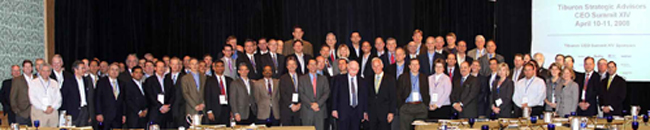
Attendees at Tiburon's CEO Summit XIV held April 10-11, 2008 in New York, NYOpening Keynote Presentation:
Chip Roame (Managing Partner, Tiburon Strategic Advisors)
Tiburon CEO Summit Vision
Mr. Roame first gave a brief overview of the vision surrounding the Tiburon CEO Summits, and thanked the Tiburon CEO Summit planning committee members, Tiburon CEO Summit XIV guest speakers, and Tiburon CEO Summit XIV sponsors:
- Tiburon's CEO Summits were created in 2001 after Mr. Roame noted the lack of CEO-level interaction across traditional industry lines, and yet saw the consistency of issues being addressed by these same executives
- Tiburon's CEO Summits have evolved from a just a handful of industry colleagues meeting in Tiburon to 125+ CEO-level Tiburon clients (and 25 additional media representatives) attending two day conferences at the Ritz Carlton Hotel in San Francisco, CA and New York, NY
- Mr. Roame reiterated the two themes of all Tiburon CEO Summits - Challenging Conventional Wisdom and Maintaining a Consumer Orientation
- Mr. Roame thanked the CEO Summit planning committee members (Tim Armour, Dennis Clark, Tif Joyce, Tom Lydon, Scott MacKillop, Kevin Malone, Kirk Michie, Skip Schweiss, and Gib Watson) for their support in securing guest speakers, securing sponsors, nominating attendees, and acting as facilitators
- Mr. Roame then thanked the nine terrific guest speakers, including Walt Bettinger (President, The Charles Schwab Corporation), Mike Byrum (President, Rydex Investments), Joe Deitch (CEO, Commonwealth Financial Network), John Hailer (CEO, Natixis Global Advisors), Joe Moglia (CEO, TD Ameritrade), John Murphy (CEO, Oppenheimer Funds), Bob Pozen (Chairman, MFS Investment Management), Ron Ryan (CEO, Ryan ALM), & Michael Steinhardt (Chairman, Wisdom Tree Investments)
- Mr. Roame also thanked the Tiburon CEO Summit XIV sponsors, including Advanced Equities Financial Corporation, Dunham & Associates, Envestnet Asset Management, Fidelity Investments (National Financial), Fiserv (Check Free), Forward Management (ReFlow), Genworth Financial (Asset Mark), Global Bridge, Jefferson National, LPL Financial Services, State Street Corporation (State Street Global Advisors), Sun Star, TD Ameritrade, The Bank of New York Mellon Corporation (Pershing), & The Charles Schwab Corporation whose financial support allow the CEO Summits to be held at the Ritz Carlton Hotel and attendance to be open to 125 CEOs
State of the Financial Services Industry
Mr. Roame then laid out a synopsis of the past six months' most newsworthy events and most insightful Tiburon research findings, outlining his expectations for the state of the financial services industry over the coming years, as consumers liquefy their assets but the competitive playing field gets more heated. He focused his comments on the key issues that would likely be addressed by the general session guest speakers, the topics that he hoped would be addressed by the general session panel discussions, and the questions that he suggested be debated in the break-out sessions:
Recap of the Semi-Annual News: Six Months of Amazing Industry News Stories
Mr. Roame started with a review of dozens of recent financial news stories, presenting related quotes from industry leaders and supporting Tiburon research for several key points:
- The most recent industry headache of sub-prime mortgages seems to be self-created, with Mr. Roame saying that "the basic premise is that the investment banks create CDOs to buy risky paper, pool those risks, and then sell those CDOs so that they can go buy more risky paper... And we are surprised when this business ultimately blows up?"
- The write-offs have been staggering, led by those at UBS, Merrill Lynch, & Citigroup, $37.1 billion, $25.1 billion, & $23.9 billion respectfully
- The sovereign wealth funds stepped in to solve many capital issues, with Singapore leading the way, taking stakes in UBS, Citigroup, Merrill Lynch, & Barclays
- Mr. Roame questioned the US government’s involvement in bailing out these companies in a capitalist system, quoting Ben Bernanke, who said that, "the damage caused by a default by Bear Stearns could have been extremely difficult to contain. We did what we did because we felt that it was necessary to sustain the viability of the American financial system"
- Individuals are also turning to others to bail them out, with Mr. Roame quoting a Bear Stearns Senior Managing Director's question to JP Morgan Chase's Jaime Dimon, "how will you make us whole?"
- Mr. Roame also quoted a Wall Street Journal reporter who brought some perspective to the size of the write-offs, questioning, "when is a good time to write off $4 billion (Deutsche Bank)? The same day that your European neighbor (UBS) writes off $19 billion!"
- While addressing the employment status of the heads of these financial service companies, Mr. Roame said, “there seemed to be a clear outcome involving CEO heads rolling until we got to HSBC and Morgan Stanley”
- Unfortunately, Tiburon's belief is that huge industry write-offs are going to continue to happen. Mr. Roame asked, what is unclear about the outcomes that will result from the compensation system? We have a system that incents us to take huge risks!
- Stepping back, Mr. Roame argued that the bigger public policy issue here is the threat to baby boomers' ability to retire; lost real estate equity, over 10% since 2006, will challenge the pending liquefaction and baby boomers' ability to retire
- And on the regulatory front, the skeptics are not so sure that the power should go to the Federal Reserve, Mr. Roame quoted Senate Banking Committee Chairman Chris Dodd, who said that, "it is like giving a bigger shovel to the guy who dug the hole"
Fundamental Industry Trends: Reinforcing Tiburon Research Findings
Mr. Roame then brought the attention of the audience away from the short-term news noise and back to the long-term fundamental industry trends, presenting some high-level Tiburon research findings:
Key Driving Factors
- US households control almost three-quarters of all investable assets, more than half invested via financial advisors
- Three-quarters of baby boomers over the age of 55 have less than $100,000 in investable assets and the consumer households' savings rate continues to hit new all time lows
- Baby boomers have not saved in the traditional way, with many assuming they would liquefy the equity in their houses, but declining house values may now challenge this strategy
- The median value of baby boomers' inheritance is only $48,000; very few receive more than $100,000
- The savings crisis is further driven by the risk of baby boomers living too long, with estimates that more than half of 65 year olds will reach age 85 and over one-third will reach 90; amongst 65 year old couples, there is a 50% chance that one (or both) will live another twenty-five years
- Consumer households have almost $23 trillion of investable assets, $35 trillion of financial assets, and $70 trillion of total assets, with an important distinction between the high dollar average and the much lower median amounts
- Hence, the solution to the perceived savings crisis will be baby boomers' liquefaction of their retirement plan assets, personal assets, and other illiquid assets, such as the rollover of 401k plan balances, the sale of houses, and the sale of private businesses
Products & Services
- Mutual funds are the dominant investment product ($10.8 trillion assets) and are used heavily by both the fast growing independent rep and fee-only financial advisor markets (39% & 61% of assets respectively) suggesting that mutual funds aren't going away, even if much of the reporting and media focus is on other products, including exchange traded funds, separately managed accounts, and hedge funds. Mr. Roame called attention to the facts ($10.8 trillion in mutual funds versus ETFs at $608 billion & separately managed accounts at $720 billion (collectively $1.3 trillion)), encouraging the group to maintain perspective
- There is some trend to packaged solutions; for instance, target date mutual funds have quickly gathered over $150 billion (although Mr. Roame cautioned that it appears that consumers are misusing these funds, mixing them into portfolios containing other funds, hence altering their overall asset allocation)
- Packaged fee-account assets have grown substantially over the past eight years to over $1.5 trillion
- More broadly, the investment process is being polarized with twin growth patterns in both market-linked products and alternative investments. Mr. Roame argued that exchange traded funds may be the fundamentally most important product invention since the mutual fund in 1940, and hypothesized that they may ultimately shift many financial advisors' role to that of managing a series of index products and focusing excess time on delivering a broader set of wealth management services. US hedge funds assets under management have grown significantly to almost $2 trillion but have remained steady since 2006
- Mr. Roame argued that investments may matter less than wealth management services as baby boomers move from the liquefaction & retirement income challenge years into either their health care & retirement income challenge years (for the less affluent) or their estate planning & charitable giving distribution years (for the more affluent)
Markets & Distribution Channels
- Close to 400,000 financial advisors are in the market, including about equal numbers of wirehouse & other employee brokers (92,000), life & property & casualty insurance agents (87,000), bank brokers & trust officers (82,000), and independent reps (also 82,000)
- Wirehouse and retail banks continue to dominate control of consumer investable assets (31% and 27% respectfully) but independent advisors continue to outgrow the competition (18% assets growth rate for fee-only financial advisors and 14% for independent reps)
- Fidelity Investments recently surpassed Merrill Lynch as the largest financial services firm when ranked by client assets, and Schwab will also surpass Merrill Lynch at current growth rates in the next year, further evidencing the growth in new channels (discount brokerage, fee-only financial advisors, and independent reps)
- Mr. Roame also pointed to an important international trend for product companies, noting that non-US mutual funds assets under management have surpassed those of US mutual funds
Financial Advisor Tactical Issues
- On a more tactical level, Mr. Roame noted it is worth understanding the model of the largest independent financial advisor, Fisher Investments, with over $43 billion assets under management: nearly everything that Fisher Investments does (eg, marketing, staffing, compensation, etc) is outside of the norm
- As competition heats up, Mr. Roame said that the game will increasingly be won through marketing. Mr. Roame argued that client retention and consolidation is now more critical as baby boomers liquefy their wealth
- Returning to his case example, Mr. Roame noted that Fisher Investments is not only the largest but also the fastest growing independent financial advisor, utilizing a well refined direct mail machine as well as other substantial marketing efforts to gather assets and spending over $50 million per year on advertising, but with a 97% retention rate Fisher Investments also doesn't lose the assets collected
Strategic Conclusions
- Institutional level mergers & acquisitions were booming but have slowed dramatically in 2008 due to the credit crisis
- There is also a substantial bifurcation happening in all businesses (e.g., banking, brokerage, mutual funds), with Mr. Roame utilizing the asset management business as an example, where a handful of firms (e.g. American Funds, Vanguard, Fidelity Investments) exceed $1 trillion assets under management, but 84% of all mutual fund companies manage less than $10 billion
- Mr. Roame noted that several companies have utilized target marketing to successfully grow their companies, including Hanson McClain Retirement Network, CMS Companies, & Clearly Gull at a financial advisor level, and both Rydex and DFA at the institutional level
- Finally Mr. Roame cautioned all of the CEO attendees that in order to keep a proper perspective it is important to not confuse high growth percentages with dollar growth rates. The fastest growing products and channels may get the most news but it is all relative to the dollar amount from which they are starting. For instance he pointed out that in dollar terms full-service brokers are outgrowing fee-based financial advisors and mutual funds are outgrowing separately managed accounts
Tiburon Strategic Advisors
After concluding his opening remarks on the State of the Industry, Mr. Roame took a few minutes to discuss Tiburon. In updating the group of clients on Tiburon's activities, Mr. Roame noted that:
- Tiburon has positioned itself uniquely as a research based strategy consulting firm for financial services firms
- Tiburon manages its research in terms of Power Point pages created and added to it's expanding library of knowledge, including mutual funds distribution, separately managed account programs, alternative investments, wealth management services, insurance products, banking services, the fee-only financial advisor market, the CPA firm market, the family office market, and various international markets
- Tiburon manages its research in terms of Power Point pages created and added to it's expanding library of knowledge, including mutual funds distribution, separately managed account programs, alternative investments, wealth management services, insurance products, banking services, the fee-only financial advisor market, the CPA firm market, the family office market, and various international markets
- Mr. Roame suggested that all clients buy its Research Report RetainerTiburon's core business market research & strategy consulting services. The firm executes projects from a top down perspective, working closely with its clients top executives
- While only serving financial services clients, Tiburon's clients also include technology companies that serve financial services companies, other consulting firms in need of financial services industry research, venture capital & private equity firms investing in financial services companies, and governments, trade groups, & conference companies. Mr. Roame presents at dozens of board meetings each year
- Tiburon delivers its research & strategy consulting services in three primary ways, including its popular research reports & research report retainer program, one day market seminars & conference speeches, and its core service in customized market research & strategy consulting projects
- While only serving financial services clients, Tiburon's clients also include technology companies that serve financial services companies, other consulting firms in need of financial services industry research, venture capital & private equity firms investing in financial services companies, and governments, trade groups, & conference companies. Mr. Roame presents at dozens of board meetings each year
Tiburon CEO Summit XIV - Schedule & Tactics
After offering up that broad synopsis and introduction to Tiburon's client services, Mr. Roame introduced the nine guest speakers grouped into three sections, including Public Policy, Products, & Management. Mr. Roame then gave a brief overview of what he expected each speaker would address:
 Public Policy
- Walt Bettinger (President, The Charles Schwab Corporation) will address the dramatic evolution around the responsibility of making financial decisions transferring from large institutions to individuals and the implications for the industry. More specifically, what the responsibilities are within the industry to help individuals, especially in the second through fourth quartile
- John Murphy (CEO, Oppenheimer Funds) will address how traditional mutual fund companies compete in an increasingly global market
- Bob Pozen (Chairman, MFS Investment Management) will address several issues surrounding sovereign wealth funds, including the source & size of sovereign wealth funds, their impact on capital markets, security & political concerns, disclosure & stability concerns, and protectionism & reciprocity
- Ron Ryan (CEO, Ryan ALM) will address the pension crisis and the need to align assets to specific liabilities. Mr. Ryan will also discuss portable alpha and the proper LDI strategy and cover liability beta & liability alpha
Products
- Mike Byrum (President, Rydex Investments), will address the evolution of Rydex and the collective competencies with Security Benefit Group. Mr. Byrum will also address Rydex's forward looking perspective and solving the retirement income challenge
- Michael Steinhardt (Chairman, Wisdom Tree Investments) will address both the history and current state of the hedge fund industry. He will also discuss his career and why he closed his firm in 1995 and why he later accepted the chairman position at Wisdom Tree Investments
Management
- Joe Deitch (CEO, Commonwealth Financial Network) will address keys to successful management, specifically theory versus practice
- John Hailer (CEO, Natixis Global Associates) will address global opportunities through deeper partnerships and innovative products. He will also review the rethinking of business models with a look at organizing towards innovation
- Joe Moglia (CEO, TD Ameritrade) will address the impact of several key industry trends, including the growth of discount brokerage, the emergence of independent financial advisors, and the importance of capturing IRA rollovers. Mr. Moglia will also address TD Ameritrade's commitment to improving technology and operations and enhancing customer service
Aside from Mr. Roame's opening keynote presentation, nine guest presentations anchored the CEO Summit agenda:
Walt Bettinger
(President, The Charles Schwab Corporation)
 Walt Bettinger is President of The Charles Schwab Corporation and oversees the strategy, development, & delivery of a full range of brokerage, investment, & banking services to Schwab's primary business units, including Schwab Investor Services, Schwab Institutional, Schwab Corporate & Retirement Services, and Schwab Investor Development. He leads the company's domestic and international field branch network with primary offices in more than 300 locations and also has ultimate responsibility for client service centers in Orlando, Cleveland, Indianapolis, Denver, Phoenix, Austin, Reno, & San Francisco. He also has responsibility for support services, including all operations and technology capabilities within the firm, supporting 7.0 million client brokerage accounts, 5,000 independent financial advisors, and thousands of corporate retirement plans, representing $1.5 trillion in client assets.
After an introduction by Chip Roame (Managing Partner, Tiburon Strategic Advisors), Mr. Bettinger addressed the dramatic evolution around the transfer of financial decision making responsibility from large institutions to individuals, and the implications for the industry. Mr. Bettinger made the following points:
- Mr. Bettinger outlined several financial challenges, including evaporating traditional pensions, projected social security & medicare bankruptcies, rising health care costs, decreasing personal savings rates, & expanding retirement years, all leading to a retirement income challenge especially for the lower quartiles of the population
- Mr. Bettinger next addressed potential for improving financial fitness. Mr. Bettinger started by dismissing some potential answers, including the internet, annuities, and government intervention. Mr. Bettinger stated that, “technology will play a role as tool, not as a solution; we still need counsel and have people-to-people interactions”
- John Cammack (Head, Third-Party Distribution, T. Rowe Price Group) asked how he envisioned getting a low cost 401k plan to retail. Mr. Bettinger responded that the government could boost participation a little but answer needs to come from this room as businesses need to develop new creative models to server all quartiles
- Mr. Bettinger talked about how The Charles Schwab Corporation has succeeded with its client focus saying that, “if your business isn’t about people, you won’t succeed in business. We run for-profit companies but we have to do it with people as a priority. Asking how much money can I make is not what has made me successful and that’s not why I got into the business.” The Charles Schwab Corporation goes further down stream than many companies but they need to find ways to go even further
- Mr. Bettinger then led a discussion on financial literacy. Steve Deschenes (Chief Marketing Officer, Retirement Income Group, Mass Mutual Financial Group) stated that, “financial literacy is low, with the average household having more debt than assets and these households are not going to become clients.” Mr. Bettinger responded that financial literacy needs to be part of the core curriculum at a young age to help future clients stay out of debt
- Mr. Bettinger ended by answering a question from Viggy Mokkarala (Executive Vice President, Envestnet Asset Management), who asked about tangible steps that the industry should take, saying that, “initial steps are being taken right now in talking about it at the Tiburon CEO Summit instead of discussing other topics”
 Mike Byrum is President of Rydex Investments and oversees the firm's portfolio management, research, and trading. Mr. Byrum is also the chairman of the Rydex Investment Strategy Committee, which determines investment policy for all Rydex products. Mr. Byrum oversees all Rydex business lines, including mutual funds, exchange traded funds, and the firm's broker/dealer, Rydex Financial Services. In addition, he is instrumental in product development and management across the firm. Mr. Byrum leads the alternatives strategies development team at Rydex, which seeks to conceptualize and shape new alternative strategy products to maintain Rydex’s position as an industry innovator.
After an introduction by Chip Roame (Managing Partner, Tiburon Strategic Advisors), Mr. Byrum addressed the evolution of Rydex and the collective competencies within its parent Security Benefit Group. Mr. Byrum also addressed Rydex's forward looking perspective. He made the following points:
- Mr. Byrum started by offering a background of Rydex, saying that, “Rydex was built on the need by fee-only investment advisors who had tactical allocation models and were not welcome by conventional mutual funds." It created index based mutual funds that offered and encouraged daily liquidity. Mr. Byrum also outlined Rydex’s value proposition of, “providing institutional-style investment strategies to individual investors by marrying the investment characteristics of institutional portfolios with the structural benefits of registered products”
- He then addressed Rydex’ recent focus on alternative investment strategies, discussing how education on this area and getting investors to understand the benefits are the biggest challenges. Mr. Byrum then added that, “Rydex is on the front-end of this new movement. Traditional asset allocation is no longer acceptable. Lower correlated asset strategies need to be added to help increase returns and lower risk; conventional markets may not be offering as much opportunity in the coming years as they have in the past”
- Mr. Byrum discussed that alternative investments are perceived to be risky but the fact is they really are intended to balance risk in individuals' portfolios. Part of misconception is that the benefit of including alternative investments in a portfolio was masked in the 1990s but has become more apparent in recent years
- Mr. Byrum concluded his remarks by saying that, “yesterday we talked about financial literacy at the level of balancing a check book & managing credit card debt and we’re here now talking about alternative investments, so there is a significant mismatch there”
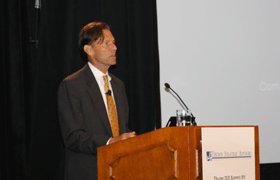 Joe Deitch is the CEO of Commonwealth Financial Network, which he founded in 1979 to create an open and supportive environment where professionals could be true to themselves (and to their clients), follow their dreams, and grow to their hearts' content. Mr. Deitch has strived to maintain the original vision of providing indispensable service and cultivating a supportive environment where all affiliated professionals can thrive.
After an introduction by Chip Roame (Managing Partner, Tiburon Strategic Advisors), Mr. Deitch addressed keys to successful management, specifically theory versus practice. He made the following points:
- Mr. Deitch focused his remarks on success: theory versus practice and bringing that success to all aspects of your life. He asked the attendees, “how many of you have mission statements in your marriage?” Mr. Deitch emphasized the importance of a consistent approach and passion to both your business and personal life
- Mr. Deitch then discussed how to fully utilize the resources we have, including our brains. He stated that a computer operates at 27,000 MIPS and the human brain operates at 100 million MIPS adding that, “our brain is constantly on – take control!”
- Mr. Deitch next addressed recruiting strategies and the importance on hiring the right people and realizing how detrimental a bad team member can be to the overall company’s goals. Mr. Deitch said that, “Commonwealth’s hiring strategy is to have clear job descriptions by profiling both the job and the department first then profiling the candidates to find the right match”
- Mr. Deitch next addressed learning from the masters and seeking expert advice, saying that “professional athletes all have coaches – many having multiple coaches to improve performance, and that business executives should also seek out coaches as business can be the greatest sport of all.” Mr. Deitch also shared a Deitch family secret of, “celebrating bad service – as it makes you look great by comparison”
- Anne Steer (Executive Vice President, Relationship Management, National Financial Services Corporation) asked, “how has your strategy evolved over the years?” Mr. Deitch responded that, “Commonwealth has maintained the same vision and that now it is easier for him to let people go as the fit needs to be right for the employer and the employee and they would be a star at a different company”
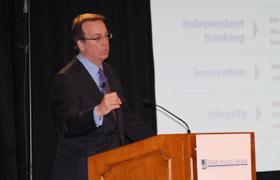 Mr. Hailer is the CEO of Natixis Global Associates and is responsible for the overall strategic development of the firm’s investment management and distribution businesses. Mr. Hailer works to create and leverage synergies, between the investment management and distribution arms of the organization. Mr. Hailer has been recognized for his leadership within the company. He manages the company’s assets and assists in building distribution architecture that provides access to the investment capabilities of the firm's affiliated managers across a range of investment platforms.
After an introduction by Tif Joyce (President, Joyce Financial Management), Mr. Hailer addressed global opportunities through deeper partnerships and innovative products. He also reviewed the rethinking of business models with a look at organizing towards innovation. He made the following points:
- Mr. Hailer started his presentation by discussing the opportunities and growth rates of international markets identifying the US, UK, France, & Japan as the more mature markets saying that, “we will participate in mature markets and innovate and participate in new markets”
- Mr. Hailer said that clients still look to the US saying that, “our clients in the middle east look to the US as the top flight asset manager” but cautioned that you can’t go into new markets with an American centric attitude and that you need local people to be successful
- Mr. Hailer next discussed how Natixis plans to stay relevant in the industry through innovation, saying that through their, “multi-manager structure, they stay innovative and nimble to stay relevant in all market places." Mr. Hailer emphasized the Tiburon CEO Summit theme of consumer orientation saying that, "our asset management ideas come from our clients and talking to them about solutions, not products”
- Mr. Hailer next discussed the difference between multi-national companies and global companies, and how Natixis has been able to leverage its global advantage, citing an example of delivering innovative solutions from Oakland to Taipei through Singapore
- Mr. Hailer summarized Natixis’ acquisition strategy by saying that, “we want to have partners; you can't be all things to all people but we make sure there's a personal fit; we don't acquire just for the assets; our goal to go deeper with existing relationships"
 Joe Moglia is CEO of TD Ameritrade, a role which he assumed in 2001. He subsequently has acquired numerous other discount brokerage firms and fought off a hostile takeover attempt by E*Trade, choosing instead to merge with TD Waterhouse in 2006. Mr. Moglia is responsible for TD Ameritrade's 150 branches, 6.3 million client accounts, over 300,000 daily trades, and $300 billion in client assets.
After an introduction by Skip Schweiss (Chief Operating Officer, TD Ameritrade Trust Company, TD Ameritrade), Mr. Moglia addressed the impact of several key industry trends, TD Ameritrade's acquisition strategy, three key priorities, and keys to leadership. He made the following points:
- Mr. Moglia started with an overview of the TD Ameritrade’s business, telling the story of how when he took over as CEO of TD Ameritrade in 2001, he asked the management team about the firm’s core competencies. They decided they were good at equity trading and that this should lead them into the active trader space
- At the same time (post-9/11) there was significant excess capacity in the brokerage industry. TD Ameritrade subsequently did nine acquisitions to absorb some of that capacity. The firm is now focused on becoming an asset gatherer rather than a trader. Bolstering this strategy is the recent acquisition of Fiserv’s custody division which gives the firm greater scale in the RIA market and a foothold in the 401(k) market
- Mr. Moglia offered the following comparisons from 2001 to 2007 he said that TD Ameritrades trades per day in 2001 were 113,000 and in 2007 reached 322,000, its client assets under management grew from $24 billion in 2001 to $300 billion in 2007, its market cap grew from $700 million in 2001 to $12 billion in 2007, and from a negative ROE in 2001 to 40% in 2007
- Mr. Moglia next identified TD Ameritrade’s three key priorities: clients, shareholders, and associates (employees). He said that the firm builds everything around these three key constituencies, saying that, “I believe we have a moral and in effect a fiduciary obligation to help our clients reach their financial goals,” reflecting on the Tiburon CEO Summits’ consumer orientation theme. In the RIA market, TD Ameritrade supports financial advisors' growth; if the RIA grows his/her business, then TD Ameritrade will be successful as well
- Mr. Moglia then addressed what he identified as key leadership attributes:
- Know yourself – “know what you’re good at, what you’re not; your strengths and weaknesses, what makes you tick:
- Passion - “do what you love, love what you do; do what you really care about, where you know you can make a difference - otherwise all you have is a job”
- Courage – “having the guts to do what you really believe is right, regardless of short-term consequences to yourself”
- Stress – “this is where the cream rises to the top; your employees will look to you for strength and guidance during times of stress”
- Ego – “leave it at the door; make decisions in the best interest of the firm, not just implementing your great ideas”
- Know yourself – “know what you’re good at, what you’re not; your strengths and weaknesses, what makes you tick:
- He ended by saying that, “leadership is about caring for others around you and the real job of a leader is to always have their best interests at heart”
John Murphy (CEO, Oppenheimer Funds)
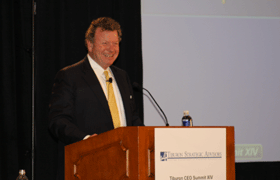 John Murphy is the CEO of Oppenheimer Funds, a role he assumed in 2000, overseeing more than $260 billion across multiple investment strategies. Mr. Murphy is responsible for overseeing the growth of the company beyond traditional mutual funds, and expanding the company’s product & service offerings with the acquisitions provided by Tremont Capital Management. In addition, Mr. Murphy oversees the company’s attempt to bring hedge funds to retail investors.
After an introduction by Chip Roame (Managing Partner, Tiburon Strategic Advisors), Mr. Murphy addressed how traditional mutual fund companies compete in an increasingly global market. He made the following points:
- Mr. Murphy started with a brief overview of Oppenheimer funds and its $250 billion in assets under management focused in retail mutual funds, separately managed account, hedge funds-of-funds, 529 plan accounts, qualified retirement plans, institutional investment management and sub-advisory services, serviced by approximately 2,600 employees
- Mr. Murphy next gave an update on the US mutual fund industry, quoting data from the Investment Company Institute showing the US mutual fund industry at $13 trillion - growing almost 100% since 2002 and representing about 25% of US consumer wealth
- Mr. Murphy then addressed the US mutual fund industry’s need to compete on the global stage. US market penetration seems to have leveled off with about 43% of US households (or 51 million) owning mutual funds with about 91 million individual shareholders. Even with this US penetration, US mutual fund companies hold less than half of global mutual fund assets and growth rates of mutual fund assets in Luxembourg and Ireland (domiciles for UCITS) have outpaced US growth in recent years. Further, mutual funds are owned by only 6%-8% of households in Asia and assets there could expand from $3.5 billion as of Q3 2007 to $6-$8 billion over the next five years
- US mutual fund companies face barriers to selling US mutual funds outside the US due to unfavorable tax treatment relative to UCITS. That is, US funds are required to distribute income and capital gains annually while UCITS have no similar distribution requirement. Further, US funds are required to be organized as complex corporations that separate the investment advisor from the mutual fund company, while UCITS have a choice as to their organizational structure
- Mr. Murphy concluded by saying that, "the time is right now to strike and we should make our congressmen and senators aware of the situation." Skip Schweiss (Chief Operating Officer, TD Ameritrade Trust Company, TD Ameritrade) cautioned that, “the Growth Act may be politically difficult given that we have a lame duck president in an election year and a Democratic controlled House of Representatives and Senate that favor taxation, protectionism, & more regulation. Given politicians’ focus on the size of the US deficit, and Democrats’ inclination to repeal the Bush tax cuts and to further raise taxes, and in light of the fact that mutual funds raise significant tax revenue with the current tax laws, improving the tax treatment on US mutual funds appears unlikely”
Bob Pozen (Chairman, MFS Investment Management)
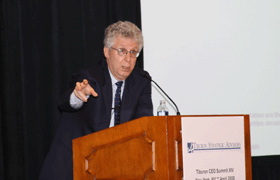 Bob Pozen is the chairman of MFS Investment Management which established the first mutual fund in the US in 1924. Today, MFS Investment Management, a subsidiary of Sun Life Financial of Canada, has more than $169 billion in assets under management, offering a wide range of products and services to investors, including more than 70 mutual funds, fixed & variable annuities, separately managed accounts, & retirement plans to retail customers, institutional investors, & insurance offerings. The firm has 15 offices worldwide, 2,400 employees, and more than five million shareholders.
After an introduction by Chip Roame (Managing Partner, Tiburon Strategic Advisors), Mr. Pozen addressed several issues surrounding sovereign wealth funds, including the source & size of sovereign wealth funds, their impact on capital markets, security & political concerns, disclosure & stability concerns, and protectionism & reciprocity. He made the following points:
- Mr. Pozen started his presentation with some background information on size & source of sovereign wealth funds, sharing from a McKinsey report that two-thirds of sovereign wealth funds assets are built on petrodollar or oil wealth with these nations seeking to diversify their assets away from the concentration on oil (primarily Middle East). Two other sources of sovereign wealth funds assets are trade surpluses (primarily Asia) and pension contributions (Asia & Australia)
- Mr. Pozen addressed the flow of sovereign wealth funds showing Asia - excluding China- as the leading source with 55% followed by the Middle East with 32% and China with 13%. The US at 37% is the leading destination of sovereign wealth funds followed closely by Europe at 35%, China at 21%, and Asia at 7%
- Mr. Pozen then addressed the impact of sovereign wealth funds in the US and international financial markets. He noted that Merrill Lynch, Citigroup, and UBS have all recently been capitalized by sovereign wealth funds
- Mr. Pozen then addressed security and political concerns with public opinion on sovereign wealth funds in the US decidedly negative - even among those who profess to know little about them. Mr. Pozen countered that sovereign wealth funds' investments tend not to be subject to many of the prevailing concerns about them stating that there are already many restrictions on foreign ownership of US companies, particularly in the crucial transportation, banking, and communications & broadcasting industries
- Mr. Pozen also challenged concerns about stability & disclosure with sovereign wealth funds, stating that sovereign wealth funds usually have long term investment horizons so they are not under liquidity pressure and that and there are US reporting mandates on all investors (e.g., 5% owners) regardless of source
Ron Ryan (CEO, Ryan ALM)
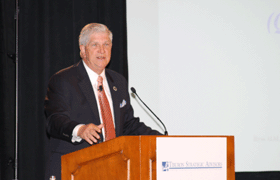 Mr. Ryan is the CEO and founder of Ryan ALM, which is focused on solving asset/liability problems through a disciplined structured systems, including custom liability indexes, liability beta portfolio, & portable alpha (liability hedge fund). Mr. Ryan is responsible for overseeing and analyzing the Treasury’s and developing indexes specific to them. Mr. Ryan is the creator of the first daily fixed-income indexes; the Lehman US Treasury indexes.
After an introduction by Chip Roame (Managing Partner, Tiburon Strategic Advisors), Ron addressed the pension crisis and the need to align assets to specific liabilities. Mr. Ryan also discussed portable alpha and the proper LDI strategy and cover liability beta & liability alpha. He made the following points:
- Mr. Ryan started by defining the correct pension plans' objectives as “a game of costs not a game of returns” and that the main problem is that pensions need to be liability driven
- Mr. Ryan stated that the real reason we have a pension crisis is that interest rates have been declining since 1982 and liabilities have been rising. The US simply cannot afford a healthcare and a pension crisis simultaneously. Over 4,000 corporations have gone bankrupt due to pensions, and the Pension Benefit Guaranty Corporation funds the obligations with the expense born by the US taxpayers. According to the Pension Protection Act of 2006, corporations have seven years to make up their liabilities or face a big problem. Thus the name of the game is for pensions to beat their liabilities by 1-2-3% per year – not to earn a 6% or a 9% alpha
- Other problems relate to inaccurate liability valuations and the use of generic indices. For performance measurement purposes, there can be no generic index that behaves like an institution’s specific liabilities. Given the wrong index, you get the wrong risk-reward characteristics of the portfolio
- Mr. Ryan went on to say that, “a much better measure of risk (better than the Sharpe Ratio which is based on the 3-month T-Bill for example) is to use the information ratio which is a measure of how the assets behave versus the objective which is usually a liability for most institutions”
- Thus it is critical that the asset allocations for pension plans be liability driven and/or more tactical in nature. That is, as the funded ratio improves, the pension plans may adjust the asset allocations to become more conservative and “take some chips off the table.” Similarly, as funded ratios decline, asset allocations should adjusted to become more aggressive to improve the rate of return and the ability to meet the plan’s liabilities
- Mr. Ryan also pointed out that if you ask any corporation to define their biggest asset, they will inevitably reply that it’s their pension plan. If you ask any corporation to define their biggest liability, they will inevitably reply that it’s their pension plan. And yet, the pension plan director is typically missing from the corporation’s board of directors
Michael Steinhardt (Chairman, Wisdom Tree Investments)
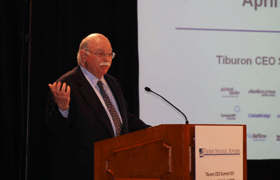 Mr. Steinhardt is the Chairman of Wisdom Tree Investments, which offers dividend and earnings-based index funds rather than traditional index funds based on market capitalization. Prior to joining Wisdom Tree Investments, Mr. Steinhardt founded Steinhardt, Fine, Berkowitz, & Company in 1967. Steinhardt, Fine, Berkowitz & Company achieved a performance track record that still stands out on Wall Street: 24% compound average annual returns – more than double the S&P 500 – over a 28 year period, accomplished through short-term strategic trading, including stocks, bonds, long & short options, currencies, all with time horizons ranging from 30 minutes to 30 days.
After an introduction by Kevin Malone (President, Greenrock Research), Mr. Steinhardt addressed his views on the state of the hedge funds industry as well as how and why he started his hedge fund and how and why he eventually closed it. Mr. Steinhardt also discussed his involvement with Wisdom Tree Investments. He made the following points:
- Mr. Steinhardt started by giving a history of how and why he started his hedge fund saying that, “the hedge fund industry is the best paid industry bar none, better than star athletes, better than entertainers.” Mr. Steinhardt also addressed why he decided to close his firm in 1995 stating that, “he found the lows lower and the highs less exciting and he was not able to separate self from performance returns." He added that, “you don’t remember the good trades – you only remember the bad ones”
- Mr. Steinhardt next addressed the current economic state - suggesting the country, economy, the financial industry and most individuals are too highly leveraged. He suggested that we are likely in a recession, but we should think about the possibility that we could be in for something worse as the country as a whole has never before been this leveraged, magnifying results both positive and negative. Mr. Steinhardt looked at the ratings agencies as one area of improvement saying that, “a good loan is a good loan until it becomes a bad loan”
- Mr. Steinhardt went on to discuss changes in the hedge funds industry. He started by saying that, in the 1980s the hedge funds industry was, “smaller counter culture that offered nirvana for people who wanted to be entrepreneurs” and that they were measured only in performance. In answering a question about the lost art of stock picking by Bryce James (CEO, Smart Portfolios), Mr. Steinhardt answered that, “there is still an army of stock pickers but they are being drowned by huge companies as they need mobility so it isn’t working with where the stock pickers are going”
- Steve Deschenes (Chief Marketing Officer, Retirement Income Group, Mass Mutual Financial Group) asked about moral hazard and if the hedge fund industry compensation plan encourages hedge fund managers to swing for the fences. Mr. Steinhardt replied that, “with 2 and 20 you should make enough to not swing for the fences and that when people had nothing to lose they usually lost. Mr. Steinhardt also noted that the industry has changed with much bigger hedge funds and that 1% of $8 billion is a good revenue line. He also noted that there has been a shift to larger institutional clients who are more accepting of moderate returns and a stable market while previously hedge fund managers wanted market volatility because, “you were smarter than the other guy”
- John Rooney (Managing Partner, Commonwealth Financial Network) asked if the hedge fund industry needed more regulation, to which Mr. Steinhardt replied that, “the market operates with extraordinary liquidity so current regulation seems sufficient”
- Mr. Steinhardt concluded by describing his efforts at Wisdom Tree, a fundamental ETF firm with $4.5 billion in assets. While describing the difference between his hedge fund and Wisdom Tree he said that, “the hedge fund started with $7 million and was profitable on day one. But with Wisdom Tree he has been here for three years and is not yet profitable” Mr. Steinhardt went on to say that, “believes the low cost annual dividend or earnings weightings of the Wisdom Tree ETFs will get about average rates of return” and that he is excited about this relatively new way to participate in the market allowing retail investors to manage money for themselves
General Session Panel Discussions
One of the key themes of every Tiburon CEO Summit is the need to more closely listen to clients. Tiburon CEO Summits' general session panel discussions (Ask the Consumers, Ask the Advisors, & Ask the Distributors) all allow Tiburon CEO-level clients to hear directly from their constituents in an unvarnished way. This is in sharp contrast to most CEOs' daily activities, where they are forced to rely on interpreting marketing data or listening to anecdotal stories from their sales forces. Addressing these clients first-hand through questions & answers helps Tiburon clients further consider innovative ideas for serving these different client groups.
Ask the Consumers
As has become the tradition at Tiburon CEO Summits, four real and unscripted consumers (Kevin, Joe, Jen, & Larry) were interviewed by facilitator Tif Joyce (President, Joyce Financial Management) for the Ask the Consumers panel. The panel included 3 panelists in their 30s- 40s and one retiree. Kevin is a soon to be married fundraiser for a major Ivy league university. Joe is in his 40s and heads a small manufacturing business. Jen, is in her 30s and mother of two, heads up her own successful public relations firm. Larry is a semi-retired professional in his 50s who has worn many hats in his life and is a quintessential do-it-yourselfer looking for more help. While each provided a unique point of view, a number of common views were shared:
- They were uniformly unimpressed with the amount and quality of service provided. Key weaknesses were, lack of proactive contact, poor communication, & lack of follow-up. For the younger professional group, a common complaint was that they felt their advisors were not paying attention to them despite having relationship balances of $100,000 to $250,000
- common feeling related to value provided was expecting a fairly customized approach from their financial advisors, tailored to their individual circumstances. Kevin said that, "I felt that I instead experienced a cookie-cutter approach from my financial advisor who was always pushing the currently featured product"
- Jen had a similarly poor experience with a Met Life representative who sold her several load funds but would not answer her questions about the strategy. She said that, "everything they said to me was a big product push"
- The consumers selected their current financial advisors in several ways; Kevin sought referrals from friends who are with several firms but none felt comfortable enough to recommend their specific financial advisors; so he went with UBS because no one he spoke to utilized them and they had won some awards discovered in a google search. Jen selected a financial advisor whom she worked with over the years as a client of her public relations firm. The trust and comfort she felt outweighed her hesitation to open her books completely to a client and his/her judgment, "if she wanted to buy a pair of $600 shoes"
- After years of handling his own investments and a recent losing streak, one panelist was looking for a financial advisor who had the time to do the needed research but was wary of financial advisors not aligning their actions with his goals & objectives
- None felt that they have the time for proper due diligence to seek out the appropriate financial advisor and were still with their current financial advisors out of inertia rather than satisfaction. Joe said that, "unfortunately, it takes a financial catastrophe to switch providers"
- Expectations from the group were clear and high. Jen described her desire for a dream team approach in which her accountant, advisor/broker, lawyer, and insurance agent were integrated in their efforts and communications
- All panelists felt that contact was reactionary rather than proactive. This was especially salient for the panelists because they are heavy technology users who use and expect email and phone outreach in their own businesses but do not see it from their financial advisors. Jen commented that, "if I treated my clients the way my financial advisor does, I would be out of business!"
- The younger panelists admitted to watching investments with daily frequency given the ready access to pricing information provided by highspeed internet and wireless technology
- Looking to the future, panelists will build retirements with someone they trust. That does not seem to include their current providers. Even Larry, the do-it-yourselfer, admitted that as he faces retirement, he needs helpful investment advice. But he cautioned that, "he has the time and interest to look closely over his financial advisor's shoulder to make sure things are being done correctly"
- Jen said that financial advisors need to pay attention to young business owners now stating, "pay attention to me now and maybe we'll go some place together"
- All panelists felt that they are willing to pay more for outsized performance for at least a part of their portfolios. Accordingly, fee sensitivity was not an issue for any of the panelists as long as returns were competitive
- The last item addressed by panelists was children and it was agreed across the board that, "kids are really expensive!" and even with timely planning, miscalculations are made. Joe complimented Ameriprise Financial for its goal defining tools, solid checklists, but projected his college tuition needs at $37,000 - significantly less than the $52,000 per year he is now paying
The panel was extremely frank and the net impression was that no provider is doing an impressive job serving such clients satisfactorily. There appears to be a huge opportunity for financial service providers to capture new relationships by providing the kind of service and experience that the panelists are seeking but have not found. The firm that does so will have an opportunity for significant disruption in the category. The attendees enjoyed the opportunity to hear direct from consumers on the Ask the Consumers panel; Tif Joyce said that, “we all need to look to the end users to direct what we do.” Tiburon's Managing Partner Chip Roame agreed, saying that, "unlike consumer goods, the financial services industry has never had a productive consumer research orientation. The objective here is to remind us all that these are our clients and they have real life needs."
Ask the Advisors
 With a similar goal to the Ask the Consumers panel, three leading financial advisors participated on the Ask the Advisors panel to allow attendees to better understand the businesses and decision-making criteria of financial advisors. Facilitated by Dennis Clark (CEO, Advisor Partners), the panelists included Kristin Doe (the leader of a Smith Barney team), Jeffrey Dunham (CEO, Dunham & Associates), & Mitch Eichen (CEO, The MDE Group). The financial advisors were selected from different backgrounds and approaches to the industry, providing wide range of perspectives. However, there was complete agreement that the investment advisory business is truly an exciting cottage industry (as noted often by Tiburon research, unlike many sectors of the economy, there is no one firm or group of companies with significant market share). Amongst the key points made by the panelists were:
- The three panelists all serve mostly individuals and have similar assets under management ranging from $0.6 billion (Smith Barney team) to $1.6 billion (The MDE Group)
- The panelists all had large average relationship sizes ranging from $0.7 million (Dunham & Associates) to $9.0 million (The MDE Group). The firms also ranged in size of operations from 4 employees (Smith Barney team) to 50 (Dunham & Associates)
- Two of the three (Dunham & Associates & The MDE Group) primarily rely on mutual funds and exchange traded funds (70% and 50% respectfully), while Kristin Doe from Smith Barney utilizes mostly individual stocks & bonds (65%)
- All three panelists’ careers and companies evolved steadily as they identified and adapted to changes in the industry and client needs
- Jeffrey Dunham started in 1983 with a love for the industry but hated the compensation structure. When he approached his boss regarding performance fees he was told, "noble idea - now get back to cold calling." He started his own RIA and hired money managers on a performance fee basis, morphing into a turnkey asset management program
- Prior to forming The MDE Group in 1987, Mitch Eichen was a senior financial counselor for The Bank of New York, providing full-service personal financial counseling, including tax and investment advice, to senior corporate executives and high net worth individuals. When he left he took 16 clients and gave himself two years to make it, joking that, "the office was only on the second floor so I could not kill myself.” He later changed his strategy and got into the assets under management business as, "1% was more than the $5,000 - $10,000 financial planning fees"
- Kristin Doe worked her way up at the wirehouses starting as a sales assistant at Merrill Lynch and is now a wealth manager at Smith Barney. As the industry evolved so did the services she offered saying that, "the business changed from having to know this much (hands a few inches apart) to having to know this much (arms wide apart)." Answering how and why she expanded her services, Kristin Doe said, "necessity - you have a large client that needs something"
- All three panelists agreed that building trust with clients was how to grow their businesses
- Dunham & Associates utilizes performance fees to differentiate itself but said that, "at the end of the day it's not about fees with most clients- it's the one they trust. Once clients trust you, they become evangelists - on the golf course, at cocktails parties, and elsewhere"
- Kristin Doe agreed and said that, “we all offer the same products so it’s all about relationships; the that is only difference is me." To maintain that trusting relationship she said that, “the best way to keep trust is to keep in contact." Specifically she is constantly emailing clients throughout the day and outside of regular business hours
- The MDE Group builds trust with its clients by separating itself from traditional Wall Street firms and potential conflicts of interest
- The panelists also addressed a number of challenges regarding performance
- Christina Doe noted that some clients can not handle risks as much as they think
- Jeffrey Dunham said that, "the client's focus is not on relative returns; clients care about the bottom line and their trigger points with their real money. They first look at the bottom right corner of their statements." Mitch Eichen added that, "we believe that benchmarks are largely oversold- if you beat the benchmark and you're down, you're still a moron"
- Finally, the panelists addressed industry trends
- On independent business models, Christina Doe said that, "it's scary to go independent because you do not have a compliance department behind you and you become a target out there"
- On vendor needs, Mitch Eichen said that, "performance has to match the story. Not just innovation - they have to deliver"
- On fees, Jeffrey Dunham identified an industry trend where managers' fees have eroded from approximately 100 to 30 basis points for some products and said that, "as an industry we have beaten the snot out of each other over fees" and concluded by saying that, “the one who wins isn't the one who lowers their margin the most”
Tiburon CEO Summit attendees valued the opportunity to listen to these successful financial advisors discuss their businesses. Tiburon's Managing Partner Chip Roame concluded that, "there is an inaccurate message going around that small financial advisors' existing client bases are under threat; this simply is not supported. They may not grow as fast as others but I am not sure that their client bases are under any threat."
Ask the Distributors
 In keeping with the Tiburon CEO Summit tradition of emphasizing the need to listen carefully to one's clients and prospective clients, the Tiburon CEO Summit Ask the Distributors panel is the third part of this series. For many Tiburon clients (e.g., investment, insurance, & technology firms), understanding the workings of distribution firms is crucial to their firm's success in gaining access to an organization's network of financial advisors. Wirehouses such as Merrill Lynch, independent broker/dealers such as LPL Financial Services, and custodians such as The Charles Schwab Corporation can account for 50% or more of financial product companies' sales. Tiburon's Ask the Distributors panel, facilitated by Tim Armour (Board Member, Janus Capital Group), allowed these distribution organizations to discuss their needs from investment management firms and other product providers through questions & answers. Four major distribution firms provided insights on how they serve financial advisors. Panelists included Tom Bradley (President, TD Ameritrade Institutional Services), Derek Bruton (CEO, LPL Affiliated Broker/Dealers), Charles Goldman (Executive Vice President, Schwab Institutional) & Mark Tibergien (CEO, Pershing Advisor Solutions). Amongst their key points were:
- Charles Goldman described how The Charles Schwab Corporation adds value, including technology, practice management and succession planning. Specifically, he addressed its recent acquisition of Etelligent Consulting saying that, “removing back office challenges is especially critical as more financial advisors leave established firms and strike out on their own. By providing opportunities to outsource administrative tasks, we can help new and established financial advisors focus on their clients and accelerate the growth of their businesses”
- Derek Bruton described LPL’s four pillars of success, including, "service, research, non-proprietary products, and world class technology,” saying that, "LPL’s job is to manage the complexity of the financial advisors' business"
- Tom Bradley made the observation that financial advisors are looking for solutions for their business practices. All of the panelist agreed that, as platforms and custodians, they are in a unique position to offer these solutions because they have the capital and collective clientele to make such solutions available. Tom Bradley said that, “we need to look at financial advisors as a small business and help them become better business people. They don't want to be told what to do, but we need to help them leverage the resources of larger businesses and empower them to both lower expenses and increase assets"
- Pershing’s Mark Tibergien agreed saying that, "the right perspective to approach this business is to focus on the financial advisor's client satisfaction"
- Tim Armour then asked the group to define the biggest issues their clients face
- On offerings, Charles Goldman responded by saying that, “Schwab needs to deliver useful information including regulatory changes derived from massive data to financial advisors”
- On rollover acquisition, Derek Bruton said that, “LPL is offering marketing assistance to help financial advisors compete against the better known wirehouses for rollover assets”
- On expansion, Mark Tibergien said that, "Pershing has a fast growing segment of financial advisors working with clients in international markets that Pershing needs to serve"
- And finally on retirement, Derek Bruton said that, "the root of the retirement issue is to get the advisor in a position to spend more time with their clients”
The panel added perfectly to the Tiburon CEO Summit's agenda of focusing the CEO-level attendees on client needs. Tim Armour (Board Member, Janus Capital Group) summarized the panel saying that, "these guys know what financial advisors want; the product manufacturers need to see them as their clients too." Tiburon's Managing Partner Chip Roame agreed saying that, "the Ask the Distributors panel adds perfectly to the goal of getting all Tiburon CEO-level clients to see that this industry has three levels of clients - the end clients themselves, their financial advisors, and the firms with which these financial advisors affiliate."
AttendeesTiburon CEO Summit XIV had 123 Tiburon client attendees, including:
- Chip Roame (Managing Partner, Tiburon Strategic Advisors)
- Tim Armour (CEO, Janus Capital Group)
- Chris Armstrong (CEO, Life’s Next Steps)
- Marion Asnes (President, Idea Refinery)
- Chuck Baldiswieler (President, Angel Oak Capital Advisors)
- Bob Beriault (Chairman, Lincoln Trust Company & Trust Industrial Bank)
- Walt Bettinger (CEO, The Charles Schwab Corporation)
- Steve Bodurtha (Partner, Inflexion Point Partners)
- Tom Bradley (President, Retail Distribution, TD Ameritrade)
- Derek Bruton (Managing Director, Oppenheimer & Company)
- Mike Byrum (Senior Managing Director, Quantitative Strategies, Guggenheim Partners)
- John Cammack (Managing Partner, Cammack Associates)
- Frank Campanale (Managing Director, Wells Fargo Advisors)
- Sal Capizzi (Chief Marketing Officer, Dunham & Associates Investment Counsel)
- Amit Choudhury (Managing Principal, Pinnacle Partners Systems)
- Dennis Clark (Managing Director, Distribution, Advisory Group, Shelton Capital Management)
- Steve Cohen (Chief Strategy Officer, Pro Funds Group)
- Ron Cordes (Co-Founder, Cordes Foundation)
- Kelly Coughlin (CEO, The Budget Boss)
- Trish Cox (Senior Vice President, Service Operations, Anthem)
- Ben Cukier (Managing Partner, Centana Growth Partners)
- Wayne Cutler (Managing Director, Brokerage & Wealth Management, Novantas)
- Cliff D’Amato (CEO, Matrix Financial Solutions)
- Chris Davis (President, Money Management Institute)
- Joe Deitch (Chairman, Commonwealth Financial Network)
- Steve Deschenes (Director, Product Management & Analytics, American Funds)
- Mike DiGirolamo (Owner, LaCucina Sabina)
- Bob Drake (CEO, Drake Financial Services)
- Jeffrey Dunham (CEO, Dunham & Associates)
- Mitch Eichen (CEO, The MDE Group)
- Marty Ferdous (Chief Operating Officer, CyberActive)
- Rob Foregger (Executive Vice President, NextCapital Group)
- Charles Goldman (CEO, AssetMark)
- Craig Gordon (Chief of Strategic Development, RBC Correspondent & Advisor Services, RBC Capital Markets)
- Mike Gianoni (CEO, Blackbaud)
- David Giunta (CEO, Natixis Global Asset Management)
- Eric Godes (President, Daintree Advisors)
- Chris Grady (Executive Vice President, Retail Sales, Athene Annuity & Life Assurance Company)
- Steven Graubart (CEO, Off-Site ED Strategies)
- Larry Greenberg (President, Jefferson National Financial)
- Keith Gregg (CEO, Innovation Equity Partners)
- Doug Grip (CEO, Continuum Capital Managers)
- Matt Grove (Senior Managing Director, Retail Annuities, New York Life Insurance Company)
- Eve Guernsey (CEO, Americas, Investment Management, JP Morgan Asset Management)
- John Hailer (CEO, North America & Asia, Natixis Global Asset Management)
- Keith Hartstein (CEO, John Hancock Funds)
- JoNell Hermanson (President, M Financial Wealth Management)
- Bob Huebscher (CEO, Advisor Perspectives)
- Rich Hughes (President, Merion Wealth Management)
- Bob Huret (Founding Partner Emeritus, FTV Capital)
- Denise Iverson (Chief Financial Officer, Dunham & Associates Investment Counsel)
- Diya Iyer (Associate, Standard & Poor’s)
- Bryce James (CEO, Smart Portfolios)
- Alistair Jessiman (Executive Vice President, Strategy, PNC Asset Management Group)
- David Johnson (CEO, Cedar Point Capital)
- Jim Johnson (Partner, Apex Venture Partners)
- Tif Joyce (Partner, Sonoma County Wealth Advisors)
- Stephen Langlois (Chief Business Development Officer, eMoneyAdvisor)
- David Lau (CEO, DPL Financial Partners)
- Greg Leekley (CEO, Vertigo Media)
- Chuck Lewis (Co-Founder, MyVest Corporation)
- Tom Lydon (President, Global Trends Investments)
- Scott MacKillop (CEO, First Ascent Asset Management)
- Larry Maffia (President, ICI Mutual Insurance Company)
- Norm Malo (Partner, Wealth Investment Partners)
- Kevin Malone (President, Greenrock Research)
- Billy McCarter (Business Head, Insurance Solutions Group)
- Jim McCool (Executive Vice President, Corporate Initiatives, The Charles Schwab Corporation)
- Bill McGovern (Executive Vice President, Raymond James Financial)
- Sanjiv Mirchandani (President, Fidelity Clearing & Custody)
- Joe Moglia (Coach, Football, Coastal Carolina University)
- Viggy Mokkarala (Executive Vice President, Strategic Business Development, Envestnet)
- John Moody (CEO, JHM Enterprises)
- Kathryn Morrison (CEO, Sun Star Strategic)
- John Murphy (Managing Director, Asset & Wealth Management Sector, Korn Ferry International)
- Jim Nagengast (CEO, Securities America, Ladenburg Thalmann Financial Services)
- Raj Neervannan (Chief Technology Officer, Alpha Sense)
- Greg Pacholski (CEO, Heureka Software)
- Patrick Pagni (Board Member, Amundi Smith Breeden)
- John Peluso (President, First Clearing Correspondent Services, Wells Fargo Advisors)
- Don Phillips (Managing Director, Morningstar)
- Bob Pozen (Senior Lecturer, MIT Sloan School)
- Andy Putterman (CEO, 1812 Park)
- Alan Reid (CEO, Forward Management, Salient Partners)
- Brian Reid (Chief Economist, Investment Company Institute (ICI))
- Neal Ringquist (Executive Vice President, Retirement Clearinghouse)
- Chuck Robinson (Managing Director, Strategic Growth, Sensible Money)
- Tony Rochte (Executive Vice President, FundsNetwork, Fidelity Management & Research Company)
- John Rooney (Managing Principal, San Diego, Commonwealth Financial Network)
- Ron Ryan (CEO, Ryan ALM)
- Neeraj Sahai (President, Ratings Services, Standard & Poor’s)
- Chris Sandlund (Director, Editiorial, NYSE Euronext)
- Michael Sapir (CEO, Pro Funds Group)
- Ray Sclafani (President, ClientWise)
- Ken Schapiro (President, Condor Capital Management)
- Beth Segers (Partner, Empirical Research Partners)
- Alan Seigerman (Chief Financial Officer, Forward Management, Salient Partners)
- Christina Schatz (Senior Portfolio Manager, Wealth Management, Morgan Stanley Wealth Management)
- Bob Schulman (CEO, ForeDestine)
- Skip Schweiss (President, TD Ameritrade Trust Company)
- Jamie Shepherdson (Managing Partner, Crossroads Capital Group)
- Dave Short (Chairman, John Carroll University)
- David Smilow (Managing Partner, D. Aaron Asset Management)
- David Smith (Founding Publisher, Financial Advisor & Private Wealth Magazines)
- Al Steele (CEO, Trilogy Athletes)
- Anne Steer (Chief Strategy Officer, TrustFort)
- Michael Steinhardt (CEO, Steinhardt Partners)
- Larry Sylvester (CEO, Ram Technologies Group)
- Allen Thorpe (Managing Director, Hellman & Friedman)
- Mark Tibergien (CEO, Pershing Advisor Solutions)
- Frank Trotter (Chairman, Creating the Void)
- John Tyers (Executive Vice President, Private Wealth Management, Citizens Financial Group)
- Carl Verboncoeur (CEO, Euro Currency Trust)
- Gib Watson (Vice Chairman, EnvestnetPMC)
- John Watts (Chairman, Sequel Energy Solutions)
- Scott Welch (Chief Investment Officer, Dynasty Financial Partners)
- Leo Wells (CEO, Wells Real Estate Funds)
- Jim Wiandt (CEO, ETF.Com)
- George Wilbanks (CEO, Wilbanks Partners)
- Mike Wilson (CEO, Mike Wilson)
- Wayne Withrow (Executive Vice President, SEI Advisor Network)
- Kurt Wolfgruber (President, Oppenheimer Funds)
- Neil Wolfson (President, SF Capital Group)
Media Representatives
Tiburon CEO Summit XIV had 26 Tiburon select media attendees, including:
- Marion Asnes (Editor-in-Chief, Financial Planning Magazine, Source Media)
- Pam Black (Editor-in-Chief, Bank Investment, Source Media)
- Susan Craig (Reporter, The Wall Street Journal, Dow Jones & Company, News Corporation)
- Carol Curtis (Special Reports Editor, Securities Industry News, Source Media)
- Jacob Daniels (Reporter, Fund Action, Institutional Investor)
- Kristen French (Managing Editor, Registered Rep, Penton Business Media)
- Diya Gullapalli (Reporter, Money & Investing Section, The Wall Street Journal, Dow Jones & Company, New Corporation)
- Bob Huebscher (CEO, Advisor Perspectives)
- Stacy-Marie Ishmael (Reporter, Financial Times Group)
- Jane Kim (Reporter, The Wall Street Journal, Dow Jones & Company, News Corporation)
- Richard Koreto (Editor-in-Chief, Wealth Manager & Advising Boomers, Highline Media, Summit Business Media, Wind Point Partners)
- Janet Levaux (Managing Editor, Research, Highline Media, Summit Business Media, Wind Point Partners)
- Nancy Mandell (Managing Editor, Wealth Manager, Highline Media, Summit Business Media, Wind Point Partners)
- Fran McMorris (Editor-in-Chief, On Wall Street, Source Media)
- Kristen McNamara (Reporter, Dow Jones Newswires, Dow Jones & Company, New Corporation)
- Leslie Norton (Asia Editor, Barron’s, Dow Jones & Company, News Corporation)
- Lori Pizzani (Editor, Lori’s Stories)
- Eric Rasmussen (Senior Editor, Financial Advisor Magazine, Charter Financial Publishing Network)
- Chris Sandlund (Executive Editor, FundFire & Ignites, Money-Media, Financial Times Group)
- Leslie Scism (News Editor, Journal Reports, The Wall Street Journal, Dow Jones & Company, News Corporation)
- Julie Segal (Senior Writer, Institutional Investor)
- Evan Simonoff (Editorial Director, Financial Advisor Magazine, Charter Financial Publishing Network)
- Tom Stabile (Senior Reporter, Fund Fire, Money-Media , Financial Times Group)
- Bob Veres (Editor, Inside Information)
- John Wasik (Columnist, Personal Finance, Bloomberg News, Bloomberg)
- Jim Wiandt (CEO, Index Publications, Charter Financial Publishing Network)
Also in attendance for Tiburon CEO Summit XIV were Tiburon employees Travis Biziorek (Research Manager), Brian Cotter (Marketing Manager), Jason Davis (Research Manager), Eric Patterson (Research Manager), Pablo Perez (Senior Research Manager), & Will Stockton (Research Manager).
Prior Tiburon CEO Summits
As noted above, details on prior Tiburon CEO Summits are also available here:
Most Recent, 2024-2025, 2022-2023, 2020-2021, 2018-2019, 2016-2017, 2014-2015, 2012-2013, 2010-2011, (2008-2009), 2006-2007, 2004-2005, & 2001-2003. - Annuities seem to be being misused, with 79% of annuities sales in 2006 really being existing policy transfers (1035 exchanges)
- Mr. Roame thanked the five terrific guest speakers, including Bruce Bond (CEO, Power Shares), Bill Hambrecht (CEO, WR Hambrecht + Company & Former CEO, Hambrecht & Quist), Norm Malo (CEO, National Financial Services Corporation), Joe Mansueto (CEO, Morningstar), & Andrew Rudd (CEO, Advisor Software; Chairman, Advisor Partners; & Former CEO, Barra) and offered insights into what each speaker would address, including the history & growth prospects of ETFs, an overview of the internal politics surrounding the Economic Stabilization Act, the changing landscape of distribution & clearing, including an overview of a new product, the interesting growth story of Morningstar, a company with broad exposure across the financial services industry, & interesting opportunities now presenting themselves in alternative investments, respectively
- Tiburon manages its research in terms of Power Point pages created & added to it's expanding library of knowledge, including mutual funds distribution, separately managed account programs, alternative investments, wealth management services, insurance products, banking services, the fee-based financial advisor market, the CPA firm market, the family office market, & various international markets
Tiburon CEO Summit XVI features a Current Events Panel, with panelists including Chuck Baldiswieler (Trust Company of the West), John Cammack (T. Rowe Price Group), Steve Deschenes (Mass Mutual Financial Group), John Murphy (Oppenheimer Funds), & Steve Wallman (Foliofn)
Guest speakers include:
Other Tiburon CEO Summit XVI highlights include the Ask the Consumers, Ask the Advisors, & Ask the Gatekeepers panel discussions, as well as six break out sessions, including:
A Closing Word: Tiburon CEO Summit XVII & Tiburon's Immediate Needs
Mr. Roame concluded his presentation with a mention of the eight guest speakers for Tiburon CEO Summit XVII, including Jon Baum (The Dreyfus Corporation), John Calamos (Calamos Asset Management), Deena Katz (Chairman, Evensky & Katz), Pete Kight (Fiserv), Steve Lockshin (Convergent Wealth Advisors), Andrew Rudd (Advisor Software & Barra), Steve Wallman (Foliofn), & Jim Weddle (Edward Jones & Company). He also mentioned immediate Tiburon needs, including hiring of principals & summer interns...
Aside from Tiburon Managing Partner Chip Roame's opening keynote presentation, nine guest presentations anchored the CEO Summit XVI agenda:
Jud Bergman (CEO, Envestnet Asset Management)
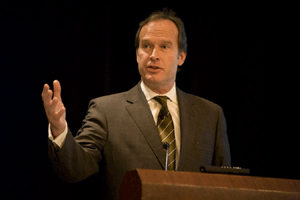 Jud Bergman has served as the CEO of Envestnet Asset Management since 1999, where he is responsible for forming & leading the Envestnet management team, guiding Envestnet's strategic alliances, and managing the implementation of Envestnet's business plan.
After a brief introduction by Chip Roame (Managing Partner, Tiburon Strategic Advisors), Mr. Bergman took some time to introduce Envestnet's TAMP structure, and followed that by discussing the various opportunities for branding that he sees in the wide-open independent channels. Mr. Bergman made the following points:
Broken Trust
Broken Industry Reputation
Broken Portfolios
The Benefits of Independence
Business Impacts for Product & Platform Providers
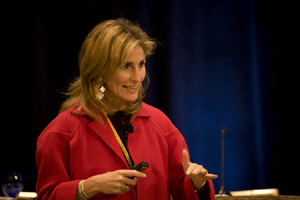 Jessica Bibliowicz has served as CEO of National Financial Partners since 1999 and as chairman of the board of directors since 2003.
After a brief introduction by Chip Roame, Ms. Bibliowicz discussed the new challenges of operating as a public company, addressed the opportunities she sees for the firm after its run of acquisitions, and talked about trends across National Financial Partners' three core businesses, including large case life insurance, employee benefits, & investment advice. Ms. Bibliowicz made the following points:
Lower Employment, Compensation, & Contributions
Potential Health Care Reform
Early Recovery Typical of Insurance
Federal Regulation of Insurance
Intra Wirehouse Movement
Winning Business from the Wirehouses
Conserving Cash
Helping Firms
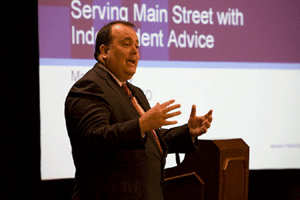 Mark Casady has served as CEO of LPL Financial since 2004 and added the chairman title in 2006. He has been instrumental in leading the company to become a multi-faceted organization. He joined the firm in 2002.
After a brief introduction by Tif Joyce (President, Joyce Financial Management), Mr. Casady addressed how both growth in the independent rep market and recent market turmoil have brought about new challenges for this market, including some of the ways in which LPL Financial plans to stay ahead of trends as the nation's largest independent broker/dealer. He focused on scale, branding, & the changing regulatory environment. Mr. Casady made the following points:
Opportunity for the Independent Model Has Never Been Greater
Different Investors Emerging from the Economic Crisis
Importance of Scale
Changing Regulatory Landscape
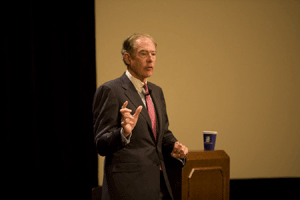 Kip Condron has served as CEO of Axa Financial and a member of the Axa Group Management Board since 2001. In addition, Mr. Condron is chairman & CEO of Axa Financial's principal insurance subsidiary, Axa Equitable Life Insurance.
After a brief introduction by John Cammack (Head, Third-Party Distribution, T. Rowe Price Group), Mr. Condron discussed how Axa Financial is addressing the challenges presented by the current state of the financial protection & wealth management markets as well as the direction of the new regulatory climate. Mr. Condron made the following points:
Disadvantage for Federal Relief
Public Policy to Create Savings Incentives
In-Plan Guarantees
Life Insurers Consolidation
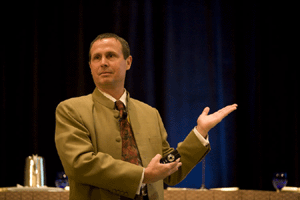 Jeffrey Dunham has served as CEO of Dunham & Associates Investment Counsel since its founding in 1985, and also as chairman of Dunham Trust Company. He also serves as a trustee, president, & principal executive officer of Dunham Funds.
After a brief introduction by Sal Capizzi (Chief Marketing Officer, Dunham & Associates Investment Counsel), Mr. Dunham introduced his consumer oriented model, harkening back to the genesis of the concept and identifying the garnering of trust as the main driver of the building of long-term client relationships that are by definition fiduciary in nature. Mr. Dunham made the following points:
Performance (Fulcrum) Fees
Inside Mutual Funds
Financial Advisor Fees
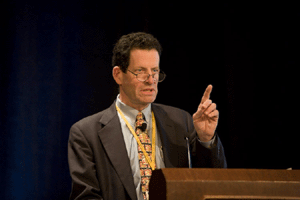 Ken Fisher has served as the CEO of Fisher Investments since founding the firm in 1979. His recent research, published in professional and scholarly journals, focuses on the emerging field of behavioral finance. Mr. Fisher is known for his Portfolio Strategy financial investment column featured monthly in Forbes magazine, where his 24-year tenure makes him the fourth longest-running columnist in the magazine's 92-year history. Mr. Fisher has also written five finance & business books including 1984’s best seller, Super Stocks and his 2008 New York Times best seller, The Ten Roads to Riches. Mr. Fisher holds a Berstein Fabozzi/Jacobs Levy Award for outstanding published research, has been on the Forbes 400 list of richest Americans since 2005, and is on Investment Advisor magazine’s IA-25 list of the most influential people in that industry. His firm is the largest direct marketer in asset management.
After a brief introduction by Tif Joyce (President, Joyce Financial Management), Mr. Fisher addressed ways in which Fisher Investments will win market share in the new market conditions. Mr. Fisher made the following points:
Consumer Focus
Core Focus
Legal Risks
Marketing Effects
Service Formalization
Reconsider Employees
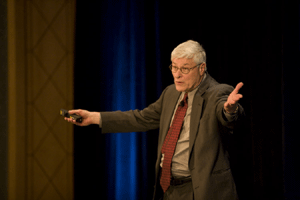 Roger Ibbotson is Professor in Practice at Yale School of Management and chairman of Zebra Capital Management, a quantitative equity hedge fund manager. He was also the founder & former Chairman of Ibbotson Associates, now a Morningstar Company, where he still serves as an advisor. Professor Ibbotson conducts research on a broad range of financial topics, including investment returns, mutual funds, international markets, portfolio management, & valuation.
After a brief introduction by Patrick Reinkemeyer (President, Morningstar Associates, Morningstar), Mr. Ibbotson addressed long-term economic growth, current unemployment, and the new U.S. administration. He compared the current economic climate to past bear markets and discussed the role hedge funds have played in the past and will continue to play in the future. Mr. Ibbotson made the following points:
Hedge Funds & Alternatives Golden Years Ended in 2007
Ten Year Returns Still Positive
Economy to Fall in 2009
Stock Market to See High Volatility & High Returns from Lows
Hedge Funds: More Withdrawals in 2009
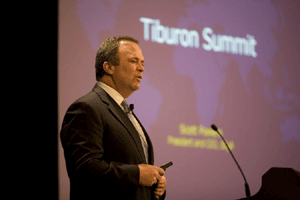 Scott Powers has served as CEO of State Street Global Advisors since 2008; State Street Global Advisors is the investment management arm of State Street Corporation. He is also a member of State Street's Operating Group, the company's senior-most strategy and policy-making team.
After a brief introduction by Tony Rochte (Senior Managing Director, Intermediary Business Group, State Street Global Advisors, State Street Corporation), Mr. Powers addressed the ways in which State Street Global Advisors will continue to attract high-net-worth investors. His presentation specifically addressed the challenges of capital preservation in the current market. Mr. Powers made the following points:
Modern Portfolio Theory Questioned
Liability Driven Investment Strategies Receiving Attention
Hedge Funds-of-Funds Disappointed Badly
Demand for Absolute Return Strategies Strong
Many Considering Hiring Fewer Managers with Larger Mandates
Pension Plans Significantly Underfunded
Value of Investment Consultants Being Questioned
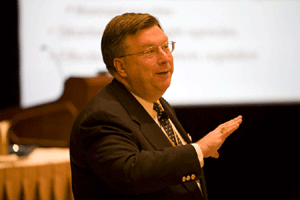 Paul Stevens has served as CEO of the Investment Company Institute since 2004. He also is a director of ICI Mutual Insurance.
After a brief introduction by Tif Joyce (President, Joyce Financial Management), Mr. Stevens addressed the state of the mutual funds market, including a review of the historical success of mutual funds’ role in 401K plans since their introduction in 1981. He specifically addressed the relationship between government & business, and how the current economic landscape presents new & unprecedented challenges in retirement planning. Mr. Stevens made the following points:
Systemic Risk
Regulatory Gaps
Municipal securities
Capital Markets Regulation
Desire to Increase Coverage of 401k Plans
Liquidity Standards
Portfolio Maturity Limits
Enhanced Credit Analysis
Client Procedures
Board Suspension of Redemptions
General Session Panel Discussions
One of the key themes of every Tiburon CEO Summit is the need to more closely listen to clients. In open acknowledgment of the truly unique market conditions created by the 2008 credit crisis, Tiburon CEO Summit XVI included a special general session current events panel in addition to its usual Tiburon CEO Summits' general session panel discussions (Ask the Consumers, Ask the Advisors, & Ask the Gatekeepers). All allowed Tiburon CEO-level clients to hear directly from their constituents in an unvarnished way. This is in sharp contrast to most CEOs' daily activities, where they are forced to rely on interpreting marketing data or listening to anecdotal stories from their sales forces. Addressing these constituents first-hand through questions & answers helps Tiburon clients further consider innovative ideas for serving these different client groups.
Current Events Panel
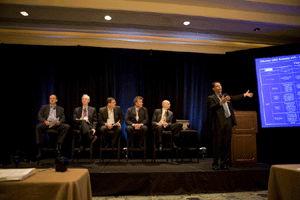 Tiburon CEO Summit XVI included a special general session panel discussion on the credit crisis. The panel participants included Chuck Baldiswieler (Group Managing Director, Trust Company of the West (TCW)), John Cammack (Head, Third-Party Distribution, T. Rowe Price Group), Steve Deschenes (Chief Marketing Officer, Retirement Income Group, Mass Mutual Financial Group), John Murphy (Chairman, Oppenheimer Funds), & Steve Wallman (CEO, Foliofn), with Chip Roame leading a discussion that focused on current events.
The panel was extremely frank and the net impression was that regulations are sure to affect the industry in ways that are yet to be determined. There was a common understanding that the culture that has dominated is absurd, and a unanimous opinion that trust between the consumers and the industry should be the main focus of each player in the industry.
Ask the Consumers Panel
 As has become the tradition at Tiburon CEO Summits, four real and unscripted consumers (Josh, Sonja, Maureen, Keith) were interviewed by facilitator Tif Joyce (President, Joyce Financial Management) for the Ask the Consumers panel. While each provided a unique point of view, a number of common views were shared.
The panel was extremely frank and the net impression was the most important quality an advisor can have is honesty and clarity of communication. A consumer in today's environment must question the motives and directives of the advisors available, and in response, it is vital that advisors respect their responsibilities to serve their clients' needs above all else.
Ask the Advisors Panel
 With a similar goal to the Ask the Consumers panel, four leading financial advisors participated on the Ask the Advisors panel to allow attendees to better understand the businesses and decision-making criteria of financial advisors. Facilitated by Jenn Connelly (CEO, JCPR), the panelists included Tom Lydon (President, ETF Trends), Mark Penske (CEO, United Advisors), Adam Sheer (President, The Roosevelt Group), & Bill Walsh (President, Hennion & Walsh). The financial advisors were selected from different backgrounds and approaches to the industry, providing a wide range of perspectives. Amongst the key points made by the panelists were.
Tiburon CEO Summit attendees valued the opportunity to listen to these advisors candidly discuss some of the strategies they've employed in trying to maintain client relationships and assets under management in these trying times.
Ask the Gatekeepers Panel
 In keeping with the Tiburon CEO Summit tradition of emphasizing the need to listen carefully to one's clients and prospective clients, the Tiburon CEO Summit Ask the Gatekeepers panel is the third part of this series. For many Tiburon clients (e.g., investment, insurance, & technology firms), understanding the workings of distribution firms is crucial to their firm's success in gaining access to an organization's network of financial advisors. Wirehouses such as Merrill Lynch, independent broker/dealers such as LPL Financial, and custodians such as The Charles Schwab Corporation can account for 50% or more of financial product companies' sales. Tiburon's Ask the Gatekeepers panel, facilitated by Bill Salus (Chief Business Development Officer, PNC Global Investment Servicing), allowed these types of distribution organizations to discuss their needs from investment management firms and other product providers through questions & answers. Four major distribution firms provided insights on how they serve financial advisors. Panelists included Bill Crager (President, Envestnet Asset Management), Steve Dunlap (Chief Operating Officer, Pershing Managed Account Solutions), AJ Harper (President, Advisor Port, PNC Global Investment Servicing, PNC Financial), & Brian O'Toole (CEO, Genworth Financial Management Wealth Management, Genworth Financial). Amongst their key points were:
The panel added perfectly to the Tiburon CEO Summit's agenda of focusing the CEO-level attendees on client needs. Across the board, the panelists concluded that the current conditions are shaping an environment in which nimble and open-minded gatekeeping will allow recovery for the marketplace and open up new markets for each firm.
Tiburon CEO Summit XVI had 128 Tiburon client attendees, including:
Media Representatives
Tiburon CEO Summit XVI also welcomed six Tiburon select media attendees, including:
Also in attendance for Tiburon CEO Summit XVI was Tiburon employee Tudor Jones (Director, Business & Marketing).
Tiburon CEO Summit XV: October 14-15, 2008
Tiburon CEO Summit XV was held October 14-15, 2008 at the Ritz Carlton Hotel in San Francisco, CA. Tiburon CEO Summit XV started at 7:45am on Tuesday, October 14, included a networking dinner that evening in Tiburon, and concluded at 4:15pm on Wednesday, October 15. Over 100 senior industry executives took two days out of their busy schedules to participate. Chip Roame (Managing Partner, Tiburon Strategic Advisors), Bruce Bond (CEO, Power Shares), Bill Hambrecht (CEO, WR Hambrecht + Company & Former CEO, Hambrecht & Quist), Norm Malo (CEO, National Financial Services Corporation), Joe Mansueto (CEO, Morningstar), & Andrew Rudd (CEO, Advisor Software & Former CEO, Barra) made general session presentations. Four general session panel discussions included a consumers panel, an advisors panel, a manufacturers panel, & a special general session panel discussion addressing the credit crisis.

Tiburon's CEO Summit XV was held October 14-15, 2008 in San Francisco, CAOpening Keynote Presentation:
Chip Roame (Managing Principal, Tiburon Strategic Advisors)
Tiburon & the Tiburon CEO Summits Vision & History
Mr. Roame outlined Tiburon's core businesses, offered a brief overview of the vision behind the Tiburon CEO Summits, & thanked the Tiburon CEO Summit XV sponsors:
- Digital consumer, digital investor, digital business