

Prior Tiburon CEO Summits (2004-2005)
Tiburon has held 47 prior CEO Summits, with the first Tiburon CEO Summit taking place in 2001. Details of Tiburon CEO Summits VI-IX are included below; for details of other Tiburon CEO Summits, please click here: Most Recent, 2024-2025, 2022-2023, 2020-2021, 2018-2019, 2016-2017, 2014-2015, 2012-2013, 2010-2011, 2008-2009, 2006-2007, (2004-2005), 2001-2003.
Tiburon CEO Summit IX: October 19-20, 2005
Tiburon CEO Summit IX was held October 19-20, 2005 in San Francisco, CA. Tiburon CEO Summit IX started at 8:00am on Wednesday, October 19, included a networking dinner that evening in Tiburon, & concluded 1:00pm on Thursday, October 20. Over 50 senior industry executives & media representatives took two days out of their busy schedules to participate. Chip Roame (Managing Partner, Tiburon Strategic Advisors), Stan Kelly (President, Wealth Management, Wachovia Corporation), Tim McCarthy (CEO, Nikko Asset Management, Nikko Cordial Group), Jeff Montgomery (CEO, NFP Securities, National Financial Partners), & Michael Sapir (CEO, Pro Fund Advisors) made general session presentations. Other general session panels included a consumers panel, an advisors panel, a strategic discussion of the investment management market by a founders panel, & a series of presentations on innovative business models.
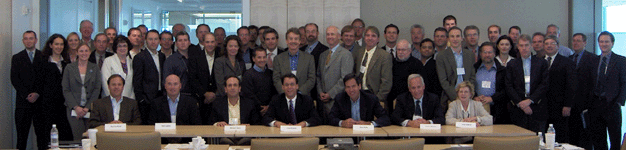
Attendees at Tiburon CEO Summit IX in San Francisco, CA
Opening Keynote Presentation:
Chip Roame (Managing Partner, Tiburon Strategic Advisors)
 Tiburon CEO Summit IX kicked off with a keynote presentation by Chip Roame of Tiburon Strategic Advisors. Chip welcomed the attendees, gave an overview of Tiburon, and addressed the state of the financial services industry, with a focus on evolving consumer needs and emerging innovative business models.
In updating the group of clients on Tiburon's activities, Mr. Roame noted that "Tiburon has positioned itself uniquely as a market research & strategy consulting firm; the firm's services include a series of research reports, conference speeches, market seminars, market research, and strategy consulting services, with the latter two accounting for more than two-thirds of Tiburon's revenues." The firm has served over 250 corporate clients and completed over 750 projects since its founding in 1998, and today, its knowledge base includes mutual funds distribution, separately managed account programs, alternative investments, wealth management services, insurance products, banking services, the fee-only financial advisor market, the CPA firm market, the family office market, and various international markets.
After sharing the short update on Tiburon, Mr. Roame discussed the state of the financial services industry broadly. This included comments regarding consumer wealth, the competitive playing field, and ways to win in the increasingly competitive market. Specifically, Mr. Roame noted that:
- The market of consumer wealth is enormous, including $17.1 trillion of investable assets and $7.5 trillion of retirement plan assets held by 108 million US households
- The competitive playing field is crowded with over 400,000 financial advisors; P&C insurance agents and independent reps now exceed wirehouse brokers in numbers
- Dozens of trends are misunderstood; Chip shared Tiburon's views of ETFs, SMAs, hedge funds, and other products, some of which are quite contrary to generally accepted market opinions
- There is a series of ways to win in the financial services industry, including not giving up on mutual funds, participating in the fee-accounts trend, and expanding product & service offers to better address the needs of aging baby boomers. Tiburon predicts that wealth management services may pass investment management services in importance as boomers age
- Three key business building initiatives are critical - target marketing, people & technology leverage, and benchmarking
- At an institutional level, Tiburon expects substantial industry consolidation driven by stock values, branding, and shifting winning markets
Finally, Mr. Roame kicked-off the CEO Summit with an introduction of the Summit agenda and some ground rules. The agenda highlights included:
- Four terrific guest presentations by Tiburon CEO-level clients
- Four participatory general session panel discussion, including the hugely popular Ask the Consumer panel
- Twelve break-out sessions, which always foster discussion and debate about the industry's future
- A casual dinner in Tiburon, overlooking San Francisco, with some exciting entertainment
Guest Presentations
Four guest presentations anchored the CEO Summit agenda:
 Stan Kelly, President of Wachovia Bank's wealth management business, presented his firm's views on the positioning of banks in general, then specifically on Wachovia's positioning and his expectations for the future. Mr. Kelly's presentation, which was brought to life by using one Wachovia city (Richmond, Virginia) as a typical slice of the entire company's operations, was titled Leveraging your Franchise to Capture the High Net Worth Market, made numerous key points:
- Wachovia has built a robust wealth management platform that serves 50,000 clients through 1,000 wealth advisors, and almost 5,000 employees in private banking, trust & investment management, wealth markets, and insurance
- Determining its sweet spot was critical; Wachovia determined the right type of relationships, the right number of relationships, and the right focus of these relationships; the firm calculated that 80% of its wealth clients had earned their wealth, so it identified four key segments (e.g., professionals, corporate executives, business owners & entrepreneurs, and ultra high net worth & multi generational families)
- Segmentation requires a deeper understanding of each segment's needs and behaviors, a developed markets approach, and enhanced relationship manager skills
- Segmentation also requires individual business units to recognize their target client bases as tightly defined and those definitions need to be respected
- Early results reveal that segmentation pays off; Wachovia has acquired 2,654 new wealth clients this year, and revenues per relationship manager have been pushed up from $2.9 million to $3.7 million
- Wachovia's next step is to dig deeper into segmentation and focus on client investment styles
Tiburon has worked closely with Mr. Kelly in developing his firm's business strategy.
 Tim McCarthy, CEO of Nikko Asset Management and former President of Charles Schwab & Company, presented his views on the growth of US concepts such as fee-based investment advice and independent advisors in markets outside of the US (especially in Japan). Mr. McCarthy's presentation titled Investment Management Trends in Asia focused on several key points:
- Asia is positioned for dramatic growth in investment management; 401K plans were just introduced in Japan in 2001 and provide an alternative to the current ultra conservative retirements plans
- Open architecture is coming to Asia; fund companies that did not embrace the change have lost over 50% of their assets
- Regulators are shockingly coordinated; this is making business easier by leveling the playing field
- Banks are the dominant distribution channel and reps are key to selling products at these institutions
- Independent channels and fee-only businesses are starting to emerge, slowly
- Nikko Asset Management has a unique employee-centric management structure to compete in this market
Tiburon's Managing Partner Chip Roame has worked closely with Mr. McCarthy in several capacities, including at Charles Schwab & Company.
 Jeff Montgomery, CEO of NFP Securities, presented his firm's views on the intricacies of building an independent broker/dealer to support acquired firms and third-party firms, which are financial planners, estate planners, and benefits companies. Mr. Montgomery's presentation, titled Realities, Strategies, & Opportunities in Financial Services Distribution, made numerous key points:
- The market is growing and wealthy people want help in a wide range of areas
- A broad sophisticated offering is required to meet the needs of the baby boomer market
- Distribution is migrating to high payouts and open architecture; in 1985, 92% of all producers were with wirehouses; today, 36% of all producers are with the wirehouses
- Margin compression is everywhere; in 2004, only 2/3 of all major insurance-owned or independent broker/dealers were even profitable
- NFP's acquisition strategy combines the resources of a large company with the entrepreneurial spirit of the principals of the acquired broker/dealers
Tiburon has worked closely with National Financial Partners, NFP Securities, and Mr. Montgomery in developing his firm's business strategy.
 Michael Sapir, CEO of Pro Funds, presented his firm's strategy for understanding and serving a target market. Mr. Sapir's presentation, titled A Funny Thing Happened on the Way to a Niche, addressed several key points:
- New and innovative ideas are often scorned. Pro Funds has been scewered in the media for offering leveraged and bear market funds. The media, including the Wall Street Journal, New York Times, and Morningstar, all have had derisive comments regarding Pro Funds
- Rather than accept that timing is inherently bad, Pro Funds has set up a fund range that accommodates active fund trading in an environment that seeks to be fair to all investors. The firm has fully-disclosed its policy regarding trading and has established an infrastructure to deal with rapid inflows and outflows
- Pro Funds' original ideas were to cater to market timers, develop products & services for their needs, and take indexing to the next level
- The firm has been hugely successful, with many first-of-their-kind funds, major insurance company relationships, and international efforts. Pro Funds has discovered a number of unanticipated markets for its leveraged and inverse index funds, including the many retail and professional investors that use funds to hedge existing positions
Tiburon has worked closely with Pro Funds and Mr. Sapir in developing his firm's business strategy.
Four general session panel discussions were held, including the popular Ask the Consumers and Ask the Advisors panels, as well as a panel on opportunities in the investment management markets, and a panel on innovative business models. All four panels included wide-open dialogue and received wide praise.
 Back by popular demand after repeated comments seeking a better understanding of consumer needs, the Ask The Consumers panel drew wide praise. Five diverse, high net worth consumers joined facilitator Tif Joyce from Joyce Financial Management. The panelists gave brief summaries of their experiences with managing their financial affairs and how they dealt with and used brokers, bankers, and advisors, making several key points:
- A significant number of panelists continued to take a self-directed approach to their wealth using discount brokerage services. This was consistent with data presented earlier the previous day by Tiburon Managing Partner Chip Roame that highlighted the size and growth of the discount broker segment
- Real Estate, especially among these largely California panelists, played a significant role in their overall wealth plans
- While many had multiple financial services relationships, there was a major opportunity for a relationship quarterback to emerge for all of the panelists. This was especially the case when considering who would help the surviving spouse
Additional comments that added insight were from a highly independent, self-directed investor who commented positively on the ease and simplicity of navigating the Vanguard web site to learn more about investing. Additionally, one affluent investor declined to pay an entry level $12,000 for a financial plan, opting instead for a free plan linked to an agreement to buy commission products from an independent advisor. Finally, one of the older panelists had more than twenty active insurance policies.
Ask the Advisors
Three leading financial advisors participated on a panel to allow attendees to better understand advisor decision-making. Facilitated by Dennis Clark from Advisor Partners & Scott MacKillop from US Fiduciary, the panel included Ken Fisher from Fisher Investments, Scott Frost from Retirement Advisors of America, & Dave Wright from Sierra Investment Management. All agreed that one of the biggest challenges is managing the growth of their practices and finding talented people to bring into their organizations. Additionally, the panelists felt that most investment product providers do not offer much help in dealing with this challenge. The panelists believed that, in general, they have more than enough products to meet their clients' needs. However, they were interested in finding low-cost investment products that are less correlated with traditional asset classes. Sizing up the competition, the panelists stated that the biggest competitive threats are open architecture platforms that encourage self-help investing, other independent advisors, and private bankers (for clients with $5 million or more in investable assets). As Dennis Clark summed up, "the industry is interested in products, but clients are interested in service."
Investment Management Industry Market Trends
The investment management panel addressed the opportunities & issues from the perspective of investment management organizations, with an emphasis on how investment products have evolved and how that might change over the next five years. Paul Schaeffer from SEI Investments began the session with a presentation on the state of the investment management business today. Kevin Malone from Greenrock Research then facilitated a panel discussion, which included Lee Chertavian from Placemark Investments, Steve Cohen from ProFunds, Dick Davies from Alliance Capital, & Alan Reid from Forward Management. Mr. Schaeffer commented that “over the next decade, the combination of demographic changes, shifting investor demand, and a changing regulatory landscape will create opportunities for those managers who are equipped to compete.” Mr. Chertavian suggested that over the next decade success will come to those investment management firms which analyze the needs of consumers correctly. Mr. Davis emphasized the importance of investment firms emphasizing their strengths and not looking to chase hot products because money is flowing in a particular direction. Mr. Malone referred the group to the research of Tiburon Strategic Advisors on the liquefaction of assets over the next ten years, citing that money from 401k plans and inheritances will create an enormous pool of assets that will need a home. Panelists continued the ongoing Tiburon CEO Summit debate regarding the size and growth rate of new investment products including ETFs, SMAs, and hedge funds. Panelists also discussed universal concern that the move to an ownership society may leave many Americans with nest eggs not large to meet their needs.
Innovative Business Models
The innovative business models panel offered the unique perspective of five Tiburon clients, encouraging other attendees to think innovatively regarding their own business strategies. The panel was facilitated by Chip Roame from Tiburon Strategic Advisors, and included panelists Mike Byrum from Rydex Investments, Ron Cordes from Asset Mark Investment Services, Jeff Lyons from Charles Schwab & Company, Mitch Politzer Ameritas Acacia, & Chuck Robinson from Northwestern Mutual. One of the most interesting models was that of Mike Byrum, who discussed how Rydex has developed innovative benchmark-based funds, including a recent foray into the alternative investments arena. Another interesting model was that of Jeff Lyons, who discussed Schwab’s retail online trading business; Mr. Lyons noted that innovations developed through Charles Schwab & Company's CyberTrader company are helping the firm add to the capabilities of its other online platforms, serving 150,000 clients. Chuck Robinson of Northwestern Mutual spoke about integrating investment services into Northwestern’s business by pairing experienced insurance executives with experienced investment advisors; he said that this had been a more effective approach than trying to train insurance executives to be investment advisors.
Attendees
Tiburon CEO Summit IX had 58 Tiburon client attendees, including:
|
|
Media Representatives
Tiburon CEO Summit IX had two Tiburon select media attendees, including:
|
|
Also in attendance for Tiburon CEO Summit IX were Tiburon employees Casie Barton (Research Manager), Vera Bulova (Research Manager), John Buck (Research Manager), Kristen Colwell (Senior Marketing & Operations Manager), Jon Freed (Research Manager), Matthew McGraw (Senior Research Manager), & Jennifer VanHove (Research Manager).
Tiburon CEO Summit VIII: April 13-14, 2005
Tiburon CEO Summit VIII was held April 13-14, 2005 in San Francisco, CA. The Summit started at 8:00am on Wednesday, April 13, included a networking dinner that evening in Tiburon, & concluded at 1:00pm on Thursday, April 14. Almost 75 senior industry executives & media representatives took two days out of their busy schedules to participate. Chip Roame (Managing Partner, Tiburon Strategic Advisors), Jessica Bibliowicz (CEO, National Financial Partners), Bill Landman (Partner, CMS Companies), Don Phillips (Managing Director, Morningstar), & Hersh Shefrin (Professor, Santa Clara University) made general session presentations. Other general session panels included a consumers panel, an advisors panel, a strategic discussion of the investment management market by a founders panel, & a series of presentations on innovative business models.

Attendees at Tiburon CEO Summit VIII in San Francisco, CA
Opening Keynote Presentation:
Chip Roame (Managing Partner, Tiburon Strategic Advisors)
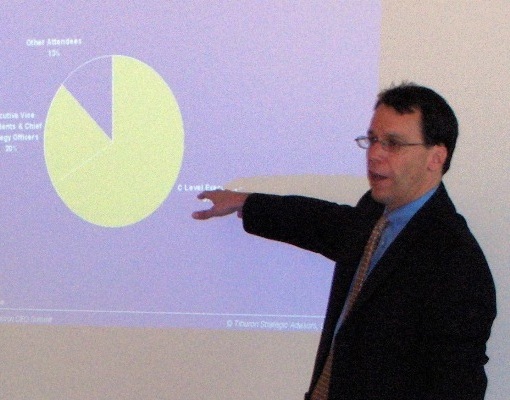 The CEO Summit kicked off with a keynote presentation by Chip Roame of Tiburon Strategic Advisors. Chip welcomed the attendees, gave an overview of Tiburon, and addressed the state of the financial services industry, with a focus on evolving consumer needs and emerging innovative business models.
In updating the group of clients on Tiburon's activities, Mr. Roame noted that "Tiburon has positioned itself uniquely as a market research & strategy consulting firm; the firm's services include a series of research reports, conference speeches, market seminars, market research, and strategy consulting services, with the later two accounting for more than half of Tiburon's revenues." The firm has served over 250 corporate clients and completed over 650 projects since its founding in 1998 and today, its knowledge base includes mutual funds distribution, separately managed account programs, alternative investments, wealth management services, insurance products, banking services, the fee-only financial advisor market, the CPA firm market, the family office market, and various international markets.
After sharing the short update on Tiburon and addressing the CEO Summit agenda, Mr. Roame discussed the state of the financial services industry broadly. This included comments regarding consumer wealth, the competitive playing field, and ways to win in the increasingly competitive market. Specifically, Mr. Roame noted that:
- The market of consumer wealth is enormous, including $17.1 trillion of investable assets and $7.5 trillion of retirement plan assets held by 108 million US households; this CEO Summit was focused on the advisor model as advisors control the majority of the market
- The competitive playing field is crowded with over 400,000 financial advisors, which is an enormous number given the concentration of US wealth
- There are a series of ways for advisors to win in the financial services industry, including not giving up on mutual funds, participating in the fee-accounts trend, and expanding product & service offers to better address the needs of aging baby boomers. Tiburon predicts that ETFs will gain substantial share and wealth management services may pass investment management services in importance as boomers age
- Three key business building initiatives are also critical for advisory organizations - target marketing, people & technology leverage, and benchmarking; these activities may separate the winners from the also rans
- At an institutional level, Tiburon expects substantial industry consolidation driven by stock values, branding, and shifting winning markets; banks and insurance companies may both acquire aggressively again if stock values rise again
Guest Presentations
Four guest presentations anchored the CEO Summit agenda:
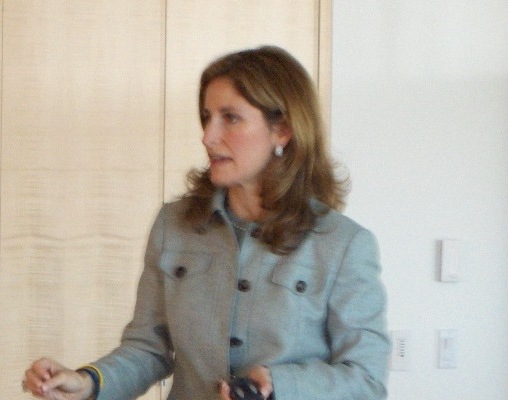 Jessica Bibliowicz presented her innovative views on the changing landscape in financial services with regard to distribution consolidation. Specifically, she discussed how NFP bridges the gap between large financial product manufacturers and independent producers, and how this approach encourages best-of-class client service. Ms. Bibliowicz discussed the history of NFP as a private and public company, and how independent distribution serves the high net worth individual and entrepreneurial has best-of-class solutions to its clients across a breadth of products." She then addressed NFP's growth strategy and the unique structure of the firm's acquisition model, adding that "NFP’s approach to acquisitions aligns the acquired firms’ interests with those of NFP, their clients, and our shareholders." NFP’s network of over 150 owned firms and more than 200 affiliated third-party distributors specialize in life insurance and wealth transfer, corporate and executive benefits, and fee-based financial planning.
 Bill Landman presented his views on building a high-end financial advisory business: target marketing, life insurance producer groups, wealth management services, long-only strategies, and alternative investments. Mr. Landman shared valuable insights from his experience as a founder of the CMS Companies, a unique and very successful advisory firm serving high net worth entrepreneurs. His firm is a member of the M Financial Group and is quite accomplished in the alternative investments market. Mr. Landman's presentation brought the CEO Summit's twin themes together by focusing on both consumers and innovative business models. Mr. Landman discussed CMS' unique and narrow target market - "entrepreneurs willing to give at least $5 million per year to CMS, all with charitable intentions." Further, Bill focused on CMS' advanced skills in alternative investments and cited various examples of the differences in performance of many private equity funds and hedge funds, emphasizing the need for careful due diligence. Mr. Landman asserted that "the size of an investment program is the enemy of returns."
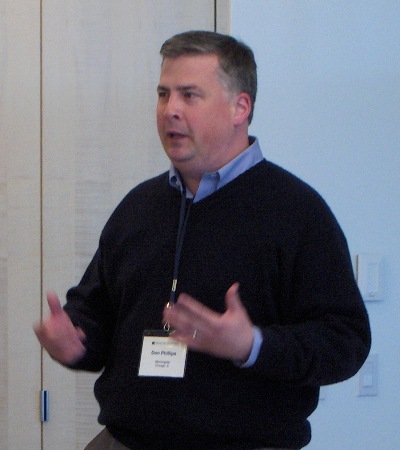 Don Phillips presented his views on the winning business model for the investments industry: putting investors' interests first. Specifically, Mr. Phillips pointed out that industry scandals cannot be tolerated and that winning firms will focus on client needs. He stated that "while the mutual funds industry remains healthy, investors and their advisors have punished the firms that have lost focus on the interests of individual investors and have rewarded those firms that have not strayed". Mr. Phillips' presentation started with the fact that 82% of mutual fund industry flows are going to four mutual fund companies (none of which have been involved in the mutual fund timing scandal and each of which is a low cost provider in its channel). He pointed out that "the conventional debates did not come to fruition with American Funds being a clear load fund family and Vanguard a clear no load, and Vanguard and Barclay's being indexers while Fidelity and American Funds clearly believe in active management." Mr. Phillips went on to use the famous Morningstar style boxes to analyze several funds, revealing style drift and varying ownership zones. Don's presentation demonstrated Morningstar's continued commitment to developing tools for the advisor to simply and graphically distill large amounts of data into useful information and construct portfolios.
 Hersh Shefrin presented his leading-edge views on understanding investor psychology with insights from behavioral finance. His book Beyond Greed & Fear has changed the debate on how many view investments. Mr. Shefrin pointed out that the motivating factors are not greed and fear, but instead are hope and fear. Amazingly, attendees learned that both retail and professional investors make decisions that are not in alignment with their objectives. Mr. Shefrin noted that "the stock market has positive returns two-thirds of the time, yet investors fall into one of two fallacies: being either overly optimistic or falling for the gamblers fallacy". He explained that those who are overly optimistic believe that if the market has risen it will continue to rise. Those who fall for the gamblers fallacy believe that if the market has fallen it is bound to reverse. Finally, Mr. Shefrin suggested that behavioral finance teaches that investors can do better than an index, but it is difficult. He stressed that "investors should take long-term views on their investments and on returns."
Four general session panel discussions were held, including the popular Ask the Consumers and Ask the Advisors panels, as well as a panel on opportunities in the investment management & institutional markets, and a panel on innovative business models. All four panels included wide-open dialogue and received wide praise.
Ask the Consumers
Back by popular demand after repeated comments seeking a better understanding of consumer needs, the Ask the Consumers panel drew wide praise. Seven high net worth consumers joined facilitators Tif Joyce from Joyce Financial Management & Joe Kiely from Kiely Financial Services. The panelists told about their experiences with brokers, bankers, and advisors, making three key points:
- Consumers want it simple. The fewer relationships, accounts, and securities, the better. One sophisticated, high net worth panelist said “I’d love to have my whole portfolio in one lifestyle mutual fund”
- The industry still needs to go a long way to offer consolidated services. Total Merrill may be a terrific idea, but few consumers believe that any one institution is currently able to solve all of their needs
- Trusting advisors is paramount to being satisfied with relationships. The panelists said that taking the time to understand their personal objectives and better explaining costs were two things advisors could do to build trust
The key take-away was that there seemed to be a divergence between extremely happy clients and frustrated & confused clients. Mr. Joyce observed that "the client is happiest when there is a strong relationship with the financial advisor."
Ask the Advisors
Six leading financial advisors participated on a panel to allow attendees to better understand advisor decision-making. Facilitated by Dennis Clark from Advisor Partners & Scott MacKillop from US Fiduciary, the panel included Vince Birley from Ron Blue & Company, Jeff Lancaster from Bingham, Osborn, & Scarborough, Tim McCarthy from Santa Barbara Asset Management, Kirk Michie from Osborne Partners, Bob Smoke from Seton Smoke Capital Management, & Morgan White from Woodside Asset Management. All agreed that one of the biggest challenges is managing the growth of their practices and finding talented people to bring into their organizations. Additionally, the panelists felt that most investment product providers do not offer much help in dealing with this challenge. The panelists believed that, in general, they have more than enough products to meet their clients' needs. However, they were interested in finding low-cost investment products that are less correlated with traditional asset classes. Sizing up the competition, the panelists stated that the biggest competitive threats are open architecture platforms that encourage self-help investing, other independent advisors, and private bankers (for clients with $5 million or more in investable assets). As Mr. Smoke summed up, "the industry is interested in products, but the client is interested in service." Mr. White added "we are successful because we solve problems for people."
Investment Management & Institutional Markets
The investment management and institutional markets panel addressed the opportunities & issues in these markets, including the impact of the mutual funds regulatory environment. Kevin Malone from Greenrock Research and Paul Schaeffer from SEI Investments facilitated this panel, which included Julie Allecta from Paul Hastings, Tim Armour from Morningstar, Jim Atkinson from Orbis Marketing, John Cammack from T. Rowe Price, & Brian Reid from the Investment Company Institute. Mr. Schaeffer commented, "rather than worrying about disappointments with the market and rising business costs, investment managers should be looking ahead. Over the next decade, the combination of demographic changes, shifting investor demand, and a changing regulator landscape will create opportunities for those managers who are equipped to compete." Mr. Schaeffer suggested that in order to succeed and thrive, managers should think of compliance as a way to gain competitive advantage and keep up with the evolution of traditional and alternative products. The panel continued the ongoing Tiburon CEO Summit debate regarding the size and growth rate of new investment products including ETFs, SMAs, and hedge funds. Panelists identified several additional trends that are having an impact on investment management organizations:
- The move to the ownership society, which is shifting responsibility for retirement savings, college savings, and health care costs from institutions to individuals
- The sea change pushing the industry from a manager-centric to an investor-centric approach with an emphasis on customization of investment products and a growing demand for investment approaches that meet goals and outcomes, not just market benchmarks
- Investor demands for comprehensive and customized financial wellness solutions, resulting in investment products wrapped into a broader set of products and services
 The innovative business models panel offered the unique perspective of six Tiburon clients, encouraging other attendees to think innovatively regarding their own business strategies. Facilitated by Chip Roame from Tiburon Strategic Advisors, the panel included participants Andy Arenberg from Barclay's, Dennis Clark from Advisor Partners, Andrew Rudd from Advisor Software, Frank Trotter from Ever Bank, John Mulherin from Ziegler, & Greg Sullivan from Sullivan, Bruyette, Speros, & Blayney. One of the most interesting models was that of Mr. Arenberg, who discussed how exchange traded funds can be utilized as building blocks in the construction of low cost, risk controlled portfolios. Mr. Clark also discussed benchmarked portfolios and ETF wraps. Another interesting model was that of Mr. Rudd, who has built several companies including Advisor Software. Mr. Rudd shared his thoughts on client acquisition, stating that "RIAs must focus on building trust and personalizing their services to each prospective client." Mr. Trotter discussed his online bank. Mr. Mulherin discussed his firm's unique target market. And Mr. Sullivan described the simplicity of his innovative model.
Attendees
Tiburon CEO Summit VIII had 70 Tiburon client attendees, including:
|
|
Media Representatives
Tiburon CEO Summit VIII had three Tiburon select media attendees, including:
|
|
Also in attendance for Tiburon CEO Summit VIII were Tiburon employees Banu Alkaya (Research Manager), Mynor Aragon (Research Manager), Scott Carlson (Research Manager), Kristen Colwell (Marketing Manager), David Dubin (Marketing Manager), Servio Lee (Research Manager), Matthew McGraw (Research Manager), Jeff Nagy (Research Manager), & Bruce Witney (Research Manager).
Tiburon CEO Summit VII: October 21-22, 2004
Tiburon CEO Summit VII was held October 21-22, 2004 in San Francisco, CA. The Summit started at 8:00am on Thursday, October 21, included a networking dinner that evening in Tiburon, & concluded at 12:30pm on Friday, October 22. Over 75 senior industry executives & media representatives took two days out of their busy schedules to participate. Chip Roame (Managing Partner, Tiburon Strategic Advisors), Bill Hambrecht (CEO, WR Hambrecht + Company and Former CEO, Hambrecht & Quist), Mark Lopez (Managing Director, LPL Financial Services), Cameron Miller (Principal, Lovell Minnick Partners), & Morgan White (Managing Director, Woodside Asset Management, Silicon Valley Bank) made general session presentations. Other sessions included an advisor panel, a consumer panel, a strategic discussion of the investment management market, & a series of presentations on innovative business models.
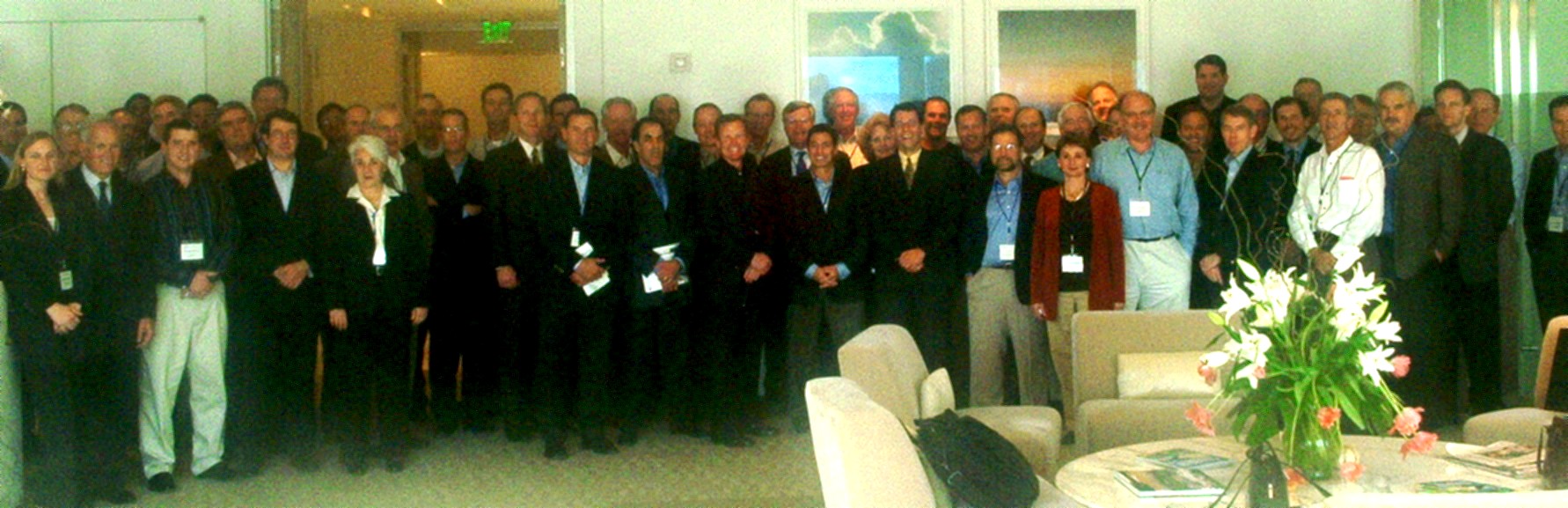
Attendees at the Tiburon CEO Summit VII in San Francisco, CA
CEO Summit Summary
The following summary was distributed after the seventh semi-annual Tiburon CEO Summit:
Introduction
Tiburon Strategic Advisors, a market research & strategy consulting firm serving the brokerage and investment management industry, held its Seventh Semi-Annual Tiburon CEO Summit last week in San Francisco, CA. Tiburon's CEO Summits have become a leading-edge forum for industry CEOs and other senior executives to gather and debate the future of the brokerage, investments, advice, and wealth management industries. Tiburon's research serves as the foundation of the meetings and all participants share views openly. To facilitate information sharing, Tiburon provides a summary like this one after each CEO Summit.
Context Setting
Tiburon’s Seventh Semi-Annual CEO Summit was held in San Francisco, CA on October 21-22, 2004. Eighty-three senior industry executives and consultants were present. Chip Roame of Tiburon Strategic Advisors, Bill Hambrecht of WR Hambrecht & Company, Mark Lopez of LPL Financial Services, Morgan White of Woodside Asset Management, and Cameron Miller of Lovell Minnick Partners made general session presentations. Other sessions included an advisor panel, a consumer panel, a strategic discussion of the investment management market, and a series of presentations on innovative business models.
Tiburon’s CEO Summits have four unique features:
- The senior level status of all attendees; Tiburon seeks to include the leading strategy maker from each client company
- The cross-industry characteristics of the attendees; Tiburon seeks to bring clients from related markets together to discuss common industry issues
- The requirement of participation; all attendees are required to participate in presenting, serving as panelists, or facilitating break-out sessions, in an attempt to create open communications and wide-ranging debates
- The lack of commercialization; Tiburon CEO Summits allow for open discussion without the presence of industry vendors and sales pitches
Tiburon CEO Summits have come to support two central themes:
- The primary focus on consumer needs. Every Tiburon CEO Summit has included the popular Ask the Consumers and Ask the Advisors panel discussions to allow direct open dialog with real clients. General session presenters such as Tiburon's own Chip Roame (a die hard consumer-oriented consultant) and behavioral finance experts have fostered this focus
- The related focus on consumer-centric innovative business models. Every Tiburon CEO Summit has included the Innovative Business Models panel and two individual innovative business model personations. Recent presentations by Bill Hambrecht (WR Hambrecht & Company), Mark Lopez (LPL Financial Services), Ken Kam (Marketocracy), Jeff Montgomery (NFP Securities), and Scott Hanson (Hanson McClain Retirement Network) have supported this theme
Opening General Session Presentations
The CEO Summit kicked off with a general session presentation by Chip Roame of Tiburon Strategic Advisors and a guest presentation by Bill Hambrecht founder of both WR Hambrecht & Company and Hambrecht & Quist. Chip addressed the state of the financial services industry, with a focus on evolving consumer needs and emerging innovative business models. Bill addressed the history and future of the investments industry, along with an insightful look into the Dutch Auction process implemented by his firm, and the newsworthy Google IPO that his firm led.
Chip Roame (Managing Partner, Tiburon Strategic Advisors)
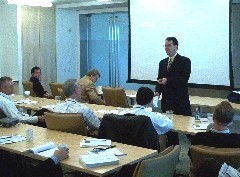 Chip Roame welcomed the attendees, gave an overview of Tiburon, and addressed the state of the financial services industry. In updating the group of clients on Tiburon’s activities, Mr. Roame noted that, “Tiburon has positioned itself uniquely as a market research & strategy consulting firm; the firm’s services include a series of research reports, conference speeches, market seminars, market research services, and strategy consulting services, with the latter two accounting for more than half of Tiburon’s revenues.”
The firm has served over 250 corporate clients and completed over 600 projects since its founding in 1998 and today, its knowledge base includes mutual funds distribution, separately managed account programs, alternative investments, wealth management services, insurance products, banking services, the fee-only financial advisor market, the CPA firms market, the family office market, and various international markets.
Mr. Roame also introduced other Tiburon business activities:
- Tiburon holds this series of CEO Summits semi-annually. Attendance is by invitation only and is generally limited to 75 senior industry executives
- Tiburon has built three executive programs (CEOs-in-Residence, Financial Advisor Roundtable, and Consulting Fellows) in an effort to bring the experiences of additional senior level industry executives to Tiburon clients. All executive program members are invited to Tiburon’s CEO Summits and are encouraged to participate in leadership roles in the CEO Summits on issues related to their respective specialties
- Tiburon offers thirteen online business benchmarking tools that are available to all types of financial advisors in an effort to help them benchmark their business practices and build more successful businesses. Almost 4,000 advisors have used these tools thus far
- Tiburon has published eleven ~100-300+ page research reports, which offer detailed analyses of growing business segments; each is available for $2,500
- Tiburon’s weekly research releases are emailed for free to interested industry executives, media representatives, conference planners, and individual financial advisors. Over 12,000 industry executives now receive these releases each week
Mr. Roame then highlighted the agenda for this, Tiburon’s Seventh Semi-Annual CEO Summit, and discussed highlights of past CEO Summits, including the consumer and innovative business models panels, the state of the industry speeches, and the popular product & market break-out sessions.
After sharing the short update on Tiburon and addressing the CEO Summit agenda, Mr. Roame discussed the state of the financial services industry broadly. This included comments on short-term challenges, consumer wealth, the competitive playing field, and ways to win in the increasingly competitive market. Specifically, Mr. Roame noted that:
- The market of consumer wealth is enormous, including $17.1 trillion of investable assets and $7.5 trillion of retirement plan assets held by the 108 million US households. Mr. Roame predicted that, "the $17.1 trillion will increase to over $30 trillion by 2010 due to the pending liquefaction of consumer wealth, making it a great time to be in the financial advice business"
- The competitive playing field is crowded with over 400,000 financial advisors. Mr. Roame noted that, “banks and full-service brokerage firms currently dominate these assets, each controlling nearly $6 trillion.” He went on though to suggest that, “independent advisors may gain substantial share in the 2000s much as full-service brokers did in the 1980s and discount brokers did in the 1990s”
- Finally, Mr. Roame noted a series of ways to win, including, “not giving up on mutual funds, participating in the fee-accounts trend, and expanding product & service offers to better address the needs of aging baby boomers.” He predicted that wealth management services may pass investment management services in importance as boomers age, and that target market strategies may be increasingly critical to success
Bill Hambrecht (Founder & Former CEO, Hambrecht & Quist and Founder & CEO, WR Hambrecht & Company)
 Bill Hambrecht and Clay Corbas from WR Hambrecht & Company presented a historical and future look at the investments industry, Google, and the Dutch Auction process. Kevin Malone of Greenrock Research introduced Mr. Hambrecht by calling him, "not only one of the great thought leaders in the investments business in the second half of the twentieth century, but also one of its most innovative leaders during this time.”
Mr. Hambrecht reviewed the history of his previous firm, Hambrecht & Quist, which was started by himself and George Quist in 1968 to provide investment banking to companies in Silicon Valley. The growth of technology stocks in the 1980s was the catalyst for Hambrecht & Quist becoming a substantial investment banking, brokerage, and venture capital firm.
The experience of bringing his own firm public in 1996 caused Mr. Hambrecht to question the IPO process. Hambrecht & Quist had several institutional investors interested in purchasing stock of its IPO; however, none of these firms were large Wall Street brokerage firms. Most of these firms did not receive the amount of stock they desired. Over time, he followed these investors and discovered eighteen months later that these firms still owned 50% of their stock purchases, while the large Wall Street firms owned none. He concluded that Wall Street, not potential long-term investors of Hambrecht & Quist, controlled its distribution of stock.
Bill Hambrecht left Hambrecht & Quist in 1998 to start WR Hambrecht & Company, in an attempt to change the IPO process. Since 1998, WR Hambrecht & Company has completed eleven IPOs using a Dutch Auction process, that is, a method that publicly collects bids on IPOs through the Internet to determine the final price. All of the subscribers pay the same price, and Mr. Hambrecht believes that the final price is more efficient.
In fact, Google used this method for its IPO. Google was interested in distributing stock to its users, but the traditional Wall Street IPO method would have eliminated these common investors from participation. Mr. Hambrecht believes that the Dutch Auction process allowed Google to receive a higher price on its offering, and Google investors were able to own shares at the offering price, instead of 25% higher where the stock traded after the offering.
Clay Corbas, a senior managing director of WR Hambrecht & Company, took the group through a review of an actual Dutch Auction process. Kevin Malone summed up the presentation by predicting that the influence of internet-based Dutch Auctions would become pervasive in future IPOs. Tiburon Managing Partner Chip Roame applauded Mr. Hambrecht's efforts saying, "few industry executives bring the consumer-centric passion that Bill Hambrecht displays. The industry should be proud of Bill Hambrecht."
General Session Panel Discussions
Four general session panel discussions were held, including the popular Ask the Consumers and Ask the Advisors panels, as well as a panel on opportunities in the investment management & institutional markets, and a panel on innovative business models. All four panels included wide-open dialogue and received wide praise.
Ask the Consumers
Back by popular demand after repeated comments seeking a better understanding of consumer needs, the Ask the Consumers panel drew wide praise. Four high net worth consumers joined financial advisor facilitators Tif Joyce from Joyce Financial Management and Joe Kiely from Kiely Financial Services, and told about their experiences with brokers, bankers, and advisors. The key take-away was that there seemed to be a divergence between extremely happy clients and frustrated & confused clients. Mr. Joyce observed that "the client is happiest when there is a strong relationship with the financial advisor."
Ask the Advisors
Six financial advisors participated on a panel to allow attendees to better understand advisor decision-making. Participants included Janet Brown from DAL Investment Company, Jane Everingham from Everingham & O'Malley, Tif Joyce from Joyce Financial Management, Joe Kiely from Kiely Financial Services, Jeff Lancaster from Bingham, Osborn, & Scarborough, and Kirk Michie from Osborne Partners. Chip Roame from Tiburon Strategic Advisors facilitated the session.
All seemed to agree that financial advisors appear to be more focused on the consumer, whereas other parts of the industry are more focused on products and services. As Joe Kiely summed up, "the industry is interested in products, the client is interested in service."
Opportunities & Issues in the Investment Management & Institutional Markets
 Kevin Malone, from Greenrock Research, Frank Maiorano from Nuveen Investments, Dick Saalfeld from Axa Investment Management, and Mitch Nichter & Greg Pusch from Paul Hastings gave a brief presentation on their views of opportunities and issues in the investment management markets, including the impact of the mutual funds regulatory environment. Mr. Malone noted, "while the shadow of the mutual funds scandal hangs over all of us, the integrity of the investments industry has been verified."
Mr. Nichter discussed the impact of recent mutual funds scandals as well as the impact of recently enacted regulations affecting the investment management industry, with particular emphasis on the likely changes in the areas of mutual funds and advisors who use mutual funds.
Mr. Nichter suggested that in the short-run, it will be expensive for advisors to meet many of the new regulatory requirements and that there may be changes in and greater disclosure concerning reciprocal payments among industry participants. However, he concluded that the long-run effects will leave the industry strong and healthy, and that US investors will continue to want and need safe, easy-to-understand, pooled investment vehicles, like mutual funds, and will continue to seek out professional advisors to assist them in their wealth management.
Mr. Pusch also noted:
- US investment models are positioned to become global investment models as the residents of developed economies such as France and emerging economies like China seek access to more investment options
- The investments industry is experiencing positive change from greater competition within the industry and the development of more efficient products and more efficient markets. He estimated that these developments were as much the catalysts for change as the government enforcement actions and regulations
Mr. Malone then transitioned to a discussion of the general health of the institutional investment management business. Mr. Saalfeld outlined his keys to success in the institutional investments business with the weight for each; he assigned the largest weights to competitive investment performance (25%) and distribution partnerships (20%). All other factors ranged in importance from 5% to 10% each.
Mr. Maiorano discussed his views on the second of Mr. Saalfeld's points - specifically, on the role of marketing in the institutional business. He stressed the need for client-centered marketing solutions. Industry participants applauded this session as a terrific top-down look at the opportunities and issues for investment management organizations.
Innovative Business Models
Finally, six Tiburon clients joined Tiburon's Chip Roame in a general session panel to discuss their respective innovative business models. Panelists included financial advisors Ken Schapiro (Condor Capital Management) and Vince Birley (Ron Blue & Company), market participants Tom Bradley (TD Waterhouse) and Jeff Montgomery (National Financial Partners), and product executives Greg Vigrass (Foliofn) and Craig Litman (Litman Gregory Asset Management).
One of the most interesting models was the diversification of Craig Litman's investment advisory business, which manages $1.8 billion in client assets. Litman Gregory has developed a separate business to assist other advisory firms - some of which are direct competitors. The firm has opened its business to sharing best practices, templates, research, and model portfolios by offering a subscription to Advisor Intelligence to over 1,000 other advisory firms. In addition, Litman Gregory offers more mutual fund research through the Litman Gregory No Load Fund Analyst and also offers its research implemented in a series of mutual funds hiring best-of-breed stock pickers. Another interesting fact came from Tom Bradley who said that advisors now account for 62% of the net asset flows at TD Waterhouse.
Product Break-Out Sessions
Product break-out sessions were held on mutual funds & exchange traded funds; fee-accounts, turnkey asset management programs, & separately managed accounts; hedge funds, venture capital & private equity, real estate, & other alternative investments; and wealth management & family office services.
Mutual Funds & Exchange Traded Funds
 Andy Arenberg from Barclays Global Investors, Christopher Lanzafame from Franklin Templeton, Keith Mitchell from Mitchell Advisors, Mitch Nichter from Paul Hastings, and Greg Pusch also from Paul Hastings led a discussion on key trends in the mutual funds and exchange traded funds marketplace.
Despite rapid growth in assets, Mr. Arenberg stated that a significant percentage of financial advisors were either not aware of exchange traded funds or how they might be used within their clients' portfolios. The conversation turned to the development of actively managed ETFs and Mr. Pusch commented that several questions remain about their viability or acceptance in the marketplace. The issue of potentially trading at discounts to net asset value, as has been the case with closed-ended mutual funds for example, was one of the unanswered questions.
Many of the attendees mentioned the impact of ETFs within their own wealth management practices, including ways in which ETFs add value to client portfolios. The group seemed to agree that by using ETFs to fill certain asset classes and sectors, advisors are able to seek other products and services to increase overall return or minimize tax liabilities for their clients.
As the discussion transitioned to the mutual funds industry, Mr. Lanzafame said that his firm and others are seeking to focus distribution and product development efforts toward registered investment advisors, as well as continuing to seek distribution outside the US. Many felt that the mutual funds industry was still seeking its footing within the new regulatory environment.
Mr. Mitchell stated that "the number of large mutual fund groups that are continuing to operate with business strategies oriented to the environment of the 1980s and 1990s is a key issue." He suggested that with increased competition from ETFs, separately managed accounts, and alternative products, mutual fund companies need to sharpen their focus on core competencies. Mr. Mitchell observed that "there is a creaking sound in the mutual funds industry today and it is emanating from the old approaches that are failing to work in this new environment. Many are facing financial pressures that will lead them to decisions that will result in smaller, more nimble offerings."
The group then discussed absolute returns, which continue to be a hot topic. Andrew Rudd from Advisor Software commented that "there is a key distinction in the investment decisions required to meet the needs of individual investors versus those of institutions." The longer time horizons of endowments, pension plans, and foundations allow them to think in more relative return terms, where individuals often face more finite horizons and tend to focus on absolute terms. The ability to deliver hedge fund results to smaller investors is still a point of debate and many attendees felt the risk/return equation could be diluted with the higher costs associated with more retail-oriented product approaches.
Fee-Accounts, Turnkey Asset Management Programs, & Separately Managed Accounts
 Dennis Clark from Advisor Partners, Kevin Malone from Greenrock Research, and Barry Mendelson from Capital Markets Consultants facilitated the discussion in the fee-accounts, TAMPs, & SMAs break-out session from the perspectives of separately managed account providers, investment research providers, and program sponsors.
Mr. Clark asked the audience to consider what seems to be a contradiction between the promised benefits of separately managed accounts - customization and tax management - and what is actually being sold and delivered. The conclusion was that wirehouse brokers are selling separately managed accounts as a product and that they are responsible for at least 85% of separately managed account assets (Tiburon data supports this conclusion).
The group also made the observation that while fee-only financial advisors are slow in adoption, these independent advisors are in the best position to implement the promised benefits of separately managed accounts as a solution versus a product. Mr. Malone discussed the importance of investment manager research in fee-based programs, including the analysis of portfolios, attribution of investment returns, and organizational character underlying investment performance.
Mr. Mendelson provided practical advice for institutional sponsors like brokerage firms, banks, insurance companies, and RIA firms in launching and maintaining fee-based investment programs. He discussed the importance of strategic planning in the development of these programs, and noted “too many players have jumped into the fee-accounts arena in the last ten years without a game plan, a brand strategy, or an approach that is integrated with their overall corporate objectives. Because branding intends to produce a specific consumer experience, every aspect of fee-account programs needs careful attention, including program naming, asset allocation advice, product selection, investment research, performance reporting, advisor training, and so forth.” The goal he said, "is to strive for consistency throughout the entire process that produces and maintains these programs.”
Kevin Malone of Greenrock Research facilitated the hedge funds, venture capital & private equity, real estate, & other alternative investments break-out session, and Tim Armour from Morningstar, Ron Suber from Bear Stearns & Company, and Jeremy Evnine from Evnine-Vaughn Associates addressed the group. Attendees at this session expressed appreciation for the thorough discussion of the hedge funds industry. Mr. Malone began by defining hedge funds in two ways: one being a hedge or balance against another investment, and the other being an investment company that typically charges an incentive fee. Mr. Malone noted that the growth of hedge funds has been directly related to the second definition.
Mr. Armour addressed the group with a presentation on hedge fund opportunities from Morningstar's perspective. Morningstar estimates that the hedge funds industry is made up of approximately 11,000 funds with $1 trillion assets under management (Tiburon data generally supports these conclusions). He also noted that currently $10 billion is invested in investable hedge fund indices offered by the likes of S&P and MSCI.
Mr. Suber addressed the group on the practical realities of hedge funds and warned the attendees that, "your clients want and/or need hedge funds or funds-of-funds based on asset allocation or competition." He also advised that, "the growth of hedge funds is here to stay." Mr. Suber took the group through the life cycle of hedge funds, which included the start-up phase, the growth phase, and the maturity phase. He suggested looking for hedge funds in the growth phase of their businesses.
Mr. Suber and Mr. Malone then interviewed Mr. Evnine, CEO of Evnine-Vaughn Associates. Mr. Evnine described his investment process, which attempts to uncover abnormal relationships between two variables, in this case stocks. By shorting one stock and buying the other stock, Evnine-Vaughn Associates waits for the relationship to normalize. The time horizons of these trades are eight-to-ten days, so turnover is very high. Diversification is also extremely high, with hundreds of trades occurring weekly. When asked to compare his knowledge of any particular company to that of an active traditional investment manager, Mr. Evnine speculated that traditional managers might need more fundamental information on firms prior to investing.
Wealth Management & Family Office Services
In the wealth management & family office services break-out session, Brent Hicks from Focus Financial Partners, Jeff Roush from CEG Worldwide, Kevin Rowell from Charles Schwab & Company, and Yari Wajid from Tiburon Strategic Advisors led a dynamic dialogue on identifying and responding to consumers' non-investment needs.
Mr. Roush drove the discussion, focusing on the often misunderstood family office market. He noted that family office services are made up of highly specialized highly complex offerings intended for exceptionally wealthy clients, and suggested that while the number of family offices will likely grow 30% by 2008, most advisors should carefully examine their resources and capabilities before entering this highly competitive niche.
Others suggested that smaller advisors should market their non-investment services as a family office for those who cannot afford a family office and outsource the necessary specialized services. Mr. Hicks added that the media is a major driver behind the rush for advisors to enter the family office services arena, and noted that many advisors now feel guilty if they are not providing these services. Mr. Rowell confirmed these experiences across the Schwab advisor client base.
Markets Break-Out Sessions
Markets break-out sessions were held on wirehouses & regional brokerage firms; banks & insurance companies; fee-only financial advisors & independent reps; and institutional markets including the 401K business.
Wirehouses & Regional Brokerage Firms
In the wirehouses & regional brokerage firms session, Evan Cooper from On Wall Street & Bank Investment Consultant, Servio Lee from Tiburon Strategic Advisors, Barry Mendelson from Capital Market Consultants, and John Tyers from Bear Stearns addressed the continuing dominance of wirehouses and the rapid evolution of the brokerage industry. Mr. Cooper noted that while the industry, and in particular the wirehouses, has most of the investment assets of US investors, the wirehouses' market share seems to be declining against the independents (Tiburon data would support this conclusion).
The session solicited active participation with a general agreement that multiple models are likely to succeed including both traditional wirehouse as well as the independents. While there continues to be a migration of advisors to independent status the wirehouses will remain formidable and ferocious competitors with national brand name recognition, significant capital to continue to evolve their offerings, and ample golden handcuffs to hang on to their biggest producers.
 The changing nature of the wirehouse sales force was discussed. Session participants concluded that wirehouses now seem to have bifurcated sales forces with successful, entrenched, and seasoned advisors not needing to change their practices significantly towards managed accounts and other fee-based offerings, while younger advisors are taking greater advantage of the entirety of the wirehouse fee-based and wealth management offerings.
It is the younger, up-and-coming wirehouse advisors that these firms are staking their continued dominance on. Mr. Tyers noted that there is "massive convergence and therefore competition in the financial services industry and the wirehouses are tough competitors. We have enormous resources to partner with producers to help them with the needs of their high-end clients."
Mr. Mendelson noted that “the scandals over the last five years have tainted the brands of major firms on Wall Street and elsewhere in corporate America. Objectivity, independence, transparency, and full-disclosure will continue to grow in importance with the informed wealthy investor. High-end advisors will not want to be forced to carry the baggage of unneeded conflicts of interest, paying for services they do not use and indiscretions that seem to occur in other parts of their firms from time to time. If wirehouses are to retain their best advisors over time they will need to offer new and alternative financial arrangements to take away some of the allure of total independence.”
The regional firms appear to be caught in the middle, with less capital to compete and less brand recognition. If they are to survive, they will have to deliver boutique offerings and take advantage of their local appeal.
Banks & Insurance Companies
Jeff Cusack from JP Morgan, Servio Lee from Tiburon Strategic Advisors, Chuck Robinson from Northwestern Mutual, and Gordon Turnbull from Wells Fargo Bank led the break-out session on banks & insurance companies. The group debated the competitive advantages of bank & insurance companies and their likely responses. Mr. Turnbull noted some distinct advantages of banks, including their huge capital advantage. He also highlighted the challenges banks face when entering the wealth management arena saying, "banks have difficulty compensating wealth managers and bringing in new wealth managers."
Mr. Cusack presented several keys to breaking down the challenges of silos, saying that, “you can’t let one silo be a risk to another silo.” He also said that banks must ask the question, “how do you compensate and incentivize correctly?” He suggested team compensation as a possible solution.
Mr. Robinson opened the discussion regarding the difficulties for insurance companies entering the wealth management business by providing background on the evolution of insurance companies into new investments, such as annuities, which arose from the stagnation of traditional life insurance products. Mr. Robinson said that problems afflicting insurance companies that have tried to enter the wealth management arena are due to the fact that most of them are losing money and “most see the wealth management business as a cost center as opposed to a profit center”.
Some participants expected great success for banks & insurance companies; others predicted slowly diminishing positions. However, all concluded that the ability to move away from siloed structures and in particular, solving the compensation disparity, will be critical for success in creating financial services hubs at banks and insurance companies.
Fee-Only Financial Advisors & Independent Reps
In the fee-only financial advisors & independent reps break-out session, Derek Bruton from Merrill Lynch, Dennis Clark from Advisor Partners, Servio Lee from Tiburon Strategic Advisors, Mitch Vigeveno from Turning Point, and Yari Wajid from Tiburon Strategic Advisors led a stimulating discussion on the challenges and opportunities in this rapidly growing and increasingly competitive market. Mr. Clark kicked off the discussion by focusing on how to best support these two groups of advisors. Mr. Bruton and several other executives from custodial firms contributed insights on their target markets and how they structure their offerings to advisors.
On the subject of breakaway brokers, issues such as deferred compensation, the power of company cultures, and brokers' fear of (or lack of interest in) managing businesses were cited as some of the reasons brokers have stayed at wirehouses and regional brokerage firms. Mr. Vigeveno noted that younger brokers are more willing to take the independent step, but that the regulatory environment, particularly recent requirements from the NASD, is making it harder to go independent.
Institutional Markets Including the 401K Business
Ward Harris from McHenry Consulting Group, Servio Lee from Tiburon Strategic Advisors, Peter Shannahan from Shannahan & Company, and Rick Tasker from the Zenith Group led a session devoted to the past and future of the rapidly changing 401K plans market.
The session included discussions on a wide range of subjects, including distribution models, fiduciary assistance, communication & education options, and pricing alternatives. Of particular interest to the attendees was the amount of transparency in retirement plans and the impact of new legislation on fees and pricing.
Mr. Tasker shared with the group his firm's creative approaches to serving the retirement plan needs of a diverse universe of plan sponsor clients. Lois Towers from Barclays Global Investors gave the group an overview of the complexities companies face in adhering to the compliance mandates from a multitude of regulatory bodies.
Mr. Shannahan led a discussion on trends and changes in the guidance & advice area and Mr. Harris noted that the current climate offers a great opportunity for investment firms and intermediaries that serve the retirement arena to deliver what the law demands and what buyers want.
Management Break-Out Sessions
The management break-out sessions generally had smaller crowds but were sometimes quite passionate, as the issues of human resources & recruiting; technology; marketing, advertising, & public relations; and the markets & investment research were debated.
Human Resources & Recruiting
Ken George from Financial Services Resource, Peter Shannahan from Shannahan & Company, Mitch Vigeveno from Turning Point, and Yari Wajid from Tiburon Strategic Advisors led a dynamic session on a wide range of human resources & recruiting issues. Key topics included benefits coverage in the face of rapidly increasing costs, the difficulty of finding quality candidates for wealth management and wholesaler positions, the use of independent contractors, wholesaler compensation, and sabbatical policies.
Mr. George noted that many more employers today are covering the cost of benefits only for employees. Mr. Vigeveno suggested that employers look at cafeteria plans as a possible solution. Mr. Shannahan discussed the fact that lifestyle issues are becoming more important to candidates in considering new positions. Julie Allecta from Paul Hastings noted that her firm has experienced some difficulty with sabbaticals, as many employees extend their time off without pay and/or do not return to their jobs.
Technology
Ward Harris from McHenry Consulting Group, Ron LoVetri from Integrated Decision Systems, and Yari Wajid from Tiburon Strategic Advisors led a session on the application of compliance technology in financial services. Participants agreed that the pressure to stay current with regulations in the areas of anti-money laundering, trade compliance, document management & retention, and codes-of-ethics are making compliance the new technology driver.
Lois Towers from Barclays Global Investors said, “the convergence of industry regulations is resulting in more robust and rational regulations.” Mr. LoVetri noted that, “compliance solutions are no longer an afterthought and are being embedded into business processes. The tight integration allows the information to be used in other customer-facing applications such as customer service.” All participants agreed that spending on compliance related systems and infrastructure will continue to increase.
Marketing, Advertising, & Public Relations
Kristen Colwell from Tiburon Strategic Advisors, Evan Cooper from On Wall Street & Bank Investment Consultant, and Brooke Southall from Investment News facilitated a break-out session on marketing, advertising, & public relations. The session included a discussion of methods for working with the media to ensure effective public relations results, and advice on the value of brand building & positioning.
Mr. Cooper and Mr. Southall started off with an enlightening discussion on working with the media and offered specific tips for improving the effectiveness of public relations efforts. Mr. Southall noted that while journalists are always seeking content, they respond most readily to submissions that are in-line with the demands of their publication's target audience and that are news worthy. Mr. Cooper added that it is important to "think of a visual angle" for the article, whether it is a graph or chart that represents the key points.
The use of professional public relations representatives who understand the firm's business is also imperative. However, Mr. Cooper stated that public relations representatives from outside the firm "tend not to know as much about the company - they are media experts, not business experts. I want to talk to the business experts." Mr. Southall and Mr. Cooper then offered the following suggestions for being quoted more often in the industry and building a brand identity:
- Become an industry expert in a specific field related to your business
- Communicate with the media often; those who return calls from the media are quoted most often
The Markets & Investment Research
Kevin Malone of Greenrock Research facilitated a discussion on the markets and investment research, noting that the upcoming presidential election has generated great uncertainty, and the markets hate uncertainty. Ken Schapiro of Condor Capital Management led a discussion on the need for financial advisors to provide clients with tools for investment decisions. Mr. Schapiro's firm has developed a set of tools that allow clients to take a serious look at their investment goals and objectives, and his firm only manages assets after thoroughly reviewing clients' needs, objectives, desires, and fears. Mr. Schapiro noted that anyone can make investments, but intelligent investors need a sophisticated road map.
Brian Reid from the Investment Company Institute addressed the group on flows into and out of mutual funds. Mr. Reed noted that only 51% of fund complexes had positive cash flows in the second quarter of 2004, down from 63% in the first quarter and from 62% for all of 2003. Mr. Reid showed a chart of net new cash flows by Morningstar ratings, showing that 137% of net new cash flows went into funds rated four or five stars, while funds rated one, two, or three stars saw negative cash flows. The group found this trend disturbing, pointing out a follow the winner mentality. Mr. Malone noted that in research that analyzed investing in either the best or the worst performing fund in a group, returns were shown to be vastly higher by picking the worst performers.
Finally, Ken Kam of Marketocracy described his plans to revolutionize the investments industry by using analysts who are not traditionally trained. The firm's web site hosts 70,000 virtual funds managed by investors in every state and over 100 foreign countries. Mr. Kam selects the stocks for his m100 fund from these virtual funds. Historically, the fund has had an average of 1,200 stocks and has substantially outperformed the S&P 500 index in both 2002 and 2003. When asked why his strategy is so successful, Mr. Kam noted that by investing with ideas generated outside of Wall Street, his fund is able to take advantage of the inefficient areas of the market.
Closing General Session Presentations
The CEO Summit closed with four short general session presentations by Mark Lopez from LPL Financial Services, Morgan White from Woodside Asset Management, Cameron Miller from Lovell Minnick Partners, and Chip Roame from Tiburon Strategic Advisors.
Mark Lopez (Managing Director, LPL Financial Services)
 Mark Lopez from LPL Financial Services presented a terrific case study of this leading independent broker/dealer. Mr. Lopez cited three major reasons for his firm's success:
- The firm has conducted independent research to deliver non-proprietary best-of-breed products and services
- The firm has been focused on selling infrastructure and support, with no retail offering
- Finally, the firm has stayed focused on the needs of advisors by asking themselves the question: What should we be doing to make the lives of our advisors better?
Morgan White (CEO, Woodside Asset Management)
Morgan White from Woodside Asset Management provided a case study for the CEO Summit’s traditional mergers & acquisitions session, having sold his financial advisory business to Silicon Valley Bank. Mr. White’s key learnings were:
- Sellers should be prepared for cultural differences; combining a corporate culture and an entrepreneurial culture has challenges
- Sellers should not underestimate the amount of time compliance takes in a corporate environment
- Sellers should have clear written business development and cross-selling plans in place
- Sellers should remember that earn-out assumptions are almost always based on retaining key contributors; therefore employee incentives are key to successful transitions
Mr. White also added that open lines of communication need to be built because changes will happen. Fast, open, and direct communications make changes easier.
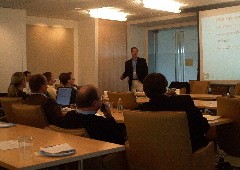 Cameron Miller from recently established Lovell Minnick Partners (formerly of Putnam Lovell) discussed his firm, the M&A environment, and the type of transactions that are being done in the current environment. He stated that there has been a huge decline in the value of deals since 2000, even though there has been an increase in the number of deals. Mr. Miller believes this has occurred due to the impact of Eliot Spitzer, Sarbone Oxley, the elections, stock prices, and geopolitical issues.
The preponderance of deals being done, now, are asset management firms buying other asset management firms, and banks buying asset management firms (Tiburon data would support this conclusion). Mr. Miller said that he feels that private deals for asset managers are currently attractive because they are now being done at discounts to public multiples. Two current areas of interest for his firm are fee-based accounts and alternative investments.
Chip Roame (Managing Partner, Tiburon Strategic Advisors)
Tiburon’s Managing Partner Chip Roame closed the CEO Summit first by offering an open forum for any unaddressed industry topics. Topics that arose included identifying and preventing potential industry scandals in the future, discussing practical methods of training & retaining qualified employees, and further defining the wealth management trend. He then reminded attendees of a few key points:
- Boomers are the key to the future of the financial services and investment management industry
- Boomers’ financial needs will evolve towards wealth management as they age
- The independent advisor markets are well positioned to pick up market share
- Superficial responses such as more product choices, claiming the ethics of fee-based investing, and simply utilizing buzz words like wealth management and life planning will be meaningless
Mr. Roame closed by stating that, "understanding and addressing client needs will be the key factor driving success as boomers age. Advisors and advisory organizations will need to better target market, develop more comprehensive product & service offers, build better infrastructure, and plan for succession." He said, "the game will be won by best serving baby boomers as they age."
General Feedback
General feedback for the CEO Summit included overwhelmingly positive comments. The balance of general session speakers, general session panel discussions, & break-out sessions, the diversity of content, and the personal interaction were all frequently complimented. Some of the highlights for attendees included:
- The state of the financial services industry speech by Tiburon's Chip Roame, and the parallel investment management strategies panel that offered a solid common understanding of the markets to all participants, regardless of their industry backgrounds
- The guest appearance of Bill Hambrecht from WR Hambrecht & Company, and the terrific case example presentations by Mark Lopez from LPL Financial Services and Morgan White from Woodside Asset Management
- The consumers panel, which highlighted the industry’s need to better understand client needs, and the advisors panel that allowed attendees to better understand the thought process of leading financial advisors
- The innovative business models panel, which allowed six separate business models to be introduced in a limited time, forcing other attendees to consider their own strategies
- The wealth management & family office services break-out session that helped set the stage for the consumer panel and the hedge funds & other alternative investments break-out session that many said gave them their first comprehensive understanding of hedge funds
- The fee-only financial advisors & independent reps market break-out session which brought together long-time custodial competitors from Charles Schwab, Fidelity Investments, TD Waterhouse, and Fiserv, along with representatives of new innovative competitors including Merrill Lynch, Bear Stearns, and Ameritrade
- And the group dinner held in Tiburon, CA, which fostered informal communications amongst members from dozens of market segments
Attendees
Tiburon CEO Summit VII had 76 Tiburon client attendees, including:
|
|
Media Representatives
Tiburon CEO Summit VII had four Tiburon select media attendees, including:
|
|
Also in attendance for Tiburon CEO Summit VII were Tiburon employees Kristen Colwell (Marketing Manager), Servio Lee (Research Manager), Jeff Nagy (Research Manager), & Yari Wajid (Research Manager).
Tiburon CEO Summit VI: April 29-30, 2004
Tiburon CEO Summit VI was held April 29-30, 2004 in San Francisco, CA. The Summit started at 11:00am on Thursday, April 29, included a networking dinner that evening in Tiburon, & concluded at 5:00pm on Friday April 30. Almost 75 senior industry executives & media representatives took two days out of their busy schedules to participate. Chip Roame (Managing Partner, Tiburon Strategic Advisors), Julie Allecta (Partner, Paul, Hastings, Janofsky, & Walker), Tim Armour (Managing Director, Morningstar), Bob Barrett (Partner, FT Ventures), Keith Mitchell (CEO, Mitchell Advisers), & Paul Schaeffer (Managing Director, SEI Investments) made general session presentations. Other sessions included a consumers panel, a debate on winning channels in the high net worth market, & a series of presentations on innovative business strategies.
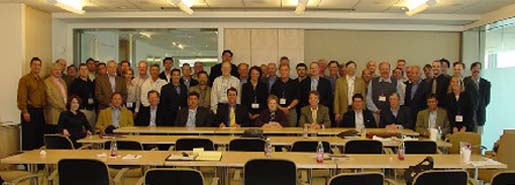
Attendees at Tiburon CEO Summit VI in San Francisco, CA
The following summary was distributed after Tiburon CEO Summit VI:
Introduction
Tiburon Strategic Advisors, a market research & strategy consulting firm serving the brokerage and investment management industry, held its sixth semi-annual Tiburon CEO Summit late last month in San Francisco, CA. Tiburon's CEO Summits have become a leading-edge forum for industry CEOs and other senior executives to gather and debate the future of the brokerage, investments, advice, and wealth management industries. Tiburon's research serves as the foundation of the meetings and all participants share views openly. As an outcome of the Tiburon CEO Summit, Tiburon makes available this summary.
Context Setting
Tiburon’s sixth semi-annual CEO Summit was held in San Francisco, CA on April 29-30, 2004. Seventy-five senior industry executives and consultants were present. Chip Roame of Tiburon Strategic Advisors, Julie Allecta of Paul Hastings, Paul Schaeffer of SEI, Tim Armour of Morningstar, Bob Barrett of FT Ventures, and Keith Mitchell of Mitchell Advisers made general session presentations. Other sessions included a consumers panel, a debate on winning channels in the high net worth market, and a series of presentations on innovative business strategies.
There are three unique features about the CEO Summits:
- The focus on consumer needs first and markets and products second
- The cross-industry characteristics of the attendees
- The open communications and debate with little commercialization
Opening General Session Presentations
 The CEO Summit kicked off with three general session presentations by Chip Roame, Julie Allecta, and Paul Schaeffer. Each discussed timely topics that cut across all markets and products, including the state of the brokerage & investments industry, an update on mutual fund regulations, and the challenges & opportunities in serving the high net worth and institutional markets.
Chip Roame (Managing Principal, Tiburon Strategic Advisors)
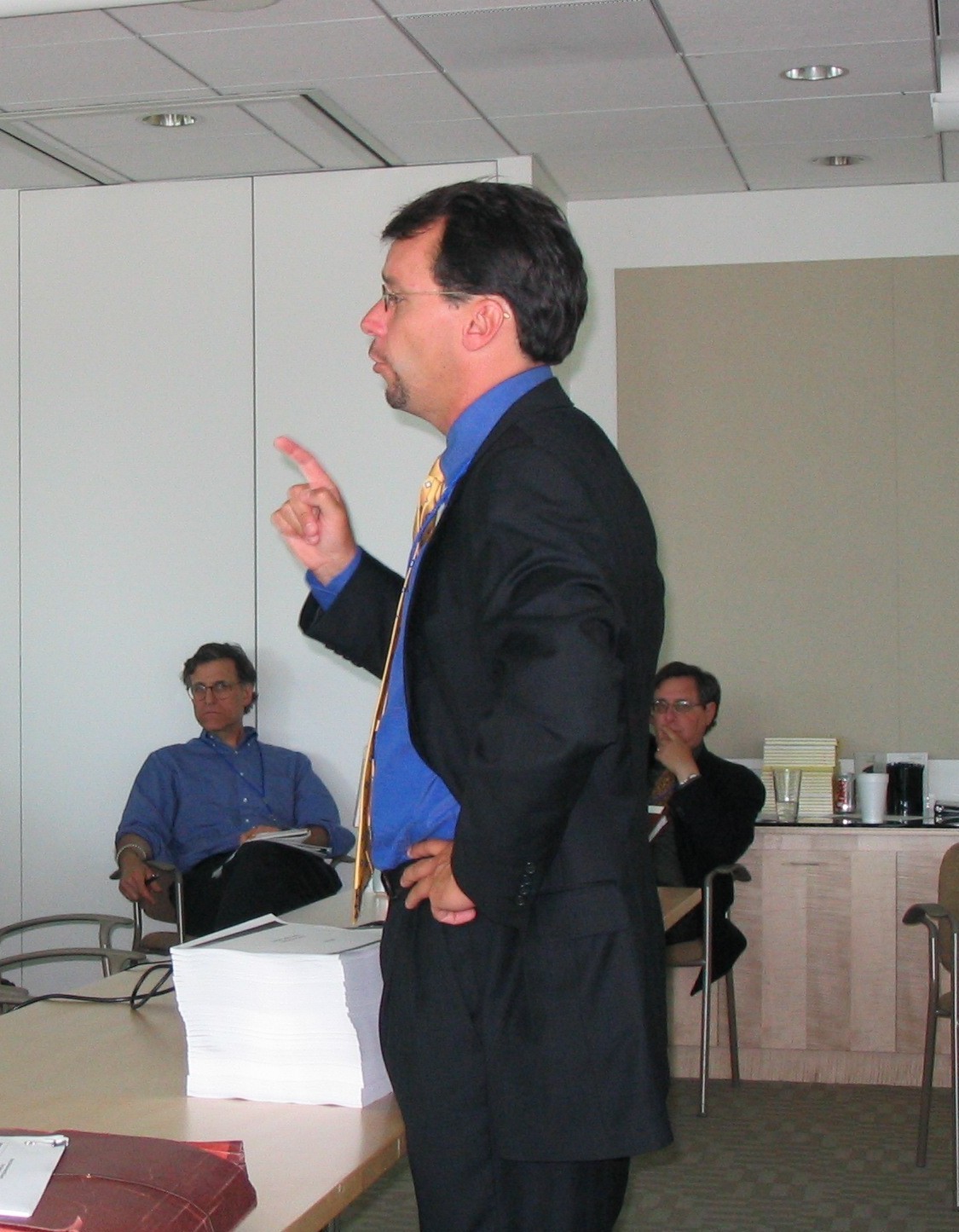 Chip Roame welcomed the attendees, gave an overview of Tiburon, and addressed the state of the industry. In updating the group of clients on Tiburon's activities, Mr. Roame noted that, "Tiburon has positioned itself uniquely as a market research & strategy consulting firm; the firm's services include a series of research reports, conference speeches, market seminars, market research projects, and strategy consulting projects, with the latter two accounting of more than half of Tiburon's revenues."
Mr. Roame also introduced other Tiburon business activities including:
- Prior to the Summit, Tiburon held the sixth meeting of the members of its executive programs. These three programs, named CEOs-in-Residence, Financial Advisor Roundtable, and Consultant Fellows, are designed to bring additional senior level expertise to Tiburon clients
- At the Summit, Tiburon introduced ten new business benchmarking tools to create a family of thirteen. These free web-based tools allow a variety of types of advisors to benchmark their business operations. The tools, in turn, provide Tiburon a steady stream of aggregate industry data.
- Mr. Roame then highlighted the agenda for this, Tiburon's sixth semi-annual CEO Summit and discussed highlights of past CEO Summits, including the visit by Tim Guinness from London and the dinner at the home of advisor Tif Joyce, both at the prior fifth semi-annual Tiburon CEO Summit
After sharing the short update on Tiburon, Mr. Roame discussed the state of the financial services industry broadly. This included comments on short-term challenges, consumer wealth, the competitive playing field, and ways to win. Specifically, Mr. Roame noted that:
- The long list of corporate and industry scandals has impacted consumer confidence in the industry and revealed a concerning non-client-focused attitude. Specifically, Mr. Roame commented that he was, "disturbed by recent reports that up to 20% of investors may not have been given appropriate mutual fund breakpoints"
- The market of consumer wealth is enormous, including $17.1 trillion of investable assets and $7.5 trillion of retirement plan assets held by the 108 million US households. Mr. Roame predicted that, “the $17.1 trillion will increase to over $30 trillion by 2010 due to the pending liquefaction of consumer wealth,” making it a great time to be in the financial advice business
- The competitive playing field is crowded with over 400,000 financial advisors. Mr. Roame noted that, “banks and full-service brokerage firms currently dominate these assets, each controlling near $6 trillion.” He went on though to suggest that, “independent advisors may gain substantial share in the 2000s much as full-service brokers did in the 1980s and discount brokers did in the 1990s”
- Finally, Mr. Roame noted a series of ways to win, including, “not giving up on mutual funds, participating in the fee-accounts trend, and expanding product & service offers to better address the needs of aging baby boomers.” He predicted that wealth management services may pass investment management services in importance as boomers age, and that targeted marketing and service strategies may be increasingly critical to success and the differentiating factors
Julie Allecta and Mitch Nichter (Partners, Paul, Hastings, Janofsky, & Walker)
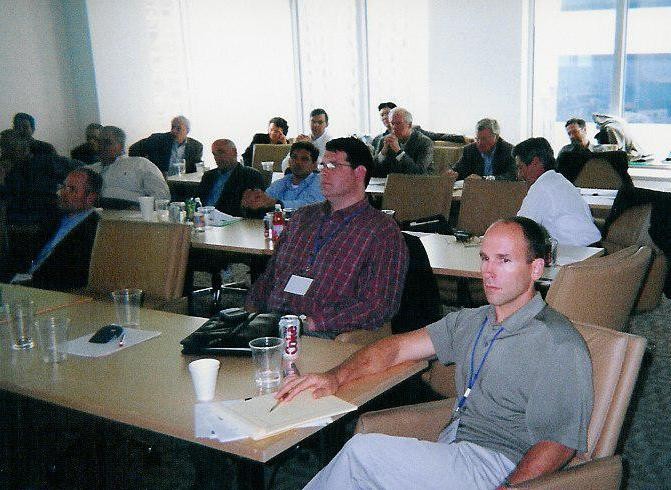 Julie Allecta, a senior partner with the hosting law firm of Paul, Hastings, Janofsky, & Walker and vice chair of that law firm's investment management practice, gave a brief presentation on her views of trends in the mutual funds industry. She discussed the impact of recent mutual fund scandals and the impact of recently proposed and enacted regulations affecting the investment management industry with particular emphasis on the likely changes in the area of mutual funds and advisors who use mutual funds.
Drawing on her 26 years of experience in the industry and her years actually working as an attorney with the SEC, Ms. Allecta suggested that, in the short run, it would be expensive for advisors to meet many of the new regulatory requirements and that there probably would be changes in and greater disclosure concerning reciprocal practices and payments among industry participants (as examples, she cited likely changes in soft dollar services and disclosure concerning mutual fund distribution payments). However, she concluded that the long run effects would leave the industry strong and healthy, and that the US investor would continue to want and need safe, easy-to-understand, pooled investments, like mutual funds, and would continue to seek out professional advisors to assist them in their wealth management.
Ms. Allecta also noted:
- That the US investment models were well positioned to become dominant global investment models as the residents of developed economies like France and emerging economies like China seek access to more investment options.
- That the investment industry was experiencing positive change from greater competition within the industry and the development of more efficient products and more efficient markets. She opined that these developments were as much the catalysts for change as the enforcement actions and many new regulations currently coming out of Washington, DC.
Before closing, Mitch Nichter, also a senior partner in the Paul Hastings investment management practice, added to Ms. Allecta’s comments and outlined some of the recent regulatory developments affecting advisors, mutual funds, and hedge funds. Ms. Allecta and Mr. Nichter’s views on new developments and possible restructurings within the investment industry were discussed at greater length in subsequent breakout sessions at the Summit.
Paul Schaeffer (Managing Director, SEI Investments)
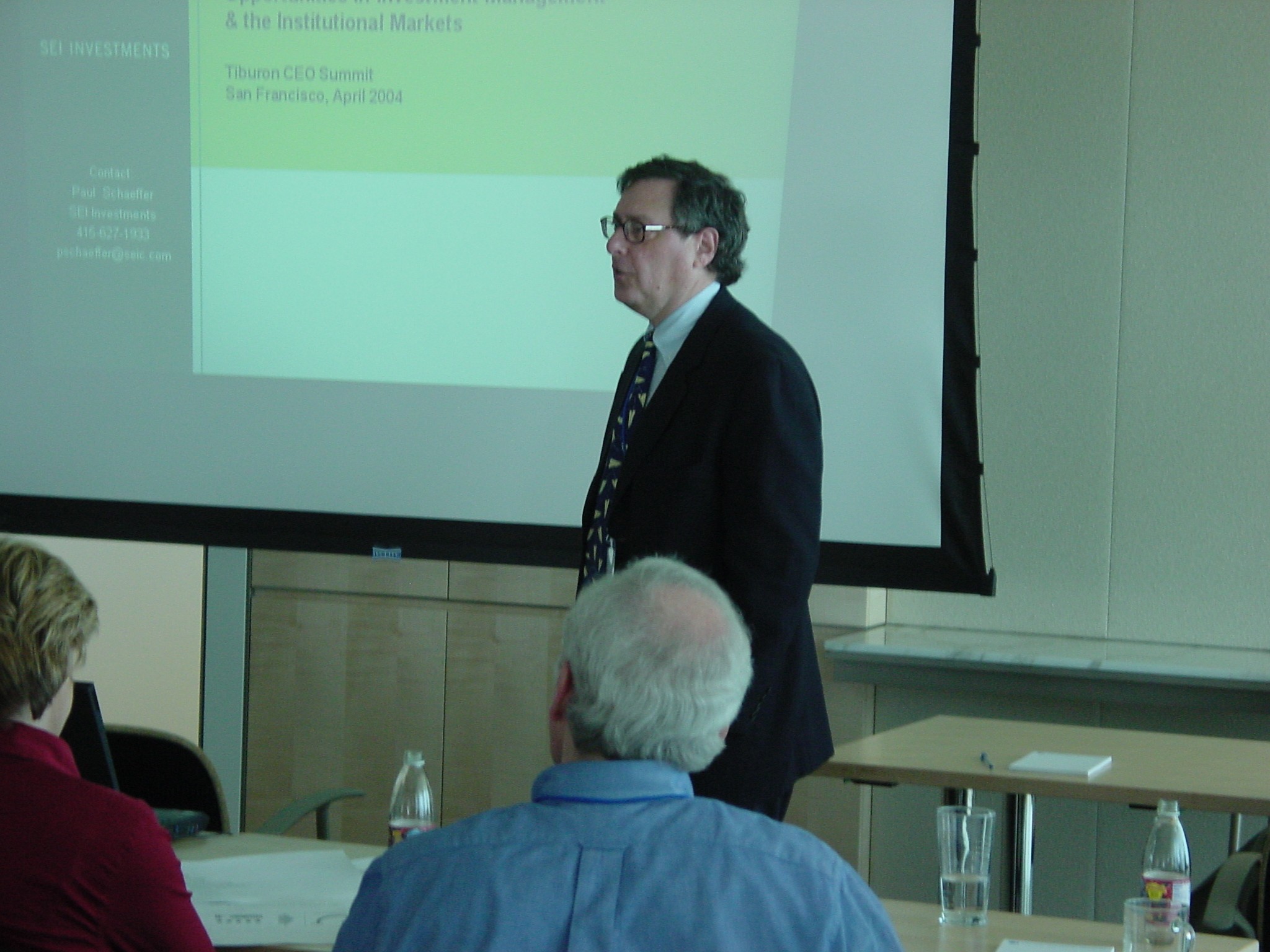 >Paul Schaeffer from SEI Investments rounded out the opening session by addressing two additional areas of opportunities for product manufacturers and opportunities for asset managers in the institutional markets. Mr. Schaeffer concluded that opportunities still exist in both of these markets.
General Session Panel Discussions
On the second day, three critical general session panel discussions were held, involving consumer needs, winning markets, and innovative business models. All three panels included wide-open dialogue and received wide praise.
Consumer Needs
Organized ad hoc after repeated comments seeking a better understanding of consumer needs, the consumer needs panel drew wide praise. Four well-educated professional consumers joined financial advisor facilitators Scott Hanson of Hanson McClain and Tif Joyce of Joyce Financial Management, and told their unpleasant stories about their experiences with brokers, banks, and advisors. One consumer summed up her experience by noting, “the investments industry is stuck in a self-imposed state of confusion. Companies spend so much time developing more complicated products that advisors can’t explain to their clients, and yet they wonder why consumers are baffled.”
Innovative Business Models
Six Tiburon clients joined Tiburon Managing Partner Chip Roame on stage to discuss their innovative business models. These included two financial advisors, two markets companies, and two product companies. Scott Hanson of Hanson McClain told of raising multiple billions of dollars of assets by narrowly targeting the needs of telephone company employees. Jeff Roush of Harris myCFO spoke of addressing the wealth management needs of the ultra affluent. David Johnson of Powell Johnson spoke of building a full-service fee-oriented brokerage firm that is attractive due to its culture. Scott Dell’Orfano from SEI Investments told of narrowing one’s target market as a strategy to deepen client relationships. Lee Kranefuss from Barclay’s discussed the booming exchange traded funds market. And Ken Kam from Marketocracy spoke of a new research source being used to beat the market.
Winning Channels Debate
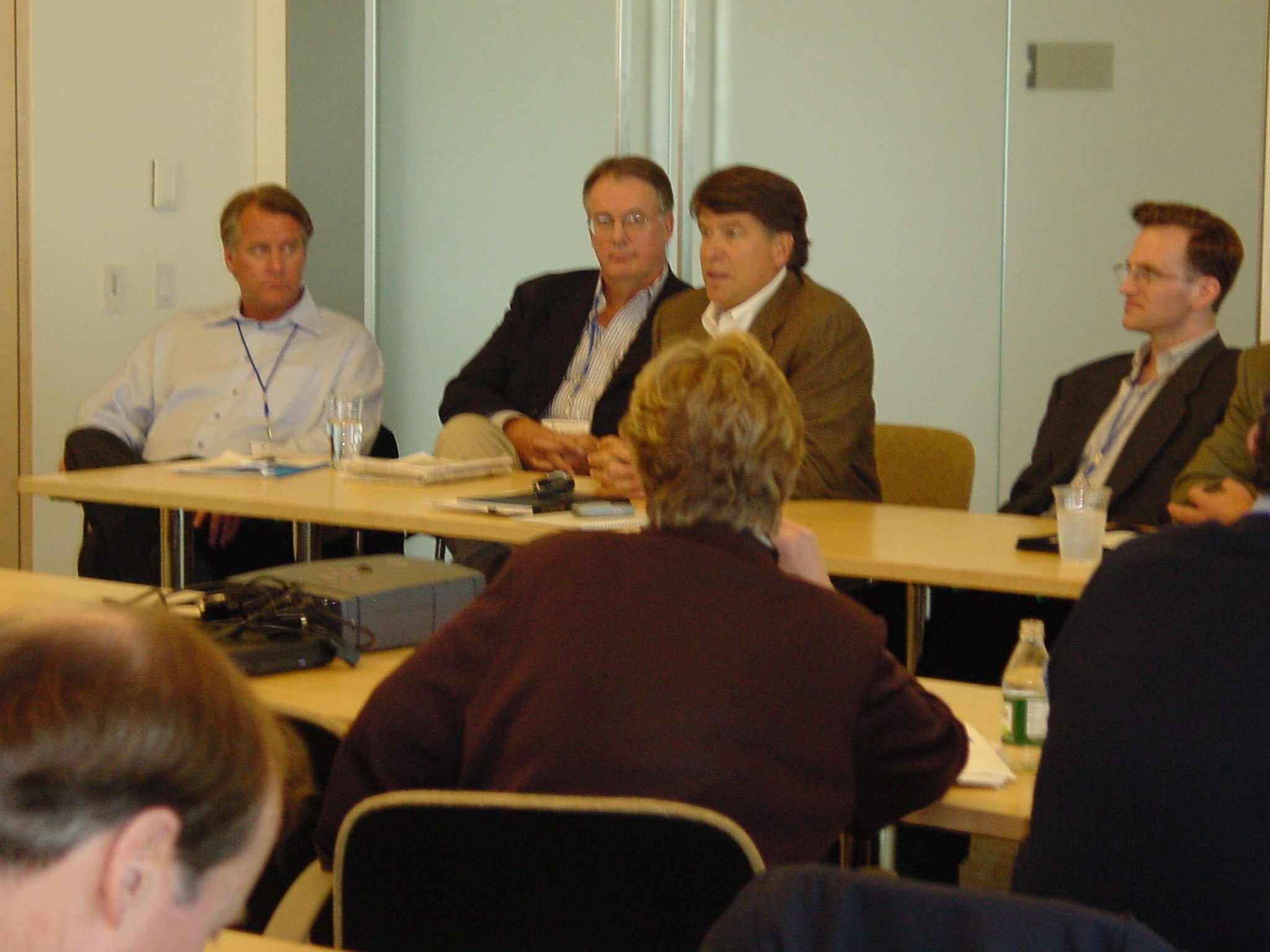 Eight leading financial services executives participated on a panel to debate the likely winning channels. While some took sides, others said many channels will excel. Panelists included Derek Bruton of Merrill Lynch, John Coghlan, formerly of Charles Schwab, David Johnson of Powell Johnson, Jay Lanigan of Fidelity Investments, Chuck Robinson of Northwestern Mutual Life, Skip Schweiss of Fiserv/First Trust, Gordon Turnbull of Wells Fargo, and Jim Wangsness of Ameritrade.
Attendees
Tiburon CEO Summit VI had 65 Tiburon client attendees, including:
|
|
Media Representatives
Tiburon CEO Summit VI had five Tiburon select media attendees, including:
|
|
Also in attendance for CEO Summit VI were Tiburon employees Jeff Gyomber (Research Manager & Consultant) & Krista Jenssen (Web Site & E-Commerce Manager), as well as Tiburon principal candidate Will Hogan (Consultant, Hogan & Company).
Chip Roame (Managing Partner, Tiburon Strategic Advisors)
Tiburon's Managing Partner Chip Roame closed the Summit first by offering an open forum for any unaddressed industry topics. Topics that arose included identifying and preventing potential industry scandals in the future, discussing practical methods of training & retaining qualified employees, and further defining the wealth management trend. He then reminded attendees of a few key points:
- Boomers are key to the future of the industry
- Boomers financial needs will evolve towards wealth management as they age
- The independent advisor channels are well positioned to pick up market share
- Superficial responses such as more product choices, claiming the ethics of fee-based investing, and simply utilizing buzz words like wealth management and life planning will be meaningless
- Rather, Mr. Roame closed by stating that, "understanding and addressing client needs will be the key factor driving success as boomers age."
General Feedback
General feedback for the Tiburon CEO Summit included overwhelmingly positive comments. The balance of general session speakers, general session panel discussions, & breakout groups, the diversity of content, and the personal interaction were all frequently complimented. Some of the highlights for attendees included:
- The consumer panel which highlighted the industry’s need to better understand client needs
- The innovative business models panel which allowed six separate business models to be introduced in a limited time, forcing other attendees to consider their own strategies
- The state of the industry speech by Mr. Roame, and the parallel speech by Mr. Schaeffer, that offered a solid common understanding of the markets to all participants, regardless of their industry backgrounds
- The fee-only financial advisors market session which brought together long-time custodial competitors from Charles Schwab, Fidelity Investments, TD Waterhouse, and Fiserv, along with representatives of other competitors including Merrill Lynch, Bear Stearns, and Ameritrade
- The wealth management, family office services, & life planning breakout session that helped set the stage for the consumer panel
- And the group dinner held in Tiburon, CA, which fostered informal communications amongst members from dozens of market segments

Chip Roame poses with attendees at the group dinner at Tiburon's Sixth Semi-Annual CEO Summit in Tiburon, CA
Prior Tiburon CEO Summits
As noted above, details on prior Tiburon CEO Summits are also available here:
Most Recent,
2024-2025,
2022-2023,
2020-2021,
2018-2019,
2016-2017,
2014-2015,
2012-2013,
2010-2011,
2008-2009,
2006-2007,
(2004-2005), &
2001-2003.